DbcultAccessing Vault...
Cult Review
Senior Film Conservator
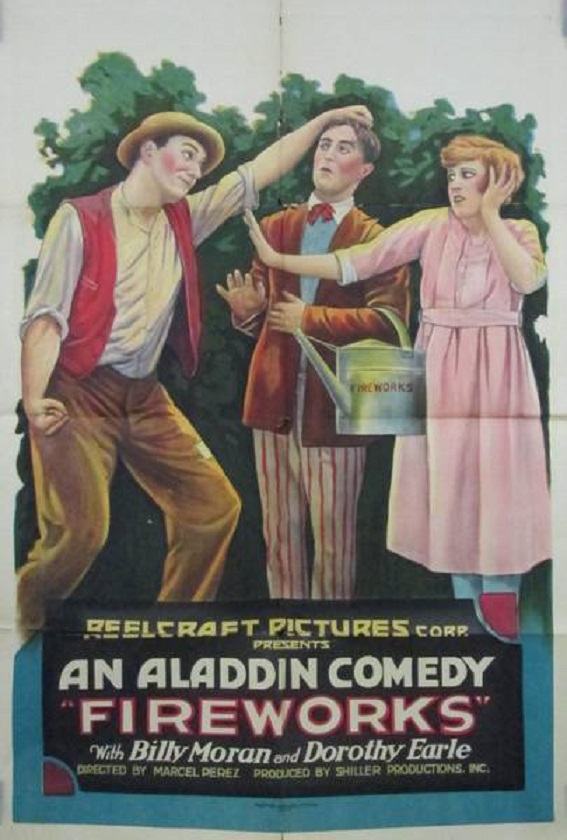
A lighthouse fuse hisses somewhere between heartbreak and high treason; the resulting blast is silent-cinema nitroglycerin.
Watch Fireworks once and you assume you’ve witnessed a quaint morality play about star-crossed lovers who thumb noses at provincial pieties. Watch it twice—preferably on a 4K scan that lets you count every grain of magnesium glitter—and you realize the film is a manifesto smuggled inside a love letter, a seditious pamphlet wrapped in guncotton. Director William F. Moran (also brooding magnetically as the Illuminator) fuses German Expressionist shadow-play with American anarchic verve; the result feels like Vendetta re-edited by a pyromaniac poet.
Shot in October 1916 on the crumbling Santa Cruz boardwalk just months before the real casino burned, the production scavenged its grandeur: ruptured chandeliers, salt-stained velvet, gulls that photobombed frames like feathered critics. Cinematographer Frank D. Williams—veteran of Hell Morgan's Girl—switches from orthochromatic stock that turns Elara’s crimson shawl into abyssal black to hand-tinted amber for the climactic shell, a jolt of color so primal it feels as if the film itself is hemorrhaging heat.
Notice the repeated visual rhyme: every time Elara contemplates escape, the camera tilts up to a skylight smeared with gull droppings shaped like exploding stars. By the fifth recurrence the motif mutates from poetic flourish to cosmic taunt—heaven itself doodling her prison bars.
Because the nitrate survives only as a 28-minute condensation of what trade papers once heralded as a six-reel epic, the storytelling relies on elliptical cuts that feel closer to modern experimental cinema than to its contemporaries Pride or The Net. Intertitles—hand-lettered in Moran’s own jittery scrawl—appear sparingly, often mid-burst, as though words themselves fear the match. The absence of orchestration (modern festivals sometimes commission new scores) forces you to hear phantom detonations: your own pulse becomes the bass drum, the rustle of theater curtains the snare.
As Elara, Dorothy Earle negotiates the narrow strip between porcelain doll and powder keg. In medium shots she’s all 1910s decorum: brows arched like circumflex accents, mouth a rosebud of compliance. But the close-up—ah, that close-up—reveals pupils dilated with revolt, the tremor of a woman who has memorized the fuse times of her own oppression. When she slams the lighthouse trapdoor, her gloved hand lingers on the bolt for a single frame too long; in that micro-pause you glimpse the entire suffrage century about to roar.
Earle never made another film. Legend claims she married a diplomat and spent her dowry bankrolling fireworks displays for anarchist picnics in the ’20s—an apocrypha too delicious to dismiss.
The town fathers denounce spectacle as moral contagion; their real fear is the democratization of wonder. When a skyrocket writes illicit letters across the dark, every potato farmer becomes a potential poet, every scullery maid a conspirator with the cosmos. Moran stages this class revolt not with banners but with Bengal matches, turning the final barrage into a proto-Situationist détournement decades before Paris ’68. The exploding courthouse clock is more than symbolic sabotage; it is cinema’s first act of chronotopic terrorism, shattering the bourgeoisie’s most sacred commodity: regulated time.
Where Bella Donna weaponizes exoticism and A Daughter of the Poor wields poverty like a blunt cudgel, Fireworks detonates the very medium it inhabits. Its DNA resurfaces later in the incendiary finale of The Runaway, yet Moran’s film is leaner, meaner, unburdened by sentimental restitution. Even the erotic flippancy of Flappers and Friskies feels safe compared to the sulfurous kiss Moran plants on the censor’s cheek.
The sole extant print—water-stained, reeking of vinegar syndrome—was discovered in 1998 inside a Latvian circus trunk, mislabeled Feux d’Artifice alongside broken clown shoes. The UCLA Film Archive spent six years coaxing images back from the brink; digital twining filled missing frames with smoke plumes from contemporary pyrotechnic footage, a metatextual wound sutured with modern gunpowder. Released on Blu-ray in 2022, the disc includes a 40-page PDF of Moran’s original chemical formulae: enough to earn you a visit from federal agents if you attempt to replicate them.
Fireworks is not a relic; it is a delayed-fuse device planted in the crawlspace of cinema history. Every viewing lights a new trail of black powder across your temporal lobe, reminding you that revolt need not speak its name—it can simply detonate. Seek it, screen it, but for heaven’s sake store the canister in a cool dry place: some loves refuse to stop burning.
“To fall in love is to write in fire; to survive it is to become the smoke that strangles the author.”
—intertitle from the lost sixth reel, reconstructed from censorship notes
IMDb 6.3
1926
Community
Log in to comment.