DbcultAccessing Vault...
Cult Review
Senior Film Conservator
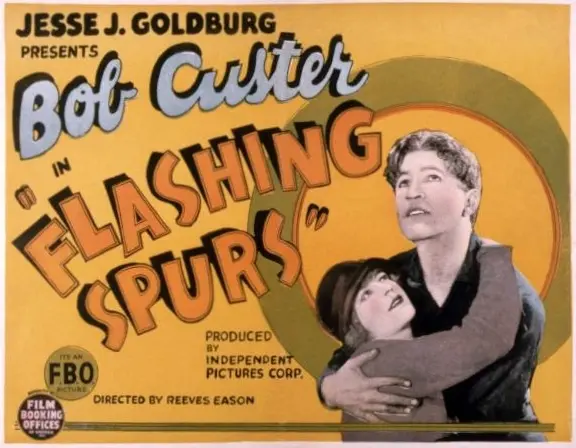
The year 1924 represented a zenith for the silent Western, a period when the genre began to shed its rudimentary origins in favor of psychological complexity and grander visual scale. Flashing Spurs, under the astute direction of B. Reeves Eason, emerges from this era not merely as a relic of horse-and-gunplay, but as a fascinating character study that interrogates the fallibility of the law. While many contemporary features, such as The Door Between, were preoccupied with domestic tribulations, Eason took his cameras into the grit of the Texas landscape to document a different kind of internal struggle.
At the heart of this celluloid tapestry is Bob Custer, an actor whose screen presence was defined by a rugged, almost stoic intensity. As Sgt. Stuart, Custer embodies the rigid morality of the Texas Rangers, a force that in the early 20th century was transitioning from frontier militia to a more formalized investigative body. His performance is a masterclass in silent-era restraint; he conveys authority through the set of his jaw and the deliberate nature of his movements, rather than the wild gesticulations that plagued lesser actors of the period. This restraint is essential, as the film’s tension relies entirely on Stuart’s internal conviction that he is hunting a criminal, even as his heart begins to suggest otherwise.
The screenplay, penned by the prolific William Berke, subverts the typical "outlaw girl" trope by making Marguerite Clayton’s character a victim of circumstance rather than a willing participant. Her involvement with the bank robbers is tangential—a web of social and familial obligations that she cannot easily sever. This thematic choice elevates the film above the standard fare of 1924. It reminds one of the social entrapment depicted in His House in Order, where reputation and reality are often at odds. In Flashing Spurs, the "indirect" nature of her guilt serves as a poignant metaphor for the fragility of female agency in the Old West.
Clayton brings a palpable sense of dread to her role. She isn't the hyper-stylized vamp found in A Prisoner in the Harem, nor is she the simplistic ingenue of The Princess of Patches. Instead, she portrays a woman caught in a pincer movement between the predatory outlaws who use her as a shield and the relentless Ranger who views her as a trophy of justice. The chemistry between Clayton and Custer is built on a foundation of suspicion, making their eventual pivot toward mutual understanding feel earned rather than manufactured by the script's necessity.
B. Reeves Eason, often nicknamed "Breezy," was a director known for his spectacular action sequences—most notably the chariot race in the 1925 *Ben-Hur*. In Flashing Spurs, his talent for kinetic energy is on full display during the chase sequences. The camera work, though limited by the technology of the time, possesses a vitality that makes the Texan plains feel like an active participant in the drama. Unlike the more static compositions seen in National Red Cross Pageant, Eason’s frame is constantly searching, panning to capture the billow of dust behind a galloping horse or the subtle play of light across a canyon wall.
The film’s pacing is remarkably modern. While many silents of the mid-20s, such as Le nabab, often succumbed to theatrical bloat, Flashing Spurs maintains a lean, propulsive narrative. Every scene serves the dual purpose of advancing the plot and deepening the psychological stakes. The bank robbery itself is staged with a verisimilitude that must have been jarring for 1924 audiences, emphasizing the sudden, violent nature of frontier crime rather than romanticizing it.
When examining the moral landscape of Flashing Spurs, it is useful to look at other films of the period that dealt with youthful indiscretion and the weight of suspicion. Youthful Cheaters explored the consequences of moral lapses in a contemporary urban setting, but Flashing Spurs transposes these anxieties onto the wilderness. Here, the stakes are not just social ostracization, but life and death. The film suggests that the law, represented by Custer's Ranger, is often a blunt instrument, incapable of discerning the subtle shades of grey that define human relationships.
Even in lighter fare like An Overall Hero or Taxi Please, there is an underlying obsession with identity and the fear of being misidentified. Flashing Spurs takes this fear to its logical, dramatic extreme. The Ranger's pursuit is fueled by a righteous certainty that becomes his greatest blind spot. It is a narrative structure that echoes the tragic misunderstandings found in Trompe-la-Mort, though filtered through the uniquely American iconography of the Western.
The ensemble cast provides a sturdy framework for the central duo. Edward Coxen and Joseph Bennett deliver performances that avoid the caricatured villainy often found in early cinema. Their characters are motivated by greed, yes, but they operate with a calculating coldness that feels grounded in reality. The presence of veteran actors like William Malan and Park Frame lends the production a sense of gravity, ensuring that the stakes feel high even during the film’s more meditative moments.
In the broader context of 1924, Flashing Spurs stands out for its refusal to provide easy answers. Unlike the overt moralizing of The Little Church Around the Corner, Eason’s film allows the audience to sit with the discomfort of the Ranger’s mistake. It acknowledges that justice is often a messy, imprecise process. This level of maturity is also evident in international works from the same year, such as the Japanese Miyama no otome, which similarly dealt with the collision of tradition and individual plight.
The technical aspects of the film—the cinematography by a largely unsung crew and the sharp editing—contribute to an atmosphere of pervasive tension. The use of natural lighting in the outdoor scenes creates a high-contrast look that mirrors the moral dichotomies at play. When the spurs of the title finally flash in the sunlight, they represent not just the speed of the law, but the piercing light of truth that must eventually dispel the shadows of doubt.
Ultimately, Flashing Spurs is a testament to the power of the silent medium to convey complex emotional landscapes. It avoids the whimsy of Playmates or the melodrama of Wanted: A Baby, opting instead for a gritty, earnest exploration of the human condition. For the modern viewer, it offers a window into a world where the frontier was closing, and the legends of the West were being codified into the cinematic language we still use today. It is a vital piece of film history that deserves a place in the conversation alongside better-known classics of the era like Miss Peasant. Through the lens of B. Reeves Eason, the dusty trails of Texas become a stage for a timeless drama of perception, guilt, and the arduous path to redemption.
IMDb 6.8
1924
Community
Log in to comment.