DbcultAccessing Vault...
Cult Review
Senior Film Conservator
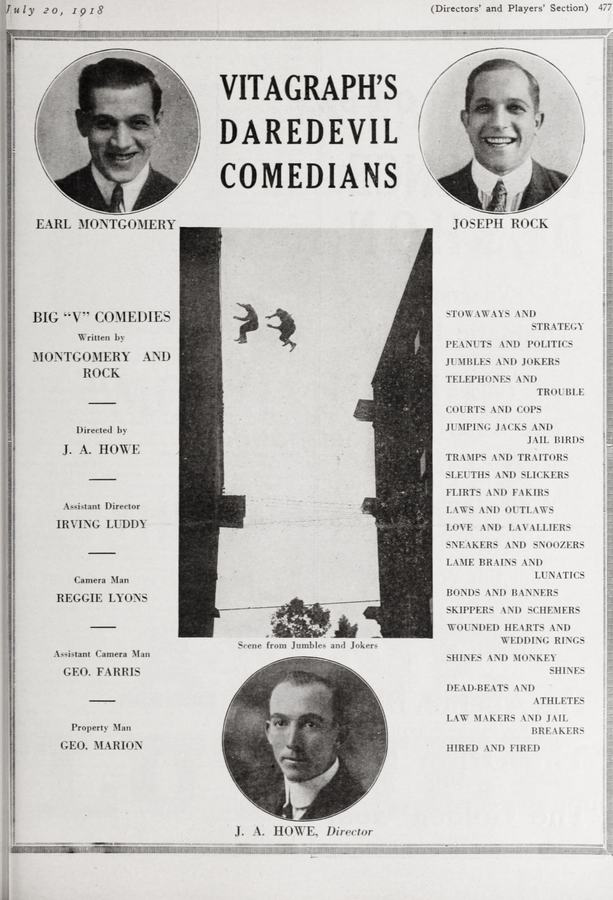
In the annals of early cinema, where flickering shadows often danced with grand ambitions and nascent storytelling techniques, there exists a particular charm in discovering forgotten gems. 'Flirts and Fakirs,' a delightful escapade starring the comedic duo of Earl Montgomery and Joe Rock, penned by their own hands, stands as a testament to the era's inventive spirit and its burgeoning understanding of visual humor. This isn't merely a historical artifact; it's a vibrant, often uproarious, piece of filmmaking that, despite its age, retains a surprising resonance. The film, in its very title, promises a duality: the lighthearted pursuit of romance and the deceptive allure of the exotic, a promise it delivers upon with a generous hand.
At its core, 'Flirts and Fakirs' masterfully weaves a narrative around the universal themes of yearning for excitement, the gullibility of the privileged, and the enduring human capacity for both charming deceit and earnest affection. Earl Montgomery, as Bartholomew 'Barty' Butterfield, the audacious con artist masquerading as 'Swami Vishnu,' delivers a performance that is both magnetic and endearingly ludicrous. His 'Swami' is not a villain of malice, but a rogue of opportunity, preying on the ennui of the upper crust with a blend of theatrical flair and calculated charm. The screenplay, co-written by Montgomery and Rock, demonstrates an acute understanding of comedic pacing, allowing Barty's elaborate ruses to unfold with a delightful crescendo of absurdity. The wealthy socialite Daphne Van Derbilt, tired of the predictable waltz of high society, represents an audience eager for spectacle, a craving that Barty readily exploits.
The film’s central conflict, the classic love triangle, is elevated by the inherent farce of Barty's mystical charades. Joe Rock, portraying the steadfast and somewhat exasperated Reginald Chesterton, acts as the grounded counterpoint to Barty's flamboyant trickery. Rock's performance is a masterclass in controlled frustration, his eyes often conveying more exasperation than any intertitle could articulate. His unwavering devotion to Daphne, coupled with his logical disdain for the 'Swami,' provides a relatable anchor amidst the escalating comedic chaos. The dynamic between these two male leads — one a flamboyant deceiver, the other a earnest protector — is the engine that drives much of the film's humor and emotional resonance. It's a testament to their collaborative writing that these archetypes feel fresh and engaging, rather than clichéd.
The creative synergy between Earl Montgomery and Joe Rock is palpable throughout 'Flirts and Fakirs.' As writers, they craft a narrative that allows their individual strengths as performers to shine. Montgomery's ability to embody the charismatic imposter, with his exaggerated gestures and seemingly profound pronouncements, is perfectly balanced by Rock's more understated, reactive comedy. One can almost imagine them brainstorming scenes, each contributing gags that would best suit the other's persona. This collaborative spirit is reminiscent of other great comedic duos of the era, where the interplay between distinct personalities generated indelible laughter. While perhaps not as widely remembered as some, their partnership in this film showcases a sophisticated understanding of comedic timing and character development, particularly for a production of its period.
The physical comedy, a hallmark of silent cinema, is executed with precision. Whether it's Barty's exaggerated 'trances' or Reginald's increasingly desperate attempts to expose him, the visual gags are meticulously choreographed. There’s a particular sequence involving a rather flimsy crystal ball and a well-timed stumble that elicits genuine laughter, demonstrating the enduring power of well-executed slapstick. This isn't mere pratfall; it's slapstick in service of character and plot, advancing the narrative while providing mirth. The film's direction, while uncredited, clearly understood the strengths of its stars, allowing them ample space to develop their comedic routines within the frame.
'Flirts and Fakirs' is more than just a series of comedic vignettes; it subtly critiques the societal hunger for novelty and the ease with which individuals, particularly those shielded by wealth, can be swayed by a compelling performance. Daphne's initial attraction to the 'Swami' isn't born of naivete alone, but a genuine yearning for something beyond the predictable social dances and superficial interactions that define her world. In this sense, the film touches upon themes explored in more dramatic contemporary works, albeit through a comedic lens. The search for 'meaning' or 'excitement' outside of conventional norms was a prevalent concern, and the film cleverly uses the 'fakir' as a symbol for all that is perceived as exotic and liberating from mundane existence.
The film also offers a gentle satire of the spiritualism craze that swept through various social circles in the late 19th and early 20th centuries. The 'Swami' is a direct caricature of the many self-proclaimed mystics and mediums who promised contact with the beyond, or insights into the future, for a hefty fee. While perhaps not as overtly critical as some later social commentaries, 'Flirts and Fakirs' nonetheless pokes fun at the credulity of those who sought solace or sensation in such figures. This cultural context enriches the viewing experience, allowing one to appreciate the film not just as a comedy, but as a period piece reflecting specific societal anxieties and fascinations.
When considering 'Flirts and Fakirs' within the broader context of silent cinema, its unique blend of romantic comedy, social satire, and physical humor places it in an interesting position. It shares the lighthearted, often farcical spirit of many early comedies, but with a degree of character depth that elevates it beyond mere slapstick. One might draw parallels to the intricate deceptions found in films like The Great Secret, though 'Flirts and Fakirs' leans decidedly into the comedic rather than the suspenseful. The film's exploration of societal expectations and the quest for something more, even if misguided, echoes the underlying currents in dramas like Society's Driftwood, albeit through a lens of gentle mockery.
The performances of Montgomery and Rock, with their clear, distinct personas, bring to mind the established comedic duos that would later dominate the screen. Their ability to convey complex emotions and motivations without spoken dialogue is a testament to the artistry of silent acting. While not a film of grand spectacle like The Submarine Eye, or a raw depiction of human struggle like Fighting Blood, 'Flirts and Fakirs' carves its own niche through its meticulous comedic timing and the charming absurdity of its premise. It’s a film that understands the power of a well-placed glance, a subtle shrug, or an exaggerated pose to convey an entire narrative beat.
The cultural phenomenon of 'orientalism,' often depicted through exoticized characters and settings, finds a playful manifestation here. Unlike some contemporaneous films that might have portrayed such figures with genuine menace or mystical reverence, 'Flirts and Fakirs' subverts these expectations by revealing the 'fakir' to be a thoroughly human, if opportunistic, figure. This lighthearted approach differentiates it from more serious explorations of cultural encounters, such as the cross-cultural dynamics hinted at in Her American Husband, instead opting for a comedic dismantling of exotic mystique.
The film’s narrative structure, building towards a grand public expose, has echoes in many mystery and suspense films of the era, where truth is often unveiled dramatically. However, here the unveiling is played for laughs, a testament to the writers' commitment to the comedic genre. The escalating stakes, from private consultations to a full-blown society gala, are handled with a deft touch, ensuring that the humor never overshadows the underlying romantic tension or the inevitable comeuppance for the charismatic fraud. It avoids the heavy-handed moralizing sometimes present in films like Birth Control, instead allowing the consequences of deception to unfold naturally within its comedic framework.
'Flirts and Fakirs' is a film that deserves greater recognition for its intelligent humor and the excellent performances of its leads. It’s a reminder that silent cinema was far from simplistic; it was a medium capable of nuance, satire, and genuine comedic brilliance. The film doesn't rely on cheap gags, but rather on well-developed characters and a tightly constructed plot that allows the humor to emerge organically from the situations. The chemistry between Earl Montgomery and Joe Rock is undeniable, a partnership that clearly understood the mechanics of laughter and the art of engaging an audience without a single spoken word.
For those interested in the evolution of comedic storytelling, or simply in discovering a thoroughly enjoyable silent film, 'Flirts and Fakirs' offers a delightful diversion. It’s a testament to the talent of its creators that a film of such vintage can still elicit genuine smiles and laughter, its themes of deception, desire, and the search for authentic experience remaining remarkably timeless. The meticulous attention to detail in the physical comedy, the subtle emotional beats conveyed through expression and gesture, and the overall buoyant energy of the production solidify its place as a noteworthy entry in the silent film canon. It reminds us that sometimes, the most profound observations about human nature can be delivered with a wink and a hearty laugh.
The narrative's resolution, while satisfyingly tying up the comedic threads, also leaves a lingering sense of the human condition's enduring complexities. Daphne's journey, though framed comically, represents a universal quest for something more fulfilling than superficial existence. Reginald's steadfastness, though initially presented as perhaps dull, ultimately proves to be the more genuine form of affection. And Barty, the charming fakir, despite his exposure, likely retains a certain roguish charm, a testament to the film's nuanced characterizations. Even in a film titled 'Flirts and Fakirs,' there is a depth of human experience to be found beneath the glittering surface of its comedic premise.
Ultimately, 'Flirts and Fakirs' stands as a charming, well-crafted piece of silent cinema that showcases the talents of Earl Montgomery and Joe Rock, both as performers and as writers. It's a film that invites us to laugh at the absurdities of society and the foibles of human nature, all while delivering a surprisingly insightful commentary on the allure of illusion and the pursuit of genuine connection. Its legacy, while perhaps not as widely celebrated as some of its contemporaries, is cemented in its ability to entertain and provoke thought, proving that a well-told story, even without spoken words, can transcend the boundaries of time.
IMDb 4.8
1921
Community
Log in to comment.