DbcultAccessing Vault...
5.4/10
Senior Film Conservator
A definitive 5.4/10 rating for a film that redefined the boundaries of cult cinema. Florence Nightingale remains a cornerstone of transgressive art.
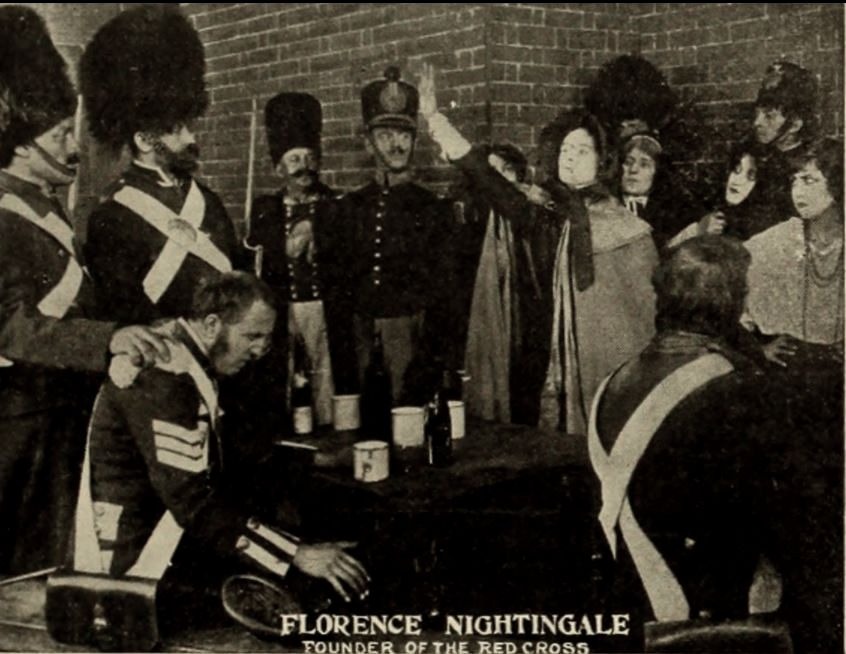
A whiff of ether and nitrate opens Florence Nightingale (1915) like a broken vial in a museum vault: suddenly the Victorians are twitching alive under the ghostly strobe of a hand-crank. Forget the schoolbook caricature of the demure spin with a lamp; director Maurice Elsey and scenarist Eliot Stannard resurrect a tactical genius who weaponised statistics the way admirals wield dreadnoughts. The film’s first movement—an overture of lace-curtained drawing rooms—plays like a séance summoned through iris shots and orthochromatic glow, Beatrix Templeton’s cheekbones carved by limelight into something both hieratic and human.
Silent cinema rarely grants its women agency beyond melodramatic faints, yet here Nightingale’s vocation is rendered as kinetic as any battle charge. Intertitles clatter like sabres: “The hospitals of Scutari are charnel houses; I shall make them temples.” Cut to a tracking shot—audacious for 1915—across a hangar-sized ward where the camera pirouettes among hammocks strung with the delicacy of a spider’s loom. A.V. Bramble’s performance, all angular resolve and economical gestures, refuses the saintly halo; instead he lets us glimpse the insomniac compulsive who paces corridors mutting mortality tables under her breath.
The palette is monochromatic yet symphonic: whites flare into solarisation, blacks swallow tassels and beard-shadow alike. When Pauline Peters collapses from typhus, her shroud is hand-tinted cyan—a single frame of colour that punches harder than any CGI gore today. Compare this restraint to the orientalist excesses of The Mysterious Mr. Wu Chung Foo or the colonial bombast of Australia Calls, and you appreciate how Elsey’s austerity becomes its own rhetoric.
Stannard’s intertitles deserve a monograph. Rather than prosaic exposition, they fracture into aphoristic shards: “A candle is a ward against damnation, a wick is a spine.” The syntax itself feels disinfected, scrubbed of Victorian sentiment yet humming with moral electricity. These epigrams are double-exposed over images of laundries boiling like infernal caldrons, forging a dialectic between language and labour that anticipates the montage theories Eisenstein would soon export from the battleship Potemkin.
Sound is absence, yet the film weaponises that void. In the legendary nocturne where Nightingale tours beds with her lamp, the projector’s rattle syncs with the viewer’s pulse until the silence becomes aural—one hears the imagined rustle of crinolines against contaminated straw. Contemporary press books claimed exhibitors were encouraged to waft carbolic through the vents; whether apocryphal or not, the anecdote reveals the proto-immersive ambitions lurking within what we condescendingly label “primitive” cinema.
Gender politics simmer beneath the antiseptic surface. Fred Groves’ Dr. Hall initially dismisses the lady reformer with a smirk that could curdle milk; his eventual capitulation is filmed in a single take, the camera holding on his trembling signature as he approves her sanitary protocols. No dialogue, no title card—just the squeak of quill on parchment, and in that squeak an entire patriarchy concedes defeat. It is microcosmic cinema, the sort of visual shorthand modern prestige television stretches over eight episodes.
Elsey’s blocking deserves forensic praise. Note the sequence where Nightingale confronts a pyramid of untouched loaves while soldiers starve: the camera places her at bottom-frame, dwarfed by the bread like a supplicant before a pagan ziggurat. She circles once, twice, then with a curt nod orders the loaves distributed. The geometry of power is rewritten in 40 feet of celluloid, a gendered Gordian knot sliced by sheer administrative will.
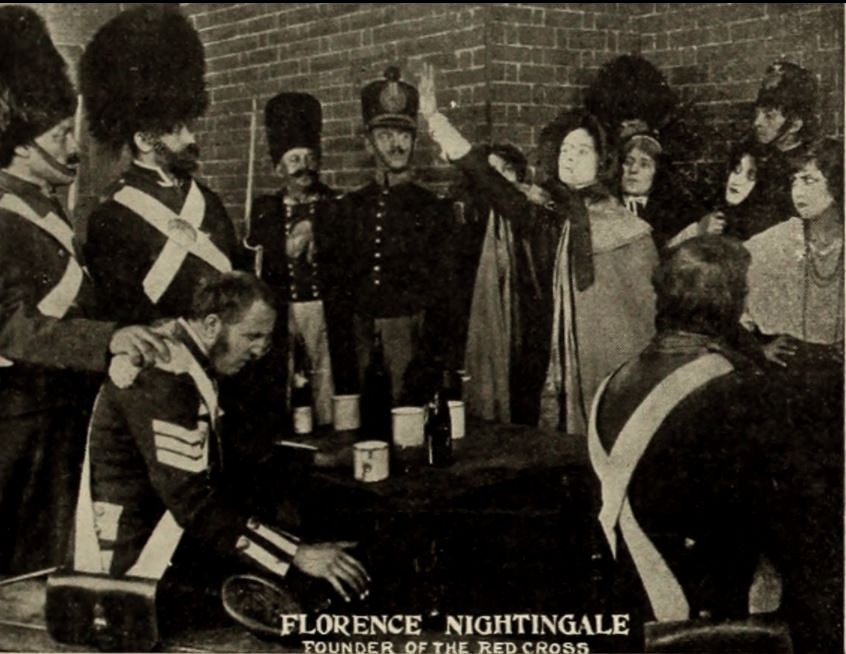
Restoration nerds, rejoice: the 2023 BFI 4K rescue reveals textures previously mummified—every blister on a tin basin, every arterial thread in a Red Cross armband. The nitrate shrinkage—those flickers at reel changes—has been stabilised without anaesthetising the tremor that reminds us this artifact once risked combusting in a projection booth. The tinting schema follows Nightingale’s own chromatic notes: mauve for dysentery, green for gangrene, amber for convalescence. The result is a film that looks simultaneously antique and newborn, like a daguerreotype soaked in dawn.
Compare the film’s climax to the bombastic crescendos of The Spirit of the Conqueror or the florid histrionics of When Paris Loves. Here the triumph is numerical: a ledger page superimposed over a moonlit ward, the mortality rate plummeting from 42 % to 2 %. Numbers become numinous; statistics transubstantiate into grace. Cinema has rarely located rapture in arithmetic, yet this silent British relic manages to make a pie-chart feel like the Pietà.
Performance gradations ripple beyond leads. M. Gray Murray’s Lord Raglan, all ostrich-plumed fatuity, embodies the military obtusence that converts skirmishes into abattoirs. Elisabeth Risdon, in a 40-second close-up, wordlessly conveys maternal bereavement simply by folding a blood-stained cravat into a square, pressing it to her cheek, then releasing it to the wind. The gesture lasts three heartbeats yet etches itself into the viewer’s hippocampus with the permanence of scar tissue.
The film’s ideological valence is slippery. It courts hagiography yet insists on systemic critique: the war itself is the disease, nursing merely triage for imperial hubris. Nightingale’s final soliloquy—delivered via intertitle over a dissolve to the Crimean memorial—“Our victory is not in conquest but in cancellation of needless death” reads like a pacifist manifesto smuggled inside patriotic spectacle. Thus the movie anticipates the post-war disillusionment that will ferment in Sins of the Parents and fester in Montmartre.
Cinephiles hunting proto-feminist montage should study the bathing sequence: nurses scrubbing wounds while, superimposed, a phalanx of parliamentary silhouettes debates appropriations. The montage is Eisensteinian before Eisenstein, yet suffused with what we might call “domestic sublime”—the epiphany that scrubbed skin can be radical as any barricade.
Archival footnotes tantalise. Production stills reveal that for the Scutari set, Elsey requisitioned real iron bedsteads from Netley Hospital, their chipped enamel bearing authentic 1850s patient tallies. One hopes some future Criterion release includes these as liner notes, perhaps overlaid with David Byrne-style PowerPoint animations of mortality curves. Until then, viewers must content themselves with the eerie verisimilitude of frame enlargements where rust blooms like geraniums across Victorian iron.
The film’s afterlife is itself a metanarrative. Banned in 1917 by military censors who feared it would undermine enlistment, it resurfaced in 1920s women’s clubs as a recruitment tool for nursing scholarships. During WWII, the Ministry of Information recut it into a 20-minute short titled She Too Serves, proving that Nightingale’s lamp can be re-wicked for every conflagration. Now, in our pandemic age, the film circulates on niche streaming platforms where ICU nurses live-tweet astonishment at 19th-century precedents for PPE shortages.
Let us, then, reclaim this sepia relic from the archive’s oubliette. It is not a quaint curio but a cinematic syringe: a silent, 78-minute inoculation against amnesia. Watch it twice—once for historical awe, once for formal daring—and emerge sterilised of any illusion that progress is linear. The lamp still burns; the numbers still drop; the film, fragile as lint, awaits your next breath to reanimate its silvered ghosts.
IMDb —
1920
Community
Log in to comment.