DbcultAccessing Vault...
Cult Review
Senior Film Conservator
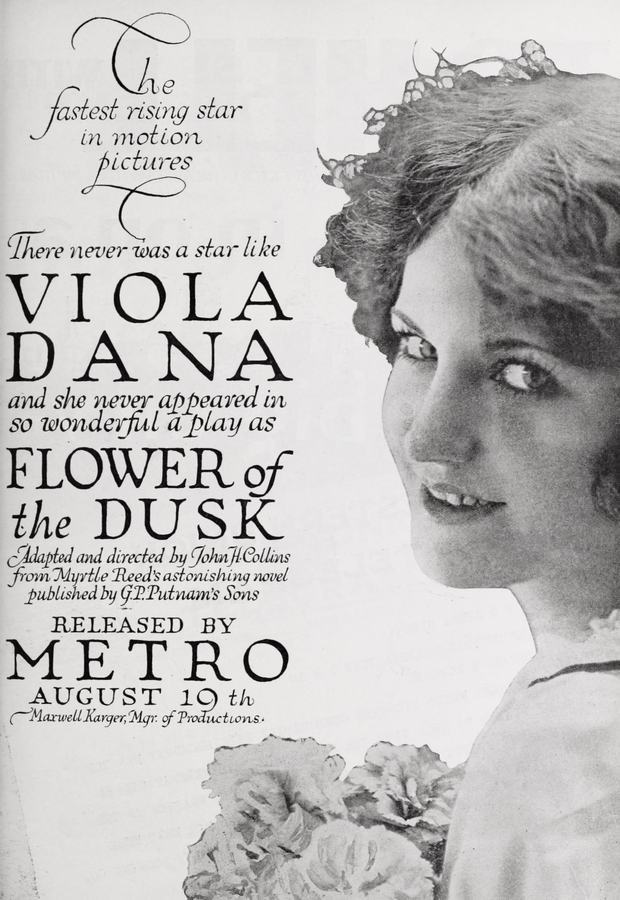
In the pantheon of early American cinema, few creative partnerships radiated as much ephemeral brilliance as that of director John H. Collins and his muse-wife, Viola Dana. Their collaboration in 1918’s Flower of the Dusk serves as a poignant, if haunting, testament to a period when the silent screen was transitioning from mere pantomime to sophisticated psychological inquiry. To view this film today is to engage with a relic of high-Victorian melodrama filtered through the emerging techniques of visual storytelling, a work that grapples with the weight of inherited trauma and the redemptive power of the 'noble lie.'
The narrative scaffolding of Flower of the Dusk is deceptively simple, yet it houses a complex exploration of perception. Ambrose North, portrayed with a visceral, trembling intensity by Howard Hall, is a man whose blindness has forced his other senses—specifically his insecurity—into a state of hyper-arousal. He is obsessed with the specter of his wife Constance, whose death by suicide remains an unhealed wound. This is not merely a story about a lack of sight; it is a meditation on the blindness of the heart. The film suggests that even with perfect vision, we often see only what our internal narratives allow us to perceive. In this regard, it shares a thematic kinship with The Miracle of Life, which similarly explores the heavy moral consequences of domestic choices.
Viola Dana, playing the crippled daughter Barbara, delivers a performance that transcends the 'waif' archetypes common to the era. There is a steely resolve in her portrayal of a woman who carries the dual burden of her own physical limitations and her father's psychological fragility. When she opens the fateful letter—a narrative device that functions as a Pandora’s box of ancestral sin—the film shifts into a higher emotional register. The revelation that Constance died not out of a lack of love for Ambrose, but because of a 'doomed love affair' with Lawrence Austin, presents Barbara with a Faustian bargain. To speak the truth is to destroy the only world her father knows; to lie is to sacrifice her own integrity at the altar of his peace.
Visually, Collins utilizes the limited technology of 1918 to create an atmosphere of suffocating intimacy. The interior of the North household is rendered in deep shadows, mirroring Ambrose's sightless world. The use of tinting and lighting to distinguish between the harsh reality of the present and the idealized, soft-focus memories of the past is masterful. This stylistic choice evokes the same atmospheric density found in Carmen, where environmental factors dictate the internal states of the protagonists. The 'Flower' of the title is not just a reference to Barbara’s blooming into womanhood, but to the fragile beauty that can only exist in the twilight of half-truths.
One cannot overlook the performance of Lettie Ford as Aunt Miriam. She represents the archetype of the 'scorned woman' whose bitterness has fermented into a potent venom. Her motivation—a desire for revenge against the man who chose Constance over her—adds a layer of Shakespearean tragedy to the proceedings. Miriam is the catalyst for the film's most harrowing sequence: the attempt to force the truth upon a man whose eyes are literally and figuratively bandaged. This cruelty is a sharp contrast to the gentle, albeit deceptive, pastoralism seen in films like The Girl of My Dreams.
The climax of Flower of the Dusk is a fever dream of operatic proportions. The confluence of Ambrose’s premature removal of his bandages and Barbara’s appearance in her mother’s wedding gown creates a moment of transcendent confusion. It is here that the film’s central thesis on the subjectivity of truth reaches its zenith. Ambrose does not see his daughter; he sees the 'spirit' of his wife returning to validate his life’s worth. In this moment, the lie becomes the ultimate truth. The tragedy is not that he dies in ignorance, but that his happiness is predicated on a carefully curated hallucination. This sequence is far more psychologically harrowing than the straightforward narratives of The Hard Rock Breed or What Happened to Jones.
The resolution, involving Barbara’s marriage to Roger (Lawrence Austin's son), serves as a symbolic cleansing. It is a classic melodramatic trope—the children reconciling the sins of the parents—yet it feels earned here. The cycle of despair is broken not by the revelation of truth, but by the endurance of love. The film suggests that while the past is a palimpsest of errors, the future is a blank page, provided one has the courage to forge a new narrative. This optimistic ending provides a necessary counterpoint to the preceding gloom, much like the emotional beats in Tears and Smiles.
To understand the impact of Flower of the Dusk, one must consider the tragic fate of its creator. John H. Collins would succumb to the Spanish Flu epidemic shortly after the film's release, cutting short a career that was arguably on the verge of redefining American cinematic language. His ability to blend the domestic with the ethereal was ahead of its time. While many of his contemporaries were focused on grand spectacles or broad comedies, Collins was interested in the micro-movements of the human soul. This film, along with others like The Iron Woman, showcases a director who understood that the most profound conflicts are those fought within the four walls of a home.
The cast, including Bliss Milford and Charles Sutton, provides a solid foundation for Dana’s luminous presence. Dana herself remains one of the most underrated stars of the silent era. Her ability to convey complex emotional transitions—from the despair of her initial discovery to the resolute strength of her final deception—is a masterclass in silent acting. She avoids the excessive gesticulation that marred many performances of the time, opting instead for a subtle, internalize approach that feels remarkably modern. Her work here is as vital as any seen in The She Devil or A Man and the Woman.
Ultimately, Flower of the Dusk is a film about the cost of peace. It asks the viewer to weigh the value of a brutal truth against the mercy of a beautiful lie. In our modern age, where transparency is often heralded as the ultimate virtue, the film’s defense of the 'noble lie' feels almost subversive. It challenges us to consider if Ambrose North was better off dying in a state of blissful delusion or if he deserved the cold, hard facts of his wife’s betrayal. By siding with Barbara’s deception, Collins makes a profound statement about the nature of compassion. It is a sentiment that echoes through other works of the era, such as Flirting with Death and The Wrong Door, which also deal with the precariousness of social and personal facades.
The film’s pacing is deliberate, allowing the tension to simmer before the explosive final act. While some modern audiences might find the plot’s reliance on coincidences—such as the timing of the eye surgery and the discovery of the letter—to be contrived, these are the essential ingredients of the genre. Within the framework of 1910s melodrama, these elements serve to heighten the emotional stakes, transforming a domestic dispute into a cosmic struggle between light and dark. It is a far more cohesive experience than the somewhat disjointed narratives found in Gatans barn or Through the Enemy's Lines.
In conclusion, Flower of the Dusk remains a vital piece of cinema history. It is a poignant reminder of the creative heights John H. Collins might have reached had he lived, and it serves as a stunning showcase for Viola Dana’s versatility. It is a film that lingers in the mind long after the final intertitle has faded, much like the scent of a flower at dusk—fading, yet unmistakably present in its haunting beauty. For anyone interested in the evolution of narrative film, it is an essential watch, standing tall alongside other significant 1918 productions like For King and Country and the curiosities of international cinema like Der Barbier von Flimersdorf.
IMDb —
1915
Community
Log in to comment.