DbcultAccessing Vault...
Cult Review
Senior Film Conservator
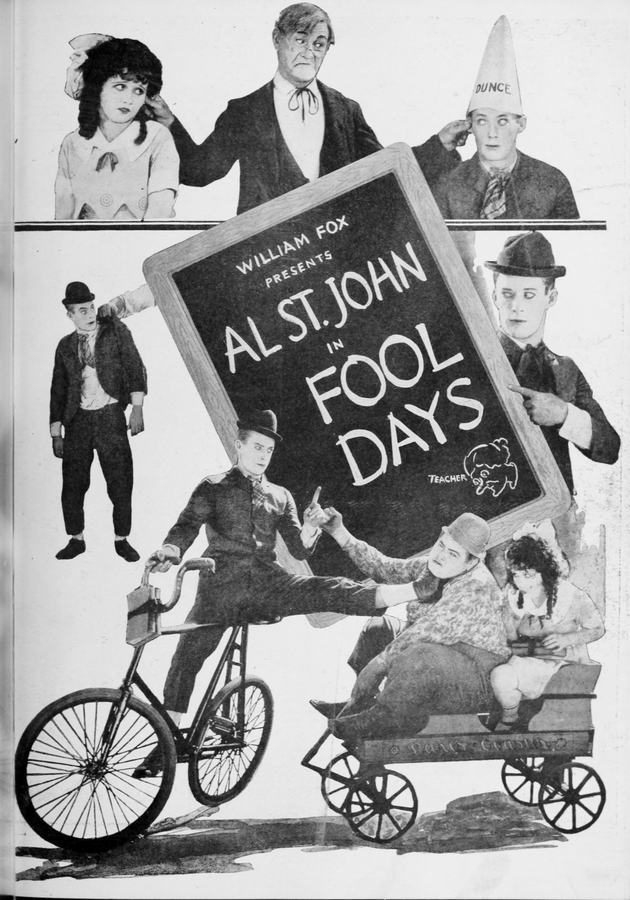
Slapstick, simians, and steam-powered sofas—welcome to Fool Days, the 1923 one-reeler that feels like a nitrate fever dream left too close to the radiator.
Most histories of silent comedy treat chimps as garnish—think Der müde Theodor’s drunken organ-grinder gag or the dime-a-dozen circus inserts that pad out college reels. Fool Days flips that hierarchy: the primate isn’t comic relief; he’s the relief pitcher, the moral compass, and the special-effects department rolled into one fur-covered package. Directors Jack White and Jack Dillon let the camera linger on Napoleon’s preternatural timing—watch how he hesitates a half-beat before yanking the fire-truck throttle, allowing the punchline (a geyser of hose water that writes ‘FOOL’ across the brickwork) to blossom in real time. It’s Keaton’s stone face swapped for a rhesus grin, and it lands every time.
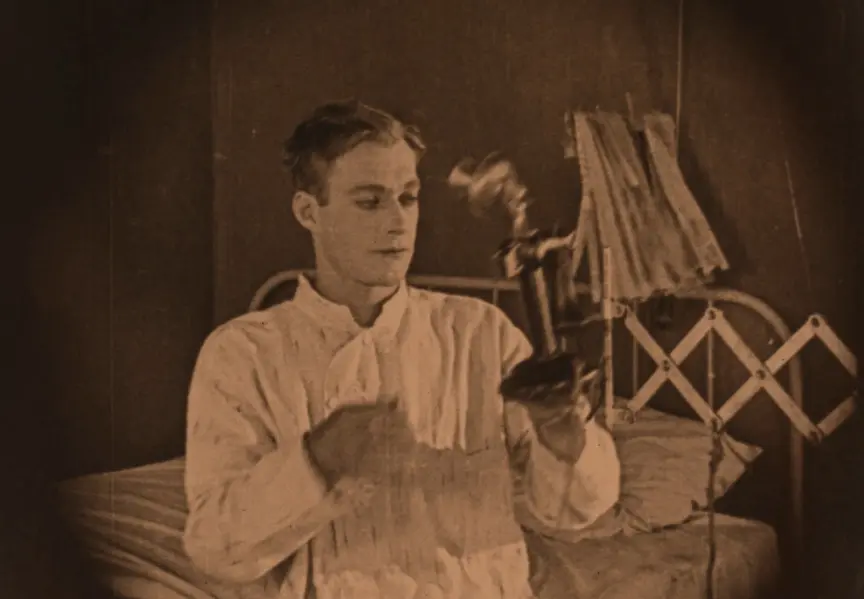
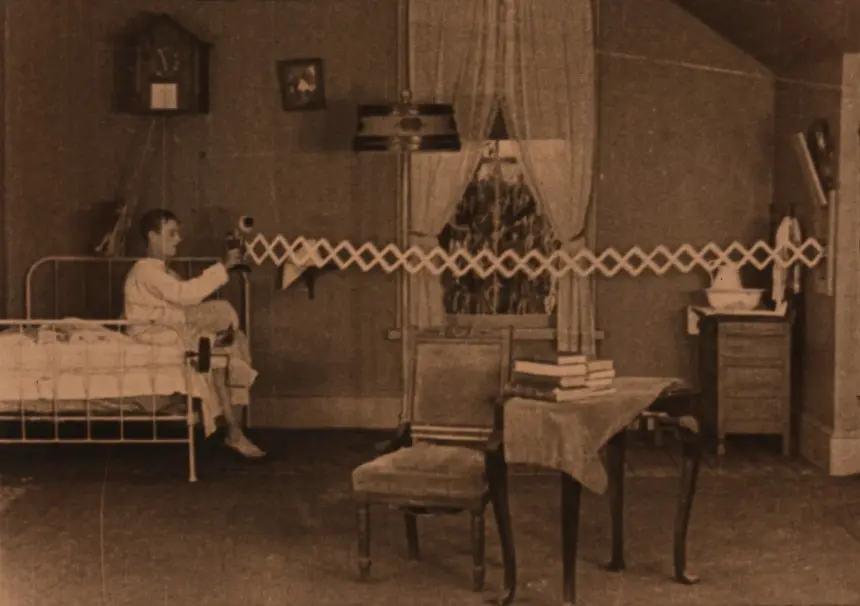
Al St. John—Buster Keaton’s cousin and frequent fall guy—here refines the art of productive laziness. Notice the opening tableau: Al awakens inside a Murphy bed that folds him, still supine, onto a conveyor of rollers; a mechanical arm brushes his teeth while another daubs shaving cream in the shape of Oklahoma. The gag economy is ruthless: every contraption appears once, detonates its payoff, and exits before the novelty spoils. Compare that to the labor-saving misfires in The Fire Flingers, where the joke repeats until the steam leaks out; Fool Days obeys the jazz dictum: solo, then split.
The school set is a cruciform corridor of doors that never open the same way twice, a spatial pun anticipating the rotating fun-house climax of Ghost City a year later. Alice Davenport’s battle-axe teacher—equal parts Whistler’s mother and Civil War general—patrols with a pointer that telescopes into a shepherd’s crook. When Napoleon pick-pockets her bustle and sells the contraband hairpins to classmates for penny chews, the film flirts with juvenile delinquency as social critique; the playground economy runs on black-market gum and eraser shavings, a miniature Depression in knee pants.
Film scholars still argue whether Napoleon’s performance was stitched together with strategic bananas or if the chimp genuinely grasped narrative beats. Frame-by-frame analysis shows him holding eye contact with off-screen trainers for exactly eight frames—long enough to calibrate but short enough to preserve diegetic illusion. The result outshines even the canine pathos of Jim Grimsby’s Boy; the ape’s fleeting smirk after catapulting a inkwell onto the headmaster’s toupee feels conspiratorial, as though he’s read the shot list and can’t wait for the next setup.
Silent-era audiences, marinated in melodramas like A Child for Sale, craved this sort of anarchic catharsis. Fool Days delivers it in 12-minute bursts, a slapstick sneeze that clears the sinuses of Victorian piety.
Editors in 1923 typically cut on impact; White and Dillon cut just before, letting the brain complete the collision. Witness the seesaw gag: Al teeters on the high end, Napoleon vaults off the low, and the film jump-cuts to the teacher’s skirt billowing upward like a startled dove, revealing knee-length bloomers stamped with the words ‘EXAM DAY.’ We never see the plank hit; we infer it, and the elision tickles harder than any visual punchline. Compare that restraint to the blunt continuity of The Joe Gans-Battling Nelson Fight, where every jab needs a spatial establishing shot; Fool Days trusts the synapses of its viewers, gambling that imagination outruns footage.
Alice Davenport’s dominatrix pedagogue might read as misogynist caricature, yet the film flips the script when she commandeers a bicycle-powered paddle to spank the entire male student body in one synchronous swipe. The gendered power inversion anticipates the proto-feminist swagger of Dangerous to Men, but retains the era’s fondness for bustle-based slapstick. The moment she inadvertently paddles herself into a storage closet, the door slamming to reveal a chalk-written ‘KARMA,’ the film winks at suffrage victories still percolating through the headlines.
Imperial anxiety seeps in through the margins: Napoleon sports a fez pilfered from a school pageant about ‘The Dark Continent’; Al’s pencil case bears a cartoon giraffe wearing a monocle. These visual puns aren’t innocent— they’re the residue of newsreels from the same year cataloguing rubber plantations and safari expeditions. Yet the film neutralizes critique by making the chimp the smartest mammal on screen, upending the civilized-primitive binary more deftly than Proletardrengen’s moralizing about class struggle.
Surviving prints carry French and American censorship snipes—frames scissored where Napoleon mimics smoking a corncob pipe. The missing foot-age leaves elliptical scars, like moth holes in a wedding dress. Rather than hobble the narrative, these absences create staccato rhythms similar to the jump-cut bruises in The Cold Deck. What remains is pure visual musk: the squeak of Al’s galoshes amplified by piano accompaniment, the ammonia whiff of photochemical decay that makes every screening an olfactory séance.
At its core, Fool Days hymns the ludic impulse—the irrepressible itch to transmute work into play. The final shot freeze-frames on Al and Napoleon suspended mid-air above a trampoline made of detention slips. Their bodies form a human-or-simian ouroboros, a perpetual loop of truancy. No moral, no reformation, no kiss-the-teacher denouement. Just the ecstasy of suspended consequence, a trait it shares with the carnival anarchy of Should a Wife Forgive? yet distilled to a single, dizzy frame.
Criterion-grade restorations could surface tomorrow, but the 16mm dupe doing the repertory rounds already radiates enough voltage to shame most CGI-laden modern comedies. Seek it whenever an archivist threads the gate; watch for the splice at 8:47 where the image hiccups and Napoleon appears to tip his hat twice—once to the teacher, once to you, the eternal fool in the dark.
IMDb 5.6
1919
Community
Log in to comment.