DbcultAccessing Vault...
Cult Review
Senior Film Conservator
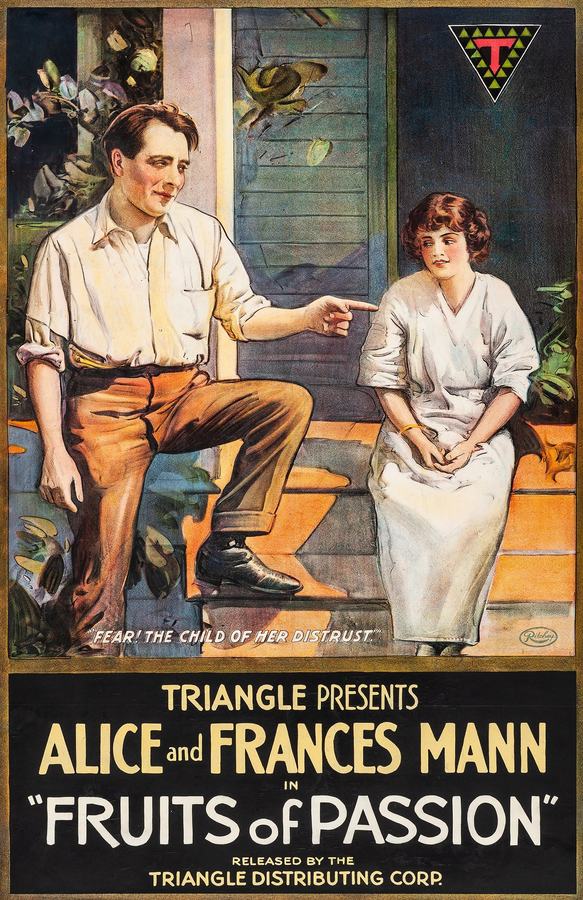
Stepping back into the nascent decades of cinema, one encounters a fascinating tapestry of storytelling, where the absence of spoken dialogue demanded an eloquence of gesture, expression, and visual metaphor. "Fruits of Passion," a 1919 silent drama, stands as a particularly potent example of this era's capacity for profound narrative and emotional resonance. Directed with an astute eye for human frailty and ambition, and penned by the collaborative genius of Henry Russell Miller and Lillian Case Russell, this film transcends its period constraints to deliver a timeless commentary on art, love, and the often-perilous pursuit of both within the unforgiving crucible of societal expectation.
The film introduces us to Elara Vance, portrayed with breathtaking vulnerability and an almost ethereal grace by Alice Mann. Mann, a luminous presence on the silent screen, imbues Elara with an innocence that is both her greatest strength and her most profound vulnerability. Her character is a sculptor, a creator whose hands channel an innate purity of vision into tangible form. Her art is not merely a craft but an extension of her very soul, uncorrupted by the commercial pressures or social posturing that so often plague the artistic world. Her initial scenes paint a picture of quiet dedication, a young woman finding solace and purpose in the tactile process of creation, far removed from the bustling, often superficial, clamor of urban life.
Enter Julian Thorne, brought to life with a captivating, yet unsettling, charisma by Colin Campbell. Campbell's portrayal is a masterclass in nuanced villainy – he's not a mustache-twirling caricature, but a sophisticated predator cloaked in the guise of an art enthusiast and benevolent patron. Thorne is a man of considerable social standing, a connoisseur whose reputation precedes him, but whose true 'passion' lies in the manipulation of others for personal gain. His interest in Elara is immediately suspect, a subtle undercurrent of calculation beneath the veneer of admiration. He sees not just her talent, but her naivety, her yearning for validation, and the potential to mold her artistic output to serve his own ends. This dynamic immediately sets up a dramatic tension that pulsates throughout the film, a battle between genuine artistic spirit and cynical exploitation.
Thorne's invitation pulls Elara from her secluded, pure artistic haven into the glittering, yet morally ambiguous, world of high society. The transition is visually striking, the film using contrasts in set design and lighting to emphasize the shift from rustic simplicity to urban grandeur. This move is reminiscent of other silent era narratives where rural purity clashes with urban corruption, such as Nobleza gaucha, which similarly explores the perils faced by innocent characters thrust into unfamiliar, morally compromised environments. Elara, initially dazzled, begins to lose her footing. Her art, once an expression of self, becomes a commodity, a tool in Thorne's social climbing. He subtly, insidiously, begins to claim her work as his own, or at least, as a product of his 'guidance,' eroding her sense of ownership and creative autonomy. The film's brilliance lies in its depiction of this slow, psychological torment, where the chains are not visible, but forged in the subtle manipulations of a charismatic individual.
The supporting cast further enriches this complex narrative. Philip Yale Drew, as the discerning and genuinely benevolent patron Richard Sterling, serves as a crucial counterpoint to Thorne. Sterling, with his quiet wisdom and unwavering belief in authentic talent, embodies the moral compass of the film. His cautious warnings to Elara, though initially unheeded, underscore the danger she faces. Frankie Mann, perhaps as Thorne's cunning sister Isabelle, adds another layer of social intrigue and rivalry, her jealous glances and whispered asides contributing to the suffocating atmosphere of deceit that begins to envelop Elara. The performances from Emil De Varney, Harry Fisher, John Lowell, Donald Hall, and Charles A. Robins, though perhaps in smaller roles, contribute to the vibrant tapestry of this silent world, each gesture and expression vital in conveying their characters' motivations and allegiances.
Henry Russell Miller and Lillian Case Russell deserve immense credit for crafting a screenplay that, despite its lack of spoken words, communicates such profound emotional depth and intricate character development. Their narrative eschews simplistic good-versus-evil dichotomies, instead delving into the more nebulous terrain of human motivation. Thorne is not merely evil; he is a product of a society that values appearance over substance, wealth over integrity. Elara is not merely a victim; she is an artist grappling with the universal dilemma of preserving one's vision in the face of external pressures. The writers masterfully utilize intertitles not just to convey dialogue, but to offer pithy observations on human nature, guiding the audience's understanding of the psychological undercurrents at play.
The pacing of the film is deliberate, allowing the audience to witness Elara's slow awakening to Thorne's true nature. This gradual realization is far more impactful than a sudden, dramatic reveal. It mirrors the insidious nature of manipulation itself, where small compromises accumulate until one's identity is almost entirely subsumed. This exploration of psychological torment and the slow burn of recognition can be seen in other silent thrillers like Angoisse, which, though a different genre, also relies on building tension through internal rather than overt external conflict.
The cinematography of "Fruits of Passion" is exquisite, a testament to the visual artistry of the period. The use of light and shadow is particularly noteworthy, often mirroring the internal states of the characters. Elara, in her early scenes, is often bathed in soft, natural light, symbolizing her purity. As she falls under Thorne's influence, shadows begin to creep in, obscuring parts of her, reflecting the encroaching darkness on her spirit. Thorne, conversely, is often dramatically lit, emphasizing his commanding presence but also hinting at the hidden depths of his deceit. Close-ups are employed sparingly but effectively, highlighting the raw emotion on the actors' faces, a crucial element in silent film where every flicker of an eye, every tremor of a lip, must convey volumes.
The set designs, from Elara's humble studio to Thorne's lavish mansion and the grandeur of the art gallery, are meticulously crafted, serving not merely as backdrops but as active participants in the storytelling. The opulence of Thorne's world, with its ornate furnishings and glittering chandeliers, contrasts sharply with the austerity of Elara's creative space, underscoring the clash of values. This attention to environmental detail is a hallmark of strong silent cinema, much like in Black Orchids, where the settings themselves become characters conveying mood and social standing.
The film builds inexorably towards its powerful climax, set against the backdrop of a grand art exhibition—a moment that should have been Elara's triumph. Instead, it becomes the stage for a dramatic confrontation, where the fruits of Thorne's deceit ripen into a bitter harvest. The tension is palpable as Elara, finally seeing through the elaborate facade, must choose between silent acquiescence and a public assertion of her truth. The emotional weight of this scene is carried almost entirely by Alice Mann's performance, her face a canvas of conflicting emotions: betrayal, anger, and ultimately, a steeling resolve. It's a moment of profound personal agency, a reclaiming of her artistic soul.
The resolution of "Fruits of Passion" avoids facile happy endings, instead opting for a more nuanced and resonant conclusion. Elara's journey is not about finding a new love to replace the old, but about finding herself, her voice, and her artistic integrity. The 'fruits' alluded to in the title are revealed to be multi-faceted: the bitter fruits of betrayal and exploitation, but also the sweet, hard-won fruits of self-discovery and freedom. This thematic depth elevates the film beyond a mere melodrama, positioning it as a poignant exploration of the human spirit's resilience. In this sense, it shares a philosophical kinship with films like Milestones of Life, which also delves into profound personal growth and ethical dilemmas over time.
"Fruits of Passion" is more than just a historical artifact; it is a vibrant piece of cinematic art that speaks to contemporary audiences with surprising clarity. Its themes of artistic authenticity versus commercialism, the dangers of manipulation, and the importance of self-worth are as relevant today as they were over a century ago. The film serves as a powerful reminder of the expressive power of silent cinema, where the absence of dialogue compelled filmmakers and actors to communicate on a deeper, more universal level. The performances, particularly by Mann and Campbell, are captivating, demonstrating the enduring power of their craft. The narrative, meticulously constructed by Miller and Russell, proves that compelling storytelling transcends technological limitations.
For those interested in the evolution of film as an art form, or simply in a compelling human drama, "Fruits of Passion" offers a rich and rewarding experience. It stands proudly alongside other significant works of its time, such as The Girl Problem or The Burglar, showcasing the breadth and depth of early cinematic storytelling. Its continued impact is a testament to the universal nature of its themes and the timeless artistry of its creators. This is a film that lingers in the mind, prompting reflection on the choices we make, the passions we pursue, and the true cost of compromising one's integrity for the sake of fleeting adoration or material gain.
In a cinematic landscape often dominated by spectacle and dialogue, "Fruits of Passion" reminds us of the profound eloquence found in silence, in the subtle shift of an actor's gaze, in the symbolic framing of a shot, and in the universal language of human emotion. It is a film that truly earns its place in the pantheon of early cinema, offering a delicate yet powerful examination of the human heart and its eternal struggle for authenticity. Its 'fruits,' both bitter and sweet, are well worth savoring.
IMDb 6.7
1933
Community
Log in to comment.