DbcultAccessing Vault...
5.7/10
Senior Film Conservator
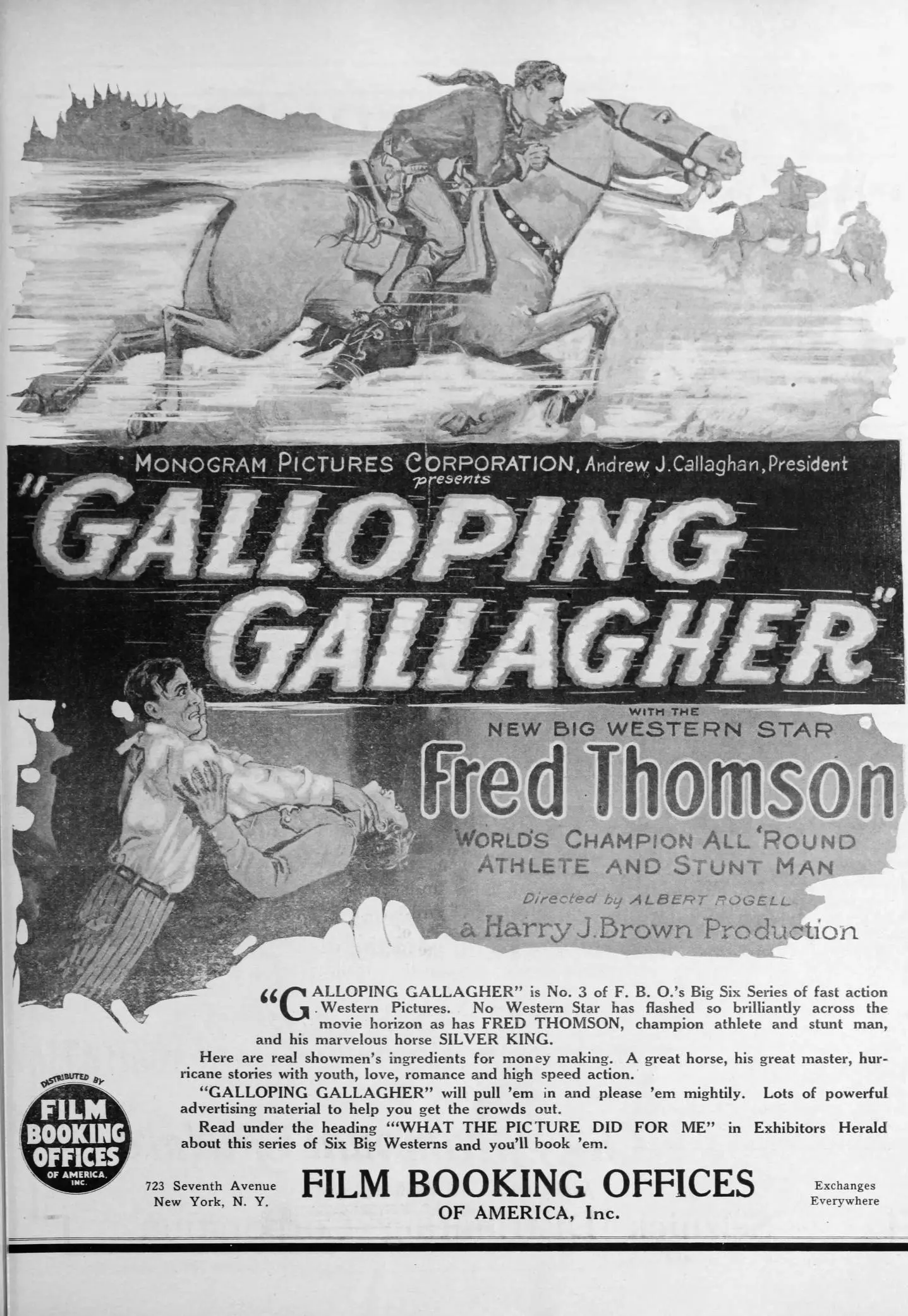
A definitive 5.7/10 rating for a film that redefined the boundaries of cult cinema. Galloping Gallagher remains a cornerstone of transgressive art.
In the annals of early Western cinema, few figures commanded the screen with the sheer athleticism and charismatic presence of Fred Thomson. Galloping Gallagher, a 1924 silent film directed by Albert S. Rogell, stands as a testament to Thomson's unique brand of cowboy heroics, seamlessly blending daredevil stunts with a compelling narrative of good versus evil on the American frontier. This isn't merely a tale of a lone rider cleaning up a lawless town; it's a vibrant tapestry woven with threads of community resilience, the insidious nature of corruption, and the profound bond between a man and his magnificent steed, Silver King. The film, penned by the prolific Frances Marion and Marion Jackson, transcends its genre conventions, offering a glimpse into the moral complexities of a burgeoning nation and the enduring allure of a hero who embodies both strength and virtue.
The narrative unfolds in a quintessential Western town, a dusty crucible of human endeavor and desperation, where the very fabric of society is being frayed by the relentless depredations of a criminal syndicate. Enter Bill Gallagher, portrayed with an understated intensity by Fred Thomson. His arrival is not heralded by fanfare or boasts, but rather by an aura of quiet competence that immediately distinguishes him from the downtrodden townsfolk and the swaggering outlaws. The town, desperate for a leader, discerns in Gallagher a rare combination of courage and principle, swiftly electing him as their sheriff. This pivotal moment is not just a plot device; it underscores the yearning for order and justice that permeated the frontier ethos, a desire for someone capable of wielding authority with both efficacy and integrity. Gallagher's acceptance of the badge is a tacit acknowledgment of his responsibility, a silent promise to restore equilibrium to a world thrown violently off-kilter.
The antagonists in Galloping Gallagher are not merely one-dimensional villains. At the apex of the criminal enterprise stands 'Lily Finger' Burke, the seemingly respectable bank president, a master of deception whose veneer of civility masks a predatory nature. Lew Meehan embodies Burke with a chilling blend of urbanity and menace, a character whose past as a barroom bouncer hints at a raw brutality barely contained. This duality—the pillar of the community by day, the orchestrator of chaos by night—adds a layer of psychological intrigue often overlooked in early silent Westerns. Burke's control over the town is absolute, extending even to the abduction of Miss Grey, a lady minister, whose moral fortitude stands in stark contrast to Burke's depravity. Her capture is not just a personal tragedy but a symbolic assault on the town's spiritual heart, making her rescue a crucial step in its redemption.
What truly elevates Galloping Gallagher beyond a standard Western is the symbiotic relationship between Fred Thomson and his equine co-star, Silver King. Thomson, a former Presbyterian minister turned vaudeville acrobat and then film star, brought an unprecedented level of athleticism to his roles. His stunts were not merely performed; they were integrated seamlessly into the narrative, imbued with a sense of genuine danger and exhilarating grace. Watching him leap from moving trains onto his galloping horse, or execute daring maneuvers that would make modern stunt coordinators blanch, one understands why he was dubbed 'The Cowboy with the Camera Eye'. His physical prowess, combined with a sincere, earnest acting style, created a hero who was both aspirational and relatable. This was a man who didn't just ride a horse; he was an extension of it, a centaur of the silver screen.
Silver King, the majestic palomino, was far more than a prop; he was a character in his own right, often credited alongside Thomson in film titles. His intelligence, agility, and responsiveness were legendary. In Galloping Gallagher, Silver King is not merely a mode of transport but an active participant in the pursuit of justice, often anticipating Gallagher's needs and executing complex actions that contribute directly to the plot's resolution. The scenes depicting their synchronized movements, whether chasing bandits across rugged terrain or navigating treacherous obstacles, are breathtaking. This partnership was a hallmark of Thomson's films, distinguishing them from those of his contemporaries and laying groundwork for future equine stars. One could argue that Silver King's contribution to these films is as significant as any human actor, a testament to the profound connection cultivated between man and beast.
Frances Marion, one of the most celebrated screenwriters of the silent era, along with Marion Jackson, crafted a narrative that, while adhering to Western tropes, infused them with a surprising degree of character development and emotional resonance. The core conflict is clear: the struggle between order and anarchy. Yet, the film delves deeper, exploring themes of hidden corruption, the vulnerability of the innocent, and the redemptive power of decisive action. The choice of Miss Grey as a lady minister is particularly poignant, representing the moral compass of the community and making her rescue not just a personal victory for Gallagher but a spiritual one for the town. Her grace and unwavering faith provide a stark contrast to the rough-and-tumble world Gallagher inhabits, highlighting the multifaceted nature of frontier life.
The burgeoning romance between Gallagher and Miss Grey is handled with a delicate touch, evolving organically from shared peril and mutual respect. It avoids the often-clichéd quick unions of many Westerns, instead portraying a connection forged in the crucible of adversity. This emotional depth adds another layer to Gallagher's character, revealing him not just as a fearless lawman but as a man capable of tenderness and deep affection. It’s a subtle yet powerful assertion that even amidst the grit and violence of the frontier, love and companionship are potent forces, capable of healing and building new futures. Such narrative sophistication was a hallmark of Marion's writing, distinguishing her contributions to early cinema.
Albert S. Rogell's direction in Galloping Gallagher is characterized by a keen understanding of pacing and visual storytelling, essential elements in the silent era. He masterfully captures the vastness of the Western landscape, using it not just as a backdrop but as an active participant in the drama. The action sequences are dynamic and clear, allowing Thomson's remarkable stunts to shine without being obscured by convoluted editing. Rogell demonstrates a deft hand in balancing the thrilling chases and confrontations with moments of quieter character interaction, ensuring that the film maintains a consistent emotional rhythm. His ability to convey complex emotions and narrative progression through purely visual means is a testament to the artistry of silent film directors.
Comparing Galloping Gallagher to other films of its era, one notes its distinctive emphasis on realism in its stunt work, a characteristic that set Thomson apart. While other Westerns like The Lion of the Hills or The Fighting Shepherdess might have focused more on dramatic narratives or star power, Thomson's films consistently delivered unparalleled physical spectacle. This focus on authentic, thrilling action sequences contributed significantly to the evolution of the Western genre, pushing the boundaries of what audiences expected from their cowboy heroes. It’s a lineage that can be traced through the daredevil riders of early Hollywood to the more sophisticated action sequences of later eras.
In an age where cinematic heroes often rely on elaborate special effects and convoluted backstories, there's a refreshing purity to Fred Thomson's portrayal of Bill Gallagher. His heroism is not derived from supernatural abilities or intricate gadgetry, but from an unwavering moral compass, exceptional skill, and an unbreakable bond with his animal companion. This simplicity is, paradoxically, its greatest strength, allowing the audience to connect with the archetypal struggle against injustice on a fundamental level. The film's message — that courage, integrity, and a steadfast spirit can overcome even the most entrenched corruption — resonates across generations.
While Galloping Gallagher might not possess the avant-garde experimentalism of a film like Camera Obscura, or the philosophical depth of Tao, its strength lies in its unpretentious embrace of classic storytelling. It delivers exactly what it promises: a thrilling adventure, a compelling hero, and a satisfying resolution. It's a film that speaks to the timeless appeal of the Western mythos, where the vast, untamed landscape serves as a crucible for moral choices and heroic deeds. The performances, particularly from Thomson and Silver King, are captivating, drawing the viewer into their world with an immediacy that belies the film's silent nature. The supporting cast, including Nelson McDowell and N.E. Hendrix, provide solid grounding for the central performances, each contributing to the rich texture of the frontier town.
In conclusion, Galloping Gallagher is more than just a historical artifact; it is a vibrant piece of cinematic history that continues to entertain and inspire. It is a powerful reminder of Fred Thomson's singular talent and the enduring magic of the silent film era. For aficionados of classic Westerns, or anyone curious about the foundational narratives of American cinema, this film offers a richly rewarding experience. It encapsulates the spirit of an age, celebrating a brand of heroism that remains eternally appealing, a testament to the power of one man, and his loyal steed, to bring justice to a lawless land. Its legacy is not just in its individual narrative, but in its contribution to shaping the very iconography of the Western genre, firmly planting Fred Thomson and Silver King among its most iconic figures.
IMDb —
1924
Community
Log in to comment.