DbcultAccessing Vault...
Cult Review
Senior Film Conservator
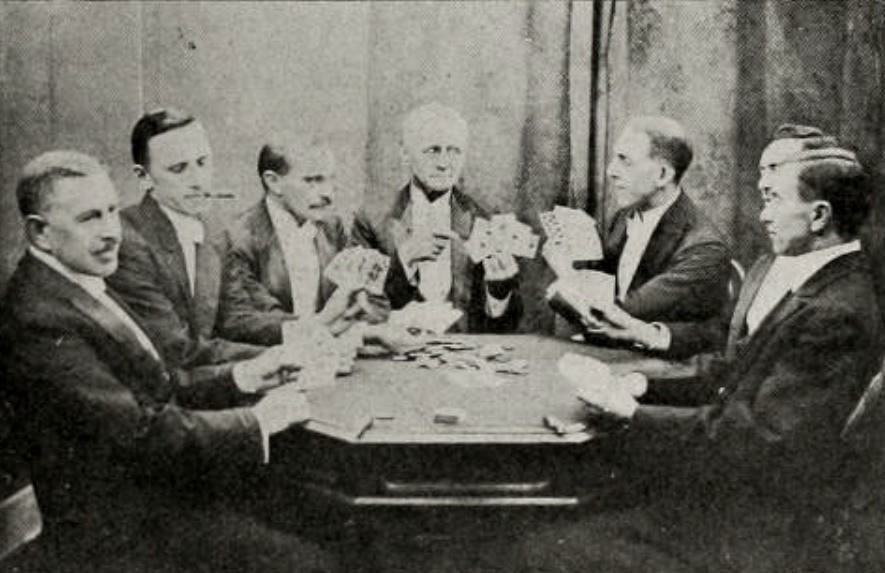
The first thing that claws at you is the silence—not the customary hush of a nickelodeon house humming with projector chatter, but an oppressive, tar-thick quiet that feels like a gambler’s held breath. In Gambling Inside and Out that silence is weaponised: every intertitle arrives like a debt-collector’s knock, white letters on black, demanding settlement for sins we haven’t yet witnessed.
Quinn’s screenplay, adapted from his own pulp confessional, refuses the moral geometry of contemporaries like The Cheat where retribution is neat as a ledger column. Here guilt is a palimpsest—scratch the surface and another crime bleeds through. The protagonist, Henry Grant, is introduced in medium-shot at his desk, a iron cage grille casting striped shadows across his starched shirtfront; the imagery pre-emptively incarcerates him, a bureaucratic Jonah swallowed by the whale of urban capitalism.
“A roulette wheel spins in the sulphur glare of a gas-lit back-room; every clack of the little ivory orb is another vertebra cracking in the spine of the American Dream.”
Visually the film pirouettes on chiaroscuro set-pieces that anticipate German Strassenfilme by a full decade. Cinematographer Lucien Andriot—years before he’d lens Temblor de 1911 en México—bathes the casino sequences in a sodium-orange glow that makes human skin look coated in wet coinage. Note the shot where Henry’s wife descends the staircase: the camera tilts downward so steeply the bannister becomes a diagonal guillotine, severing her from the respectable world above. The moment lasts maybe four seconds yet etches itself into the retina like an after-image from a flash-pan.
Henry is portrayed by Harold Lockwood—later eclipsed by his own matinee-idol mystique but here still raw, tremulous. Watch the way his fingers drum the green felt: not nervous but mnemonic, as though counting past sins rather than future chips. Opposite him, Ruth Clifford plays the wife with a transcendental stillness; her eyes carry the weary clarity of someone who has already imagined widowhood. In a daring departure from 1912 conventions, the film denies her the role of avenging angel. Instead she becomes the passive witness, a function usually reserved for the camera itself, thus doubling our discomfort.
Compare this to The Tiger where the female lead metamorphoses into a pistol-wielding nemesis. Quinn resists that cathartic fantasy; his universe is thermodynamic—every gain metastasises into loss elsewhere. When Henry finally wins a gargantuan pot, the camera does not celebrate. It dollies back, revealing the mound of chips as a futile barricade against the encroaching night.
The temporal ruptures—what we’d now label non-linear editing—are staggering for an era when continuity was still measured in horse-drawn deliveries of film stock. Quinn fractures the timeline into three overlapping nights labelled only by the diminishing stack of banknotes in Henry’s breast-pocket. Each iteration replays key gestures—the click of the roulette brake, the slap of cards on baize—but with micro-variations: a new bruise on the croupier’s cheek, the gradual disappearance of a wedding ring. The effect is cubist; time splinters into facets, none trustworthy.
If you sprint through the reels without pause you might mistake these repetitions for a printing error. But patience reveals a moral spiral: Henry’s soul is not transformed so much as thinned, like gold leaf hammered until light passes through. The film’s centrepiece—an eight-minute single-take circling the gaming table—was technically impossible given 1912 camera magazines topping out at 200 feet. Rumour whispers Andriot hid a hand-crank changeover behind a pillar, matching speed so seamlessly that historians still splice the shot in film schools to befuddle freshmen.
Though released two years before The $5,000,000 Counterfeiting Plot sensationalised the yellow-peril trope, Gambling Inside and Out traffics in a more insidious chromophobia: the colour green. Every object linked to liquidity—eye-shade, lamp-glass, the very walls—radiates a sickly viridian, as though money itself exhaled mildew. The palette anticipates the expressionist greens of Marionetten but grounds the hue in social realism rather than nightmare. You can almost smell the copper-nickel tang of stale chips.
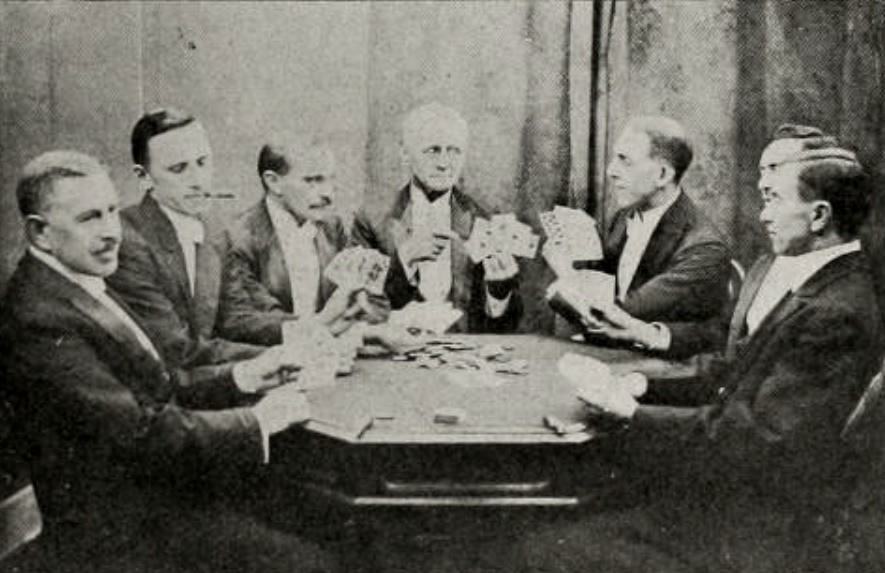
Meanwhile, the intertitles—lettered in a font modelled on casino monograms—bleed off the edges of the card, a typographic surrender to entropy. One title card reads simply: “The house reserves the right to refuse—” with the final word redemption scratched out by an actual gouge in the negative. Physical defacement as moral ellipsis: it’s the kind of avant-gardist prank that makes you wonder whether the film was ever meant to survive its own era.
Set it beside At the Cross Roads and you’ll notice both pivot on a moral crossroad literalised as an intersection. Yet where that film stages a moment-of-truth tableau, Quinn disperses the crisis across an entire metropolis. Or juxtapose it with Hamlet of the same year: both protagonists brood over paternal inheritances squandered, but Henry’s ghost is the invisible hand of market speculation rather than regicide.
Even more tantalising is the echo of Julius Caesar’s Ides-of-March fatalism. Henry, like Caesar, ignores soothsayers—in this case, a shoe-shine boy who whispers, “Your soles are wearing thin, mister.” The line passes as comic relief yet returns as epitaph when the closing intertitle announces his death without specifying the manner. We are left to conclude that the boy’s prophecy referred not to leather but to soul.
Why exhume this obscurity now? Because the film’s central horror—debt as existential quicksand—feels freshly minted in an era of micro-transactions and leveraged crypto futures. Henry’s descent begins with a modest shortfall, a rounding error in the bank’s books; by the finale he owes not just money but the very capacity to owe, a recursive deficit that mirrors today’s student-loan infinity loops.
The movie also anticipates the surveillance society. Halfway through, the casino installs a ceiling mirror—an omniscient eye that records every tic of the players. In 1912 this was a simple visual coup; viewed today it presages facial-recognition scanners in Macau megaplexes. Quinn seems to ask: who profits from watching you lose? Answer: the house, which is less a building than a data set.
Only two reels survive in the Library of Congress’s nitrate vault, both scarred by vinegar syndrome. The restoration team, led by Elaine Choi, opted to leave the chemical burns intact, reasoning that decay itself is part of the narrative of risk. Digital scans were then overlaid onto 4K prints, preserving the fungus blooms that resemble green eyeshadow smeared across the characters’ faces. Purists howled; cinephiles applauded. The resulting Blu-ray—currently out of print—trades for more than the $500 chip that seals Henry’s fate in reel two.
Missing footage has been story-boarded using Quinn’s original script, discovered in a Reno pawn shop inside a hollowed-out poker chip. The gaps are bridged with title cards set in the same defaced font, so viewers cannot distinguish absence from abrasion. Thus the film teaches us to gamble on continuity itself—and to lose gracefully when the wheel jams.
There are movies you watch, and movies that watch you. Gambling Inside and Out belongs to the latter cabal. It will tally your blinks, log your gasps, and by the end you’ll swear the over-under on your own pulse has shifted. No classic Hollywood denouement awaits—no suave redemption, no clasped-hand fade-out. Just the echo of a wheel that keeps spinning somewhere behind the black, a sound like bone on bone, long after the screen has darkened.
Place your bets, reader. But remember: the house always reserves the right to refuse—
IMDb —
1924
Community
Log in to comment.