DbcultAccessing Vault...
Cult Review
Senior Film Conservator
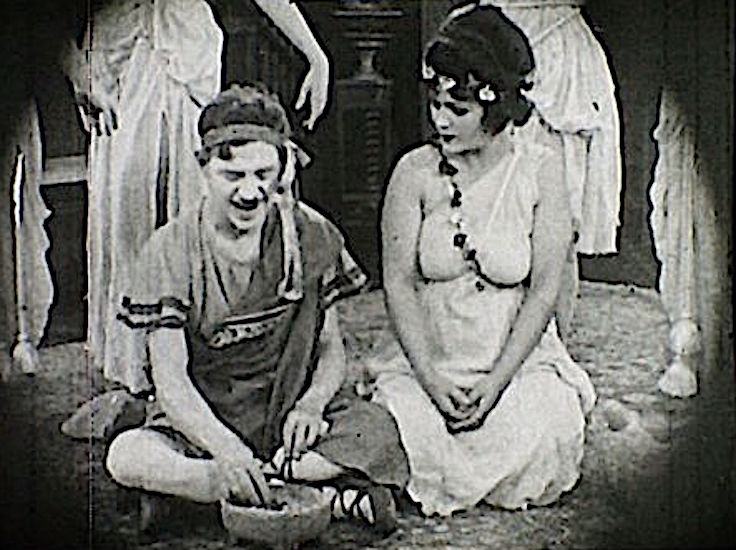
Hal Roach’s one-reel cocktail Greek Meets Greek sloshes together Bacchic drapery and gin-soaked syncopation until the punchbowl overflows onto the parquetry of 1922 propriety. Clocking in at a brisk dozen minutes, the film nevertheless distills an era’s vertigo: the moment when Victorian bustles were being torched to feed the boiler of modernity, and every Charleston kick felt like a heresy against the Parthenon.
Shot in the honeyed light of Roach’s nascent lot, the short is a pocket revolt against chronology itself. Xenophon Socrates O’Brien—portrayed by Robert Emmett O’Connor with the pomp of a self-appointed Pericles—embodies the generational scold, nostrils flaring at the merest whiff of jazz. His tirade against the Vanity Fair Girls is less dialogue than arias of indignation, each syllable freighted with the suspicion that civilization peaked somewhere around 430 BCE and has been limping ever since.
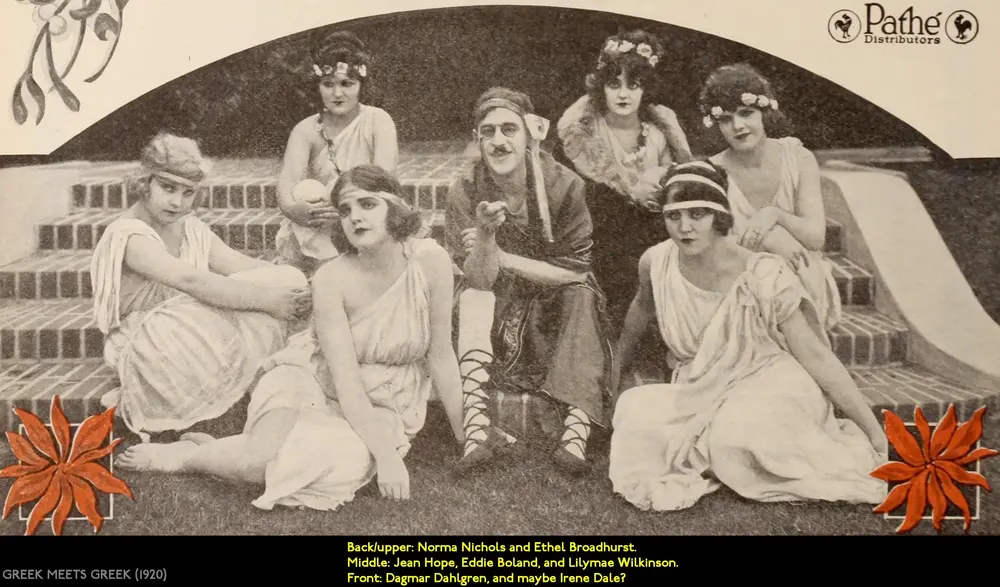
The maidens—Dagmar Dahlgren, Irene Dale, Norma Nichols, Jean Hope—counter his antiquarian sermon with the puckish sagacity of flappers who know that silk is meant for shimmying, not for sculptural tableaux. Their heist of domestic linen is filmed in caffeinated jump-cuts: curtains billow like triumphal flags, tablecloths unfurl into makeshift peplums, and the villa is left skeletal, a mausoleum of middle-class respectability.
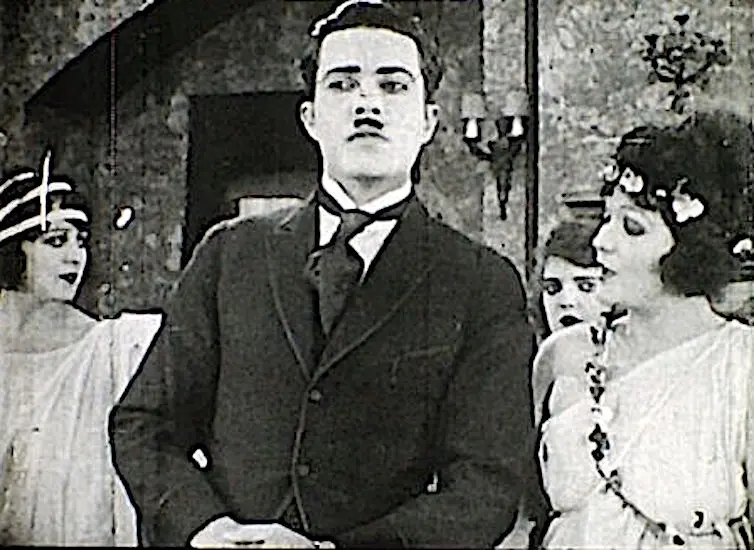
On the lawn they conjure a tableau vivant that is half In the Palace of the King grandeur, half backyard pageant. The camera ogles their improvised chitons, the safety-pin clasps glinting like miniature constellations against the linen. There is no attempt at archaeological accuracy; instead, the film delights in the friction between cheap cotton and classical gesture, between the erudite and the makeshift.
Enter the Professor, essayed by Eddie Boland with the rubbery elasticity of a cartoon Socrates. His business card might as well read “Maestro of the Shimmy, Ph.D. in Hip Gyrations.” His lessons are a carnival of misdirection: he demonstrates the torso ripple, the knee pop, the shoulder shimmy, each maneuver dissolving into slapstick entropy. The girls imitate with the fervor of acolytes, yet every beat arrives a half-second late, turning the sacred into the ridiculous. Roach choreographs the sequence like a cubist fugue: limbs fracture space, angles collide, and the dance becomes a kaleidoscope of flesh and fabric.
The climax—a centrifugal “merry-go-round” spun to a frenetic rag—feels like Possession’s emotional whirlpool rendered in Keystone tempo. The Professor, now draped in a toga purloined from the linen stash, pirouettes until gravity claims him. He collapses center-frame, a wilted laurel wreath shading his eyes, while the girls orbit like planets freed from Ptolemaic dogma.
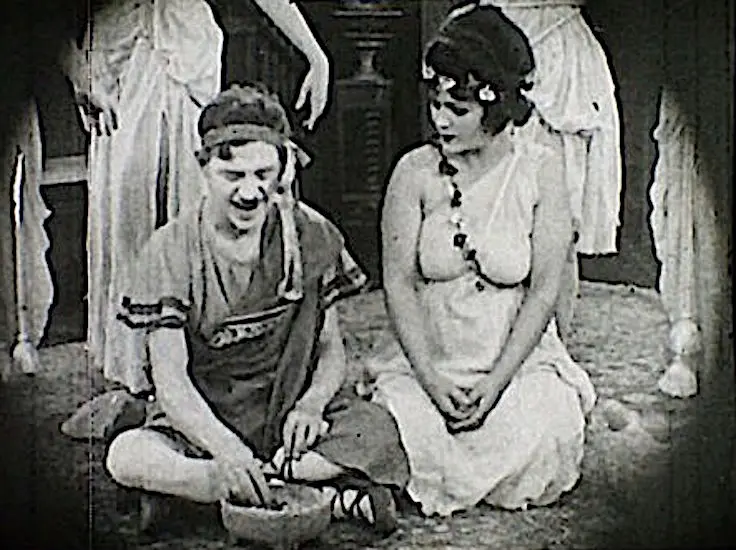
Visually, the film revels in chiaroscuro: high-noon sunlight bleaches the lawn to ivory, while the villa’s doorframes yawn into tenebrous rectangles. The tonal palette—sepia degraded to bruise—anticipates the tinting experiments of later Roach shorts. Intertitles, sparse and sardonic, arrive like postcards from a jaded muse: “Grace? Antiquity? Try again next Tuesday.”
Compare the anarchy here to the pastoral fatalism of A magyar föld ereje, where soil itself exacts tribute, or the Gothic guilt of The Brand of Satan. Roach’s universe is lighter, yet the levity slices just as deep: beneath the petticoat flutters a meditation on cultural amnesia, on how every generation forges its own Delphi out of bedroom curtains and hubris.
Sound, of course, is absent, but the silence vibrates with ghost syncopation. Modern viewers conditioned to talkie wisecracks may find the pantomime refreshingly cerebral; the comedy resides in the mismatch between rhetorical grandeur and bodily pratfall, between Xenophon’s rolling syllables and the Professor’s rolling hips.
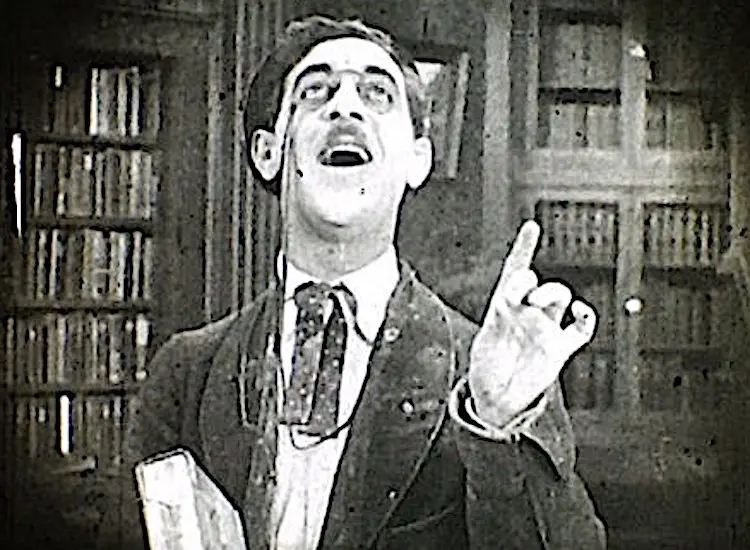
Performances oscillate between commedia swagger and intimate flickers of rebellion. Dagmar Dahlgren’s sidelong smirk as she knots a curtain into a chlamys could launch a thousand dissertations on gendered spectacle. Irene Dale’s footwork—half sylph, half jackrabbit—embodies the era’s hormonal thrum. And when Norma Nichols breaks the fourth wall with a wink, the century collapses: 1922 suddenly feels as porous as a linen sheet.
Gender politics, admittedly, wear the patina of their age. The girls’ agency hinges on pilfering domestic textiles, a literal domestication of revolt. Yet within Roach’s slapmatrix, such theft becomes insurgent art: they re-stitch the household into a stage, re-tailor patriarchal space into a circle where skirts whirl like galaxies. If Respectable by Proxy interrogates social climbing, Greek Meets Greek interrogates social antiquing—peeling gilt from the past to gild the shimmy of the now.
Technically, the short is a marvel of constraint-based ingenuity. Budgetary shoestrings necessitate location economy: one villa, one lawn, one sustained gag. Yet Roach wrings variegation through montage—eyeline matches that ricochet from bare ankle to scandalized bust, iris-ins that punctuate the Professor’s escalating apoplexy. The camera, often handheld, lurches with the dancers, embedding the viewer inside the centrifuge.
Comparative note: where Flirting with Fate weaponizes coincidence, and Little Miss Optimist weaponizes naïveté, Greek Meets Greek weaponizes anachronism itself. Time becomes elastic, a rubber band snapped between Periclean ideal and jazz-age kineticism. The snap stings precisely because it is playful.
Restoration status remains spotty; most prints circulate in 8 mm dupes, gate-scratched and chemical-ghosted. Yet the defects enhance the dream-drunk aura, as though the film itself were shimmying out of history’s corset. Archivists at MoMA have floated a 4 K scan, but funding trickles; thus the short survives in the digital underbrush, a half-remembered bacchanal awaiting rediscovery.
Verdict: Greek Meets Greek is a shot of ouzo ignited inside a speakeasy—brief, incandescent, likely to singe your eyebrows if you lean too close. It lampoons pedantry, celebrates corporeal vernacular, and proves that toga parties were kitsch even a century ago. Seek it out in the twilight zone between YouTube takedowns and archive.org resuscitations; let its linen-swaddled mayhem remind you that history, like dance, is best performed with a wink, a safety pin, and the audacity to mispronounce your own name.
IMDb —
1917
Community
Log in to comment.