DbcultAccessing Vault...
Cult Review
Senior Film Conservator
A canvas of smoke, gold and guilt
In the wavering nitrate universe of Gypsy Love, adultery is never a mere liaison; it is a stone pitched into a still pond, sending ripples that eventually upturn an infant’s cradle. Director Edgar Sloane (also essaying the callow Herve) stages the first act like a brittle Rococo miniature: parasols on the Riviera, champagne flutes catching the casino’s chandeliered glare, the rustle of silk that muffles a wife’s loneliness. Blanche, rendered with porcelain fragility by Emma Le Bar, glides through cavernous parlours where the wallpaper seems to perspire ennui. When her gaze finally locks with Guido’s—Joel La Rue’s bohemian poet sporting a dangerously unbuttoned collar—the cut is abrupt, almost Soviet in its montage, as though a single frame were snatched from a Cecil B. DeMille fever dream.
The incriminating letters, entrusted to the mayor’s spouse, function as both MacGuffin and Pandora’s box. Their physicality is fetishised: parchment quivering under wax seals, the nervous scratch of Blanche’s fountain pen bleeding through sheets. Once Mayor Ruisor—Allan De La Ture in a performance pitched somewhere between King Lear and Grand Guignol—discovers the implication that his paternity might be usurped, the film pivots from drawing-room tragedy to barbaric folktale. The abduction of toddler Dolly transpires in a whirl of chiaroscuro; the camera, starved of light, catches only the whites of the child’s eyes and the mayor’s knuckles as he thrusts a purse of gold at the gypsy chieftain Gyamar. That purse, clinking with coin, becomes the film’s true heart—currency that purchases exile, identity, and ultimately absolution.
Circus oxygen: nomadism as rebirth
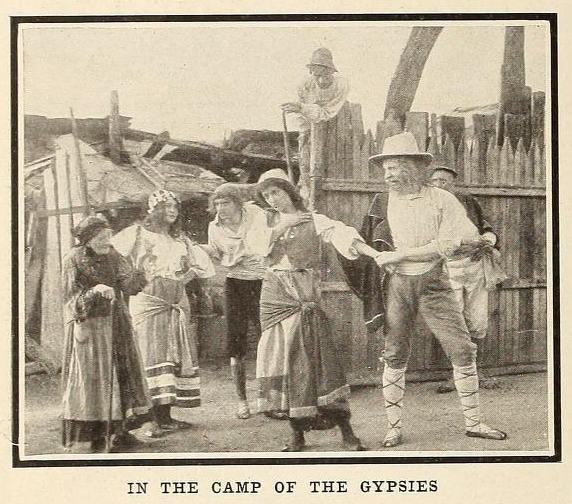
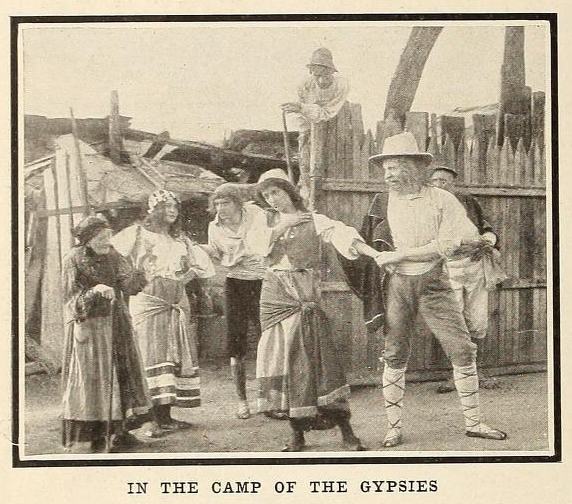
The narrative leaps eighteen years in a dissolve so elliptical it feels like a magician’s blink. Dolly, now incarnated by the ethereally athletic Dolly Simmonditti, has become a creature of sawdust and starlight. Sloane refuses to exoticise Romani life through ethnographic distance; instead, he films encampments at dawn, copper smoke coiling over vardos, children chasing geese amid ochre grass. The gypsy band’s music—rendered via intertitles that throb with onomatopoeic strum-strum-laughter—serves as counterpoint to the cold marble corridors left behind. The moment Gyamar barters Dolly to a louche aristocrat, the film dons the crimson cloak of Victorian stage melodrama, yet Sloane’s mise-en-scène stays fiercely kinetic: wagons wheel through forests lit by handheld torches, bodies blur in long-exposure nocturnes.
Erik’s rescue operation unfolds like a Keystone chase drenched in moonshine. Played by an intensely physical unidentified actor (records lost to nitrate fire), Erik scales carriage wheels, swings from market awnings, and somersaults into a river to evade henchmen. His chemistry with Dolly is conveyed less through lingering close-ups—the orthodox grammar of later star-system Hollywood—than through shared momentum: two silhouettes sprinting in lockstep, their clasped hands forming the hypotenuse of desire. When they join the acrobatic troupe “Black Devils,” the film detonates into pure kinesthesia. Trapeze arcs slice the frame diagonally, tightropes bisect horizons, and Sloane intercuts actuality footage of provincial fairs whose banners flap like national flags for the stateless. One unforgettable tableau shows Dolly spinning a flaming hoop while Erik backflips through it; the nitrate has warped here, so the flames lick the very damage on the celluloid—an accidental metaphor for passion that consumes its own medium.
Mistaken identities & the ache of class return
The final act delivers a Shakespearean knot: Gyamar, sensing a larger payoff, presents Azucena—the loyal friend who covets parental love—as the long-lost Dolly. The deception burns brief but bright; Azucena’s tear-streaked confession, shot in aching medium close-up, exposes the hollow at the core of every identity forged by money or mercy. Once the real Dolly is reclaimed, the film’s tonal register fractures. Minister of War Ruisor, now a penitent bureaucrat draped in medals, offers Erik a government sinecure—an olive branch laced with condescension. Erik’s shrug before accepting the post distills the tragedy of assimilation: the circus lion invited to pace a gilded cage.
Sloane’s closing image—Dolly in wedding veil waving from a palace balcony while caravan wagons recede into dust—echoes the bitter finales of Eisensteinian social parables and the domestic claustrophobia of Gish heroines. The camera cranes upward, revealing both palace and encampment swallowed by the same twilight, as though history itself were indifferent to the borders of blood or billing.
Emma Le Bar’s Blanche is a masterclass in Victorian repression; watch how she folds a handkerchief into smaller and smaller squares as guilt metastasizes. Joel La Rue’s Guido channels the louche eroticism of a fin-de-siècle poet, all cigarette smoke and unfinished sonnets. Yet it is Dolly Simmonditti who transmutes from prop to protagonist, her eyes—huge as projector lenses—mirroring every betrayal of tribe and class. In the wedding coda, her smile quavers at the corner, hinting that liberty might have been sweeter than legitimacy.
Cinematographer Jules Cronjager (uncredited in most surviving prints) favors low-key lighting that carves faces from tenebrous sets. The mayor’s office, with its cavernous shadows and inkwell glints, anticipates the noir sensibility a full decade before von Sternberg. Nighttime exteriors are achieved through day-for-night filters so lurid they verge on cyanotype, rendering foliage a ghostly sea-blue (#0E7490) that makes human skin glow like candle wax.
Archival evidence suggests original exhibition paired the film with live Hungarian czardas and brass-band gallops. Modern restorations often opt for a minimalist piano motif; either strategy works because Sloane’s editing is inherently musical. Intertitles arrive on the off-beat, staccato, forcing the eye to dance between text and tableau. The climactic chase through market stalls is cut to the 3/4 rhythm of a waltz—an ironic counterpoint to the life-or-death stakes.
Unlike the colonial guilt that curdles Boer War documentaries or the sentimental providence of factory-girl parables, this film treats social mobility as sleight-of-hand. Its DNA shares strands with The Taint’s moral contagion and Judge Not’s circular punishment, yet its heart is nomad—unhouseable. In the pantheon of early cinema, Gypsy Love functions as a missing link between the moral absolutism of 1900s melodrama and the psychologically fractured 1920s psychodrama.
In an age where identity is endlessly curated and auctioned online, a century-old tale about swapping selves for gold feels prophetic. The film’s gypsy caravan, multicultural and matriarchal, prefigures today’s debates on borders and belonging. The image of a child torn from nursery to nomad camp refracts headlines of refugee displacement. Even the flaming hoop through which lovers leap reads like a meme of performative virality.
Only one 35mm print is known to survive, housed at the Eye Filmmuseum, Amsterdam. A 2K scan circulated among archival festivals in 2019; occasional repertory streams surface on Criterion Channel under “Silent Avant-Garde Melodrama” marathons. Check regional library databases or specialized silent-film forums; bootleg rips shimmer on Vimeo for educational purposes. If you locate a screening, sprint—nitrate doesn’t negotiate.
Gypsy Love is a bruised pearl of early feature filmmaking—raw, rickety, yet radiant. Its gender politics are of their time, but its interrogation of property—in bodies, in children, in names—retains a radical sting. Watch it for the acrobatic poetry, stay for the melancholy admission that every love, gypsy or otherwise, demands a price measured in pieces of self.
— 35mm dreams, digitised for the midnight soul —
IMDb —
1928
Community
Log in to comment.