DbcultAccessing Vault...
Cult Review
Senior Film Conservator
Spoiler-rich soil ahead—tread softly if you prefer your cinema unspoiled.
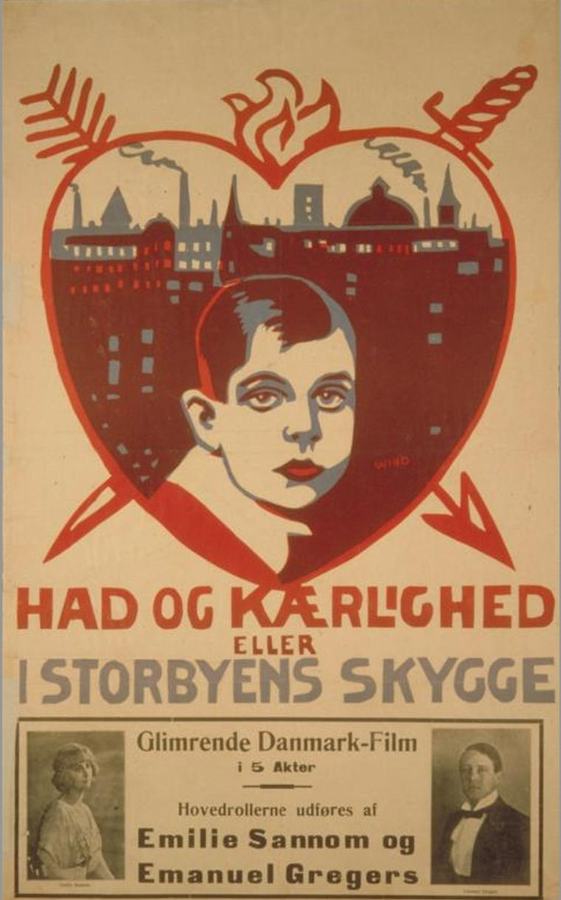
There is a moment—wordless, of course—when John Blixen’s hand, mottled like the back of an ancient toad, releases the armrest of his Baroque chair. The wood sighs; the hand stays frozen mid-air, as though even gravity hesitates to claim him. Director Emanuel Gregers lets the shot linger for three full seconds, an eternity in 1915 grammar, and in that pocket of suspended time the entire film pivots from domestic melodrama to something far more sulphurous: a premonition that property itself is a carnivore feeding on its guardians.
Danish silent cinema is littered with moral fables—Environment flayed the hypocrisy of temperance leagues, while Sowers and Reapers painted agrarian virtue in hues so saccharine they could rot molars. Had og Kærlighed (literally “Hatred and Love,” though the Danish word “had” drips with Old Norse venom) refuses such binary cosiness. Gregers, moonlighting from his usual matinée-idol roles, orchestrates a funeral march for patrilineal certainty, anticipating the corrosive genealogies of later Scandinavian auteurs without ever succumbing to the Lutheran moralism that hobbles The Life and Passion of Jesus Christ.
The film’s aesthetic DNA splices Dreyer’s later rectitude with a streak of Gothic expressionism. Interior scenes are drenched in tenebrous pools: candle nibs gutter against velvet drapes, carving out caverns of shadow where creditors whisper like carrion crows. Cinematographer Känitz Simonsen tilts furniture toward the lens, turning parlours into skewed confessionals. Exterior shots, by contrast, bask in overexposed noon—fields so white they feel X-rayed—so that every blade of grass becomes a fiscal ledger, every furrow a debt trench. The edit alternates these extremes without cushioning dissolves, creating a visual staccato that mirrors Ralph’s manic oscillation between spendthrift euphoria and claustrophobic dread.
Performance registers operate at a frequency modern viewers might misread as hamminess until you recalibrate to 1915 semaphore. Emilie Sannom, remembered today for her stunt-dives in A Rough Shod Fighter, here compresses her athleticism into stillness: eyes widening by micrometres, breath visible only in the tremor of a lace fichu. When she finally speaks the intertitle “Deres umyndige hjerte kender ikke sin egen ondskab” (“Your infant heart knows not its own wickedness”), the words detonate because her face has already confessed them three shots earlier. Opposite her, Peter S. Andersen’s Ralph is a study in foppish entropy—cravat skewed, pupils blown wide as if laudanum were the family sacrament. The moment he fondles a silver cigarette case engraved with the family crest, you sense he is weighing not nicotine but the aristocratic burden that tobacco might momentarily lighten.
Jonna Neiiendam, playing the spinster aunt who inventories every dust mote, supplies the film’s sly comic marrow. Watch how she fondles a cameo brooch whenever the conversation turns to solvency—an unconscious tell that turns the heirloom into a behavioural metronome. Bertel Krause, as the family solicitor whose smile never reaches the reticule of his eyes, embodies capitalism in a frock coat; his repeated adjustment of pince-nez becomes a capitalist pulse, ticking off compound interest with each metallic click.
The narrative skeleton feels Ibsen-adjacent yet veers into a psychoanalytic thicket that anticipates Strindberg’s ghost sonatas. Mid-film, Ralph experiences a fever dream staged with double-exposure: his father’s corpse sits up in the coffin, balances the estate keys on a desiccated tongue, then swallows them. The image lasts perhaps four seconds, but it inoculates the rest of the story with a surreal dread that no inheritance ledger can discharge. When Ralph awakens, the keys are real in his sweaty palm—an ancestral baton he never asked to carry.
Comparative contextualization proves illuminating. Where Hell’s Hinges channels its moral retribution through saloon shoot-outs and ecclesiastical infernos, Had og Kærligion weaponizes etiquette: a misplaced calling card, a soup tureen served cold, a banns announcement read aloud one Sunday too late. The violence is intestinal—inheritance law as slow-motion disembowelment. Likewise, while From the Valley of the Missing relies on abduction and last-minute rescues, Gregers denies us cathartic velocity; the pacing is deliberate as gangrene, each scene an incremental amputation of Ralph’s options.
The film’s intertitles deserve their own sonnet. Rather than mere expositional grout, they crackle with poetic atrophy: “Arv er en hånd, der kramper om sin egen hals” (“Inheritance is a hand that strangles its own throat”). The font—an elongated Art Nouveau serif—bleeds into the imagery so that text becomes tombstone engraving. Note how the negative space around the letters forms a silhouetted noose if you squint at 2 a.m., a detail I refuse to believe accidental.
Musical accompaniment in 1915 Copenhagen would have been supplied by a solitary pianist obliged to sight-read from a prompt script. Surviving cue sheets suggest a motif of Grieg-esque minor thirds segueing into discordant whole tones whenever the camera lingers on the estate’s iron gates. Restored screenings today often commission new scores; I recommend requesting a prepared piano—paperclips woven among strings to mimic the jangling of ancestral keys. The percussive rattle syncs uncannily with Ralph’s trembling hands.
Gender politics simmer beneath the brocade. The female servants circulate information like a clandestine postal service; knowledge is their only negotiable currency. When Sannom’s character ultimately betrays Ralph by revealing the hidden codicil, her motivation is less moral outrage than Darwinian self-insurance: she is pregnant, and the unborn must be collateralised before the estate’s insolvency metastasizes. In 1915, such pragmatic foeticide of patriarchal myth feels almost futuristic.
The final tableau—Ralph alone in the manor’s great hall, auctioneers measuring doorframes—echoes the last shot of The Pride of New York, yet where that film implies cyclical reinvention, Had og Kærlighed offers a cadaverous terminus. Snow drifts through a shattered skylight; Ralph extends his palm to catch a flake that never melts, an inverted stigmata. Fade to black without closing intertitle. The audience is abandoned inside the mausoleum, forced to exhume their own verdict on whether bloodlines are prisons or passports.
Restoration status: partial. Only two nitrate prints survive—one at the Danish Film Institute, another in a private Berlin archive. The latter contains a 40-second segment excised from domestic release, presumably for implying incestuous subtext between Ralph and his cousin Nathalie Krause. Digital 4K scans reveal hairline scratches across reel three that resemble lightning bolts, a poetic scar the archivists wisely chose not to digitally erase. Seek out the DFI’s 2018 Blu-ray; its sepia grading hews closer to original tinting notes discovered in Gregers’s personal papers.
Critical reception in its day oscillated between moral panic and grudging reverie. The conservative daily Nationaltidende condemned the film for “ungodly preoccupation with lucre,” while the avant-garde journal Klingen celebrated its “cinematic autopsy of bourgeois decay.” Overseas, the New York Mirror dismissed it as “another glum Scandinavian sermon,” proving that American critics have always confused introspection with miserabilism.
Legacy tentacles reach into unexpected crevices. Carl Theodor Dreyer cited Had og Kærlighed as formative when storyboarding Leaves from Satan’s Book; observe how both films hinge on a patriarch’s death triggering moral freefall. More recently, Thomas Vinterberg’s The Celebration borrows the dining-room-as-battlefield choreography. Even television juggernaut Succession owes Ralph Blixen a debt: the feckless heir whose cruelty is rooted in existential smallness.
Viewing recommendations: schedule at twilight, curtains drawn, phone exiled to another room. Pour a glass of chilled akvavit; let the caraway bite echo the film’s astringency. Keep a notebook handy—though the film predates Freud’s Beyond the Pleasure Principle by three years, you will find yourself scribbling phrases like “death drive commodified” and “inheritance as Thanatos venture capitalism.”
In the pantheon of silent Nordic cinema, Had og Kærlighed occupies a liminal alcove: too austere for fans of Cheerful Givers, too morally corrosive for devotees of The Sentimental Lady. Yet its bruised majesty lingers like peat smoke in wool. Long after the auctioneer’s gavel fades, you will find yourself listening for the clink of nonexistent keys, wondering which heirlooms in your own life are already counting down to their liquidation.
Verdict: essential. Not as historical curiosity, but as living tissue—an unquiet testament that land and blood are merely differing states of debt. Let it in, and you may never again walk through an ancestral doorway without hearing the hinges ask for interest.
IMDb 6.4
1932
Community
Log in to comment.