DbcultAccessing Vault...
Cult Review
Senior Film Conservator
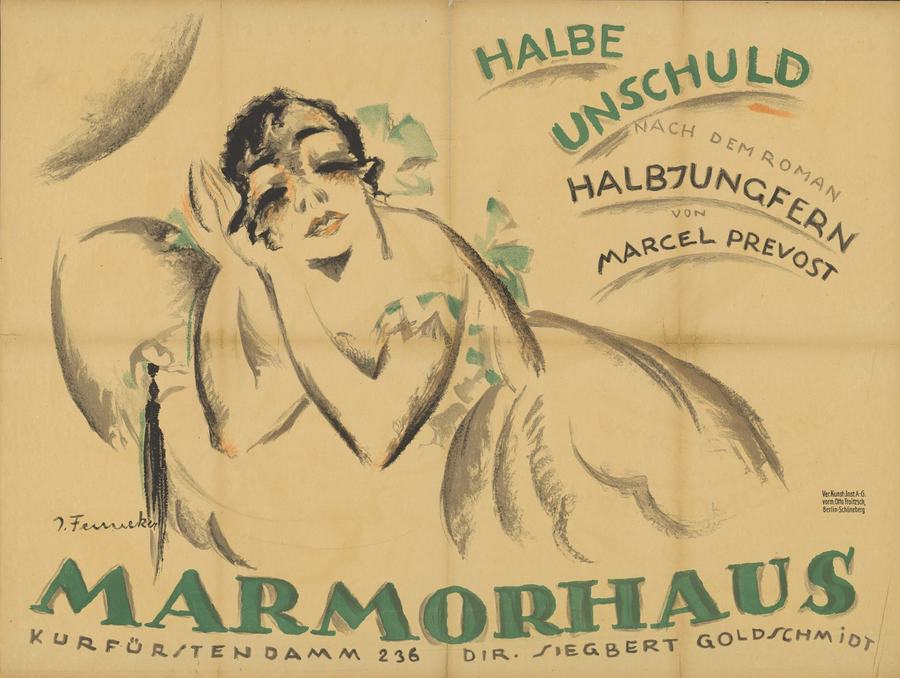
There are films you watch and films that watch you—Halbe Unschuld belongs to the latter caste, a mercury-silvered mirror thrust so close to the face that every viewer breathes upon it, fogging the guilt. Director Adolf Trotz, working from Marcel Prévost’s scandalous 1907 novella, orchestrates a visual sonata of half-tones: lamplight buttering the Biedermeier wainscoting, then guttering into bruise-colored dusk; lace curtains inhaling like lungs when a door slams off-screen. The camera glides at waist height, adopting a conspiratorial child’s POV, so that adult legs—starched trousers, silk stockings—loom like colonnades of an alien city. From the first frame you sense the coming catastrophe not through plot signposts but through the way wallpaper roses seem to perspire.
Weimar cinema loved its prostitutes and vamps; Trotz instead fetishizes repression itself. Note the palette: bone-white, tobacco-brown, absinthe-green—colors that bruise rather than bloom. When Rita and Dora first share the frame, the set dresser scatters marigolds on the table, yet the flowers are out of focus; sharpness is reserved for the needle that Rita slips through linen, a metronome of pent-up energy. Listen to the soundscape: no score, only the hush of a pendulum clock amplified until it resembles a heartbeat, then overlaid with the faint squelch of fingertips on damp fabric. The effect is uncanny—you feel the humidity of forbidden contact before it happens.
Lotte Schüler, barely sixteen during shooting, gives a masterclass in porous innocence. Watch her pupils dilate when Rita lets a tape-measure snap back against her own thigh—an involuntary spasm of curiosity that quickly retreats into the etiquette of the bourgeois drawing-room. Schüler’s voice has the brittle clarity of Bohemian crystal: it rings, then threatens to fracture. Opposite her, Marie Lenz maneuvers Rita like a slow-blooming orchid hiding a wasp inside. She never telegraphs predation; instead she offers tiny gifts—a pressed violet, a French phrasebook—each wrapped in the tissue paper of plausible deniability. When the law finally slams its gavel, Lenz’s face collapses into a smile so wan it could be a spasm of indigestion. Guilt, the film insists, is never a monolith but a constellation of micro-expressions.
The trial sequence, twelve merciless minutes, prefigures Lang’s M in its fevered montage but swaps Expressionist angles for the clinical glare of a surgical theater. Prosecutor Herr von Kahlenberg, a walrus-mustached pedant, brandishes Dora’s blood-spotted handkerchief as if it were the Shroud of Turin; defense counsel Frau Löwenfeld, one of early cinema’s rare female lawyers, counters with a hymnal annotated by Dora’s governess—“She sings like a lark, Your Honor, larks are not known for carnality.” Trotz cross-cuts to the public gallery where bourgeois wives fan themselves with indictment pages, their tongues darting like lizards tasting scandal. The camera tilts up to a skylight: outside, a Zeppelin drifts, a colossal silver phallus mocking the pretense of moral adjudication.
Scholars still quarrel over whether the film is a cautionary tale, a lesbian melodrama, or a proto-feminist exposé of patriarchal jurisprudence. The truth is that Halbe Unschuld occupies a chronotope—Bakhtin’s term for time-space—of its own. The boarding-school cloisters, the seamstress’s garret, the spinning-mill in exile: each locale is a petri dish where same-sex desire is incubated under bell-jar oppression. Contrast this with Unge hjerter, the Norwegian youth-picaresque where boys’ erotic fumbling unfurls under wide Nordic skies, or with The Ghost Flower’s Californian Art-Nouveau liberation. Trotz’s Vienna refuses catharsis; it offers only the perpetual half-light of guilt, hence the title’s untranslatable nuance: not innocence betrayed but innocence halved, shared like a forbidden apple bitten by both Eve and the Serpent.
Cinephiles will spot DNA strands linking this 1929 curio to later landmarks: the claustrophobic lodger rooms of Poor Schmaltz, the panicked religiosity of The Volunteer, even the adolescent militarism of Boy Scouts to the Rescue where innocence is weaponized rather than criminalized. Yet Trotz’s film is more radical because it withholds the comforts of genre: no suicide on the courtroom steps, no last-minute rescue by a benevolent uncle. Instead the ending folds back upon itself like a Möbius strip: Rita, exiled yet alive, sends Dora a postcard depicting the very cloister where the girl is now imprisoned. The postcard arrives blank; censorship by timidity. We last see Dora pressing the card against the grille of a cloister window, moonlight turning the paper translucent so that the convent’s own stone silhouette shows through—an image of captivity superimposed upon captivity, infinite regress of half-guilt.
The 2023 4K restoration by the Austrian Film Museum rinsed the print of decades of nicotine and ideological grime, revealing the original tinting: tobacco-amber for interiors, chlorine-green for the courthouse, cobalt for the cloister. Suddenly the film feels not like an archival relic but a live wire. In an era when politicians again police adolescent bodies and queer identities, Halbe Unschuld speaks in tongues of warning. Note how the hypocritical fathers—bankers, magistrates—never receive comeuppance; Trotz knew that structural power does not topple within a three-reel morality play. Instead he leaves us with a challenge: to recognize ourselves in the half-guilt, to admit that we still partake in the voyeurism of the courtroom gallery, the gossip of the sewing circle, the hush that follows any declaration of deviant love.
Great art refuses to answer the questions it poses; it re-etches them on the viewer’s retina. After the lights come up you will find yourself measuring your own memories against the film’s merciless caliper: Whose affection did you once betray with silence? Whose adolescence did you police under the guise of protection? Halbe Unschuld offers no absolution, only the bitter clarity of a mirror wiped with vinegar. Watch it alone, late, preferably while rain freckles the window. When the final iris-in closes like an exhausted eye, you will taste iron in your throat—the flavor of your own half-guilt, bitten through at last.
Verdict: A devastating Weimar jewel that queers the coming-of-age template and indicts every spectator who ever whispered “scandal.” Essential, unsettling, immortal.
IMDb 7
1932
Community
Log in to comment.