DbcultAccessing Vault...
Cult Review
Senior Film Conservator
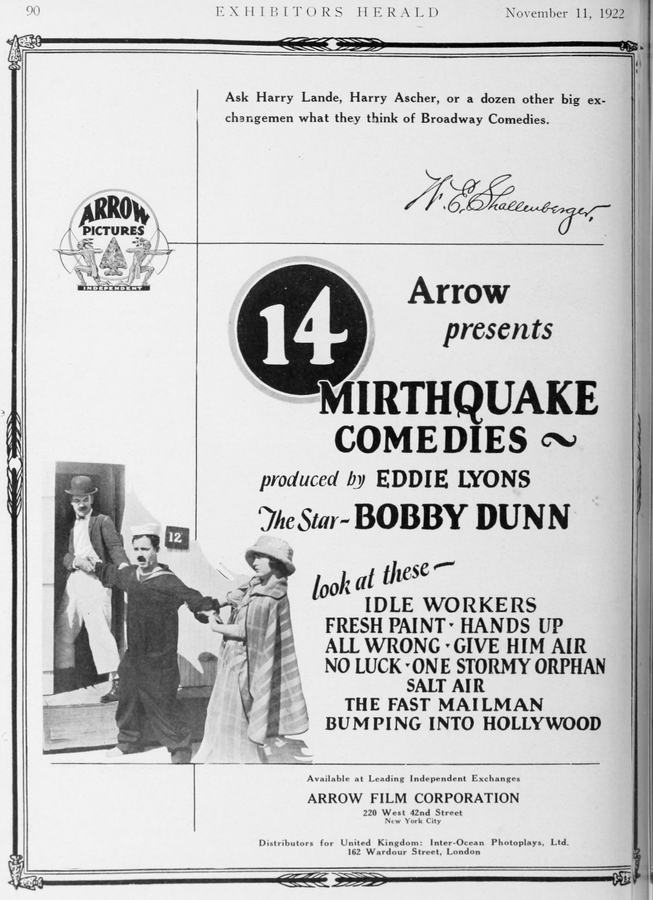
Vincent Bryan’s Hands Up (1922) is a cinematic relic that thrives on contradiction—a film titled for tranquility yet steeped in turbulence, its characters cloaked in paradox. Set in the illusory paradise of Angels' Rest, the narrative unfolds as a series of collisions between myth and reality, with Bobby Dunn (the titular figure) serving as both protagonist and pawn in a game of survival. Bryan, a director known for his economical yet evocative storytelling, crafts a world where the line between heroism and opportunism is perilously thin, and where the townsfolk’s desperation to believe in a savior mirrors their own complicity in their town’s decay.
At the heart of Hands Up lies the tension between Bobby’s outsider status and the community’s need to mythologize him. Arriving by train, he is an anomaly in a town that has long since surrendered its innocence to the shadow of Black Wolf, a gang leader whose presence is as much a legend as the $10,000 bounty on his head. Bryan’s decision to award Bobby a badge after a botched capture is a masterstroke of narrative irony—a gesture that underscores the town’s willingness to conflate perception with truth. This badge, a symbol of authority, becomes a burden as much as it is a reward, forcing Bobby into a role he neither sought nor earned.
The film’s most compelling dynamic is its exploration of duality, both in character and setting. Angels’ Rest is a town of contradictions: its name a cruel joke that hints at the ceaseless upward climb of its inhabitants toward survival. The gang confrontations, staged with a starkness that prefigures later Westerns like Loyalty, are less about action and more about the erosion of trust. Black Wolf’s gang and their rivals are not mere adversaries but existential threats that expose the fragility of the town’s social order. Bryan shoots these scenes with a static camera, forcing the audience to linger on the faces of those who watch, complicit, as violence consumes the streets.
Black Wolf himself is a figure of fascination—a villain who embodies the chaos the town both fears and craves. His repeated jailbreaks are not just plot devices but a recurring motif that mirrors the town’s cyclical descent into disorder. The dynamite sequence, where Bobby narrowly avoids death, is a turning point that strips away any illusion of control. Bryan frames this moment with a claustrophobic tightness, the explosion’s shockwaves reverberating through the town’s collective psyche. When Black Wolf finally hangs Bobby from a tree, the scene is less a confrontation than a reckoning, a physical manifestation of the weight Bobby has carried since arriving.
The love story with the village beauty is handled with a delicacy that contrasts sharply with the film’s brutality. Her role as both muse and savior is not played for sentimentality; instead, Bryan positions her as a symbol of the town’s last vestige of hope. The moment she shoots the rope that suspends Bobby is a crescendo of agency, a refusal to let the narrative be dictated by external forces. This act, though brief, is the film’s emotional core—a reminder that even in a world of lies and violence, human connection can be a form of resistance.
Comparisons to Bryan’s other works are inevitable. Hands Up shares thematic DNA with The Typhoon in its depiction of communities under siege, though Bryan’s earlier film leans into natural disasters while this one opts for human-made chaos. The character arcs here feel more constrained than in Prima Vera, where emotional depth was more central, but Bryan compensates with a taut, almost claustrophobic pacing. The film’s black-and-white palette, though rudimentary by today’s standards, enhances its mood, casting Angels’ Rest in a perpetual twilight where moral ambiguity reigns.
What elevates Hands Up beyond its genre conventions is its nuanced critique of heroism. Bobby’s journey is not one of triumph but of disillusionment. The badge he wears becomes a shackle, a constant reminder of the burden of expectation. This is a film that resists tidy resolutions; even the final act of the beauty’s rescue is tinged with ambiguity. Is she saving Bobby, or is she reinforcing the narrative he has been forced to inhabit? Bryan leaves such questions unanswered, trusting the audience to grapple with the film’s moral complexity.
The technical execution of Hands Up is a testament to Bryan’s craftsmanship. The editing, though brisk by modern standards, is deliberate, each cut a step in the tightening web of tension. The use of dynamite as both a literal and metaphorical device—its explosive power a metaphor for the town’s latent volatility—is handled with stark visual economy. The final scene, where Bobby collapses into the beauty’s arms, is a masterclass in understatement. Bryan allows the shot to linger, the silence between them speaking volumes about the cost of survival.
In the broader context of early 20th-century cinema, Hands Up occupies a unique space. It is neither a silent film epic like The Last Days of Pompeii nor a romantic interlude like Un Romance Argentino, but something in between—a genre piece with literary aspirations. Its influence can be seen in later Westerns that embraced moral ambiguity, though Bryan’s approach is more restrained, favoring suggestion over overt symbolism.
For modern audiences, Hands Up offers a glimpse into the evolving language of film. Its exploration of identity and power dynamics anticipates themes that would dominate 1950s and ‘60s Westerns, yet Bryan’s execution is firmly rooted in the era’s limitations and strengths. The film’s brevity—clocking in under an hour—serves it well, with no scene lingering past its due. Each frame feels purposeful, contributing to a narrative that is as much about atmosphere as it is about action.
In conclusion, Hands Up is a film that rewards close attention. Its layered narrative and thematic richness make it more than a simple Western, and its exploration of heroism’s duality remains relevant. While it may lack the spectacle of No Trespassing or the emotional intensity of The Girl Who Dared, it carves out its own niche in the annals of early cinema. For those willing to embrace its quiet intensity, Hands Up is a rewarding experience—a film that understands that the truest conflicts are not always the loudest.
IMDb 5.3
1926
Community
Log in to comment.