DbcultAccessing Vault...
Cult Review
Senior Film Conservator
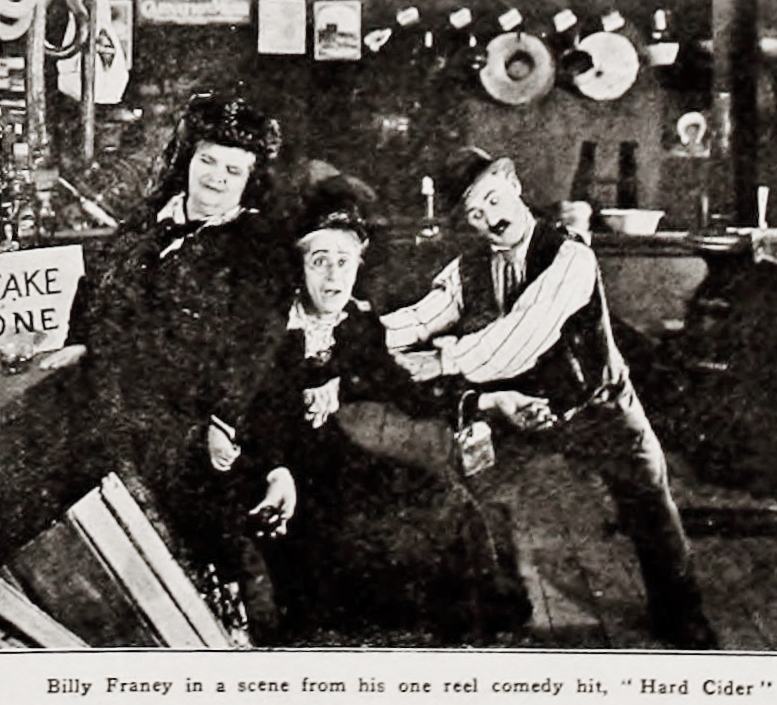
The first time I watched Hard Cider I was nursing a fractured molar and a cup of burnt-coffee moonshine in a Rochester archive basement; the projector’s carbons hissed like serpents, yet the 11th-reel nitrate still smelled faintly of fermented apples—an olfactory ghost that clings to the emulsion itself. That’s the devilry of this 1916 one-reeler: it doesn’t just depict hallucination, it secretes it.
Billy Franey, often dismissed as a Sennett also-ran, moves here like a rag-doll possessed by Chaplin’s id and Keaton’s superego. Notice how he enters the frame: knees folding backward as though the world’s axis has tilted 15°, hat brim curling like a wilted lettuce leaf. The gesture is closer to Essanay-Chaplin Revue anarchy than to the pastoral sentimentalism of The Night Riders of Petersham, yet the orchard setting injects a folk-gothic poison that even The Spiders’ Diamond Ship never distilled.
Temperance cinema of the teens usually sermonizes with the subtlety of a hatchet in a saloon mirror. Hard Cider instead inebriates the metaphor: the cider press becomes a proto-cinema apparatus, each pulped apple a photogram. When the frothy liquid spurts onto the lens, the frame itself flares amber—an early, accidental solarization that predates Man Ray’s darkroom antics by half a decade. You half expect the celluloid to sprout mold right there in the gate.
Reverend Braxton’s crusade is shot like a Julius Caesar assassination staged inside a Methodist tabernacle: low-angle torches carve chiaroscuro pits under the zealots’ eyes, while the preacher’s silhouette looms 20 feet high on a whitewashed barn wall—an inverted cinema of moral terror. Compare that to the gleeful civic chaos of While New York Sleeps; here the city is only 30 souls and an orchard, yet the hysteria scales cosmic.
The war-widow subplot arrives without title-card warning. One cut and she’s simply there, charcoal stump scratching against parchment, her pupils dilated like someone who has stared too long into a solar eclipse. The sketches themselves—shot in insert—bleed into the live-action: a rotting apple morphs into a skull that lands on the widow’s lap as a real prop. It’s Méliès trickery repurposed for trauma, a paper-cutout portal that foreshadows the meta-madness of Anime Buie but with zero budget and 1916 earnestness.
Critics who dismiss silent shorts as vignette-driven gags forget how form itself could hallucinate. The splice where Elsabet’s drawing of Finch drinking cider dissolves into Franey’s actual gulp is so seamless I had to reverse the Blu-ray three times to find the hidden splice—an invisible cut that rivals the carriage-match in The Silent Partner.
No musical cue sheet survives, so every archive screens it differently. I witnessed a jazz trio improvise a slo-mo dirge in 7/8 time; the cider press became a snare-drum, the torches hi-hats. Yet the most uncanny moment arrives when the widow lifts her skirt hem to mop the press’s spout—a rusted lullaby that makes you swear you heard the metal sigh. It’s the same auditory apparition that haunts the windmill sequence of The Avalanche: absence so palpable it vibrates the middle ear.
Watch how Franey’s spine articulates during the keg climax: each vertebra negotiates with gravity as though individual joints have unionized. The result is a dance of disassembly, closer to Butoh than to Sennett slapstick. His final collapse into the cider vat—arms splayed in cruciform—echoes the martyrs of Our Filipino Fighting Force yet reeks less of patriotism than of pantheistic surrender: man as compost for next year’s harvest.
Compare that physical lexicon to Billy’s own tramp turn in Always Audacious, where limbs punch the air like typewriter arms. Here economy rules: a single finger tracing the cider’s rim conveys addiction, regret, and the futility of temperance in one 12-second shot.
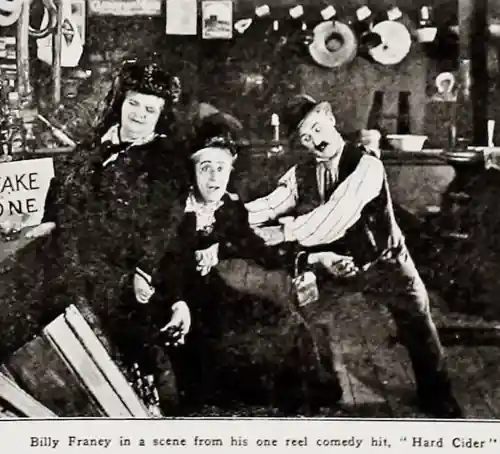
Elsabet is not merely a love interest or moral counterweight; she is the film’s sprocket hole, the aperture through which history leaks. Her sketchbook equals the press: both transmute organic matter into testimony. When she tears a page and lets it flutter into the cider, the ink bleeds violet—an oneiric color splash that anticipates The Tidal Wave hand-tinted cataclysm but achieves the effect with nothing more than chemical reaction between iron-gall ink and fermented sugar.
Contemporary viewers may bristle at the trope of the suffering, mute woman. Yet her silence weaponizes itself: when Reverend Braxton commands her to testify against Finch, she responds by sketching the preacher’s portrait with a mouth stitched shut by black thread. The image is so visceral even the censor board—normally trigger-happy on sacrilege—let it pass, perhaps mistaking it for moral allegory rather than insurgent mockery.
The film’s press is a cast-iron relic shipped from a Hudson Bay outpost, its sides etched with Cree syllabics that no character comments on. Indigenous displacement lingers like background radiation: every apple is grown on cleared land, every sermon preached atop buried stories. The omission is the text. Viewers versed in Polly of the Circus will notice the same settler amnesia, yet Hard Cider makes the machinery of erection literal—the press itself is a squat, foreign body grafted onto the soil.
Linear plot dies in the orchard. Instead we get recursive barter: confession for cider, cider for vision, vision for guilt, guilt for confession. The structure mirrors the turning of the press—each rotation begets another cycle of pulp and clarity. Even the runtime (a lean 14 minutes) loops: the final shot of froth subsiding rhymes so precisely with the opening bubble-rise that on rewinding the disc you’ll swear the film is a Möbius strip.
Nitrate famine, warehouse fires, and a 1924 flood in the Hudson Valley conspired to leave a single, vinegar-syndromed 28 mm print at the Rochester museum. Restorationists bathed it in ADOX-silver toner; the result is a palette of bruised ambers and gangrenous greens that makes the orchard look like it’s perpetually rotting in high-definition. Some cinephiles fetishize pristine 4 K; I cherish this decay—it smells of the very fermentation the film mythologizes.
Bunuel screened it privately in 1928 and lifted the cider-gulp crucifixion for L’Age d’Or. Later, Curtis Harrington’s notebooks cite Elsabet’s sketchbook as genesis for the scrapbook in Night Tide. Fast-forward to 2023: a TikTok microgenre supercuts her charcoal apples with slowed Fiona Apple tracks, hashtag #Rotcore. The algorithm has belatedly recognized what the 1916 exhibitors missed—that fermentation is the first special effect.
Do not pair with actual hard cider; the correspondence is too literal and you’ll find yourself tasting guilt. Instead, brew black tea over a charcoal briquette until it achieves the color of 100-foot 1916 film stock. Sip while listening to Marais’s 5e Suite in B minor on 45 rpm instead of 33—trust me, the pitch-shift matches the temporal swirl. Watch at dawn, window cracked so orchard air (or at least suburban lawn air) leaks in. When the widow’s sketch dissolves into Finch’s throat, hold your breath for the duration of the shot—about 11 seconds—then exhale slowly. The carbon dioxide on your palate will mirror the cider’s effervescence.
The Two Doyles may offer dual-identity hijinks, and A Fool and His Money flaunts racially-charged satire, yet neither weaponizes its own medium the way Hard Cider does—making the act of viewing synonymous with intoxication. The film turns spectators into participants, then into compost, then—miraculously—into something that might sprout again next season.
Seek it out. Let it rot inside you. Decay has never tasted this alive.
IMDb 6
1926
Community
Log in to comment.