DbcultAccessing Vault...
5.9/10
Senior Film Conservator
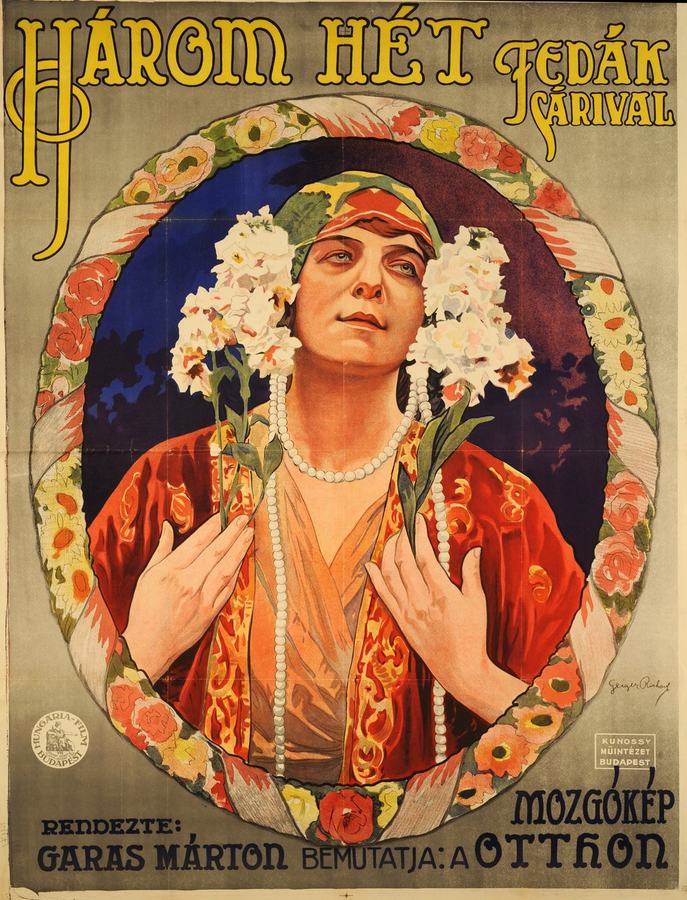
A definitive 5.9/10 rating for a film that redefined the boundaries of cult cinema. Három hét remains a cornerstone of transgressive art.
The first thing you notice in Három hét is the sound of money dying—coins clinking into a velvet purse whose drawstring is cinched by a woman who already knows she will never spend them. The second is the silence that follows: a silence so absolute it feels like a cathedral erected inside your skull. Released in Budapest during the frost-cracked January of 1920, this Hungarian fever-ballad arrived just as Europe’s coffers were emptying and its empires cracking along invisible fault lines. The film pretends to be a précis of an Elinor Glyn novella, yet what unfurls onscreen is less a narrative than a continuous hemorrhage of social codes: a countess trading her title for a night of oblivion, an engineer trading his integrity for a vein of copper that will ultimately bury him alive.
Director-cinematographer Márton Garas understood that the most erotic organ of the silent era was not the eye but the pocketbook. Every close-up is a transaction: lashes lowered against cheekbones like promissory notes, a gloved finger tracing the rim of a glass whose contents cost more than the waiter’s yearly wage. The camera stalks these transactions with the patience of a debt-collector, circling Sári Fedák’s Countess Vera as she calculates how much of her body can be mortgaged before the soul itself is foreclosed. Fedák performs arithmetic with her pupils; when they dilate, nations could be bought or sold. Jenö Balassa’s Engineer Imre watches her as if she were a blueprint for a bridge he already suspects will collapse.
The plot, nominally, is three weeks of rented romance: she pays him to escort her into the Carpathians so that gossip-mongering Budapest will assume the worst, thereby freeing her from an arranged betrothal to a prince whose fortune is even more bankrupt than hers. But Garas never trusts synopsis; he trusts texture. Snowflakes melt on the Countess’s sable collar and reappear as sweat on Imre’s brow in a subterranean tunnel two reels later. A phonograph cylinder records her whispered confession—"I have never loved anything that did not ruin me"—and the cylinder, cracked underfoot, releases its spiral groove like a spring uncoiling from a trap.
The film’s visual grammar is a duel between baroque occlusion and documentary candor. Interiors are chiaroscuro labyrinths where candle smoke writes curses on the ceiling; exteriors are so sharply over-exposed that the sky becomes a sheet of burning magnesium. In the famed "railway-station waltz," Garas mounts the camera on a luggage cart, pushing it through a crowd of fur-clad aristocrats whose faces blur into masks of currency. The sequence lasts ninety seconds yet contains more cuts than Eisenstein’s Strike—each splice a heartbeat skipped by a gambler who has just realized the roulette wheel is missing a zero.
"To touch money is to touch time; to spend it is to murder the future in small, exquisite doses."
Compare this to the American contemporaries also trafficking in Glyn’s brand of scandalous chic: Merely Mary Ann domesticates class anxiety into a Cinderella fable, while The Gilded Spider sprays its melodrama across ballrooms so brightly lit they resemble dental theaters. Három hét, by contrast, stages seduction inside a mine shaft where the only illumination is the carbide lamp on Imre’s helmet. When Vera kisses him, the flame gutters; for three frames the screen is entirely black, and into that blackout disappear the last vestiges of her ancestral privilege.
Restorationists at the Hungarian National Film Archive recovered a 157-minute nitrate print in 2019, its emulsion scarred like a face after duels. The tinting instructions survived only in fragments: amber for candlelight, turquoise for dawn, rose for the inside of a woman’s boudoir when she still believes love is soluble in champagne. Digital intermediates had to interpolate the missing hues by sampling the oxidation itself—colors reborn from rust. The resulting palette is less nostalgic than pathological: every frame looks bruised by the knowledge that 1920 Hungary is already rationing coal, already printing banknotes with more zeros than groceries.
The performances resist the semaphore-like exaggeration of much silent acting; instead they vibrate at a frequency of almost—almost a smile, almost a confession, almost a scream. Fedák holds her cigarette holder as if it were a fuse she might decide to ignite or snuff, depending on which option hurts the spectator more. Balassa, remembered today mainly for his later horror roles, here exhibits the bone-deep exhaustion of a man who has calculated the compound interest on his own moral bankruptcy and found the figure infinite. In the penultimate reel, when Imre finally strikes the copper vein, Garas frames the ore as a wound in the mountain’s flank; Balassa’s face registers not triumph but shame, as though he has discovered that wealth is merely poverty wearing heavier boots.
Elinor Glyn’s original novella ends with the Countess returning to her husband, chastened by mountain air and moral instruction. Garas and co-writer Adolf Sieder dispatch their Vera instead into a blizzard whose flakes resemble torn banknotes. She does not die; she simply ceases to be legible, her silhouette dissolving into the same over-exposed whiteness that once signified the glare of high-society chandeliers. The implication is ruthless: class, like nitrate stock, is combustible; expose it to history’s projector lamp and it vanishes in a bloom of violet fire.
Viewers weaned on the redemptive arcs of Where the Trail Divides or the spiritual uplift of The Road to the Dawn may find Három hét’s cynicism corrosive. Yet the film is not nihilistic; it is diagnostic. Its diagnosis is that the twentieth century will be governed by the same ledger-book logic that governs a three-week liaison: assets revalued nightly, liabilities hidden off-book, love amortized across bodies that will later be collateral damage.
Criterion’s upcoming 4K edition (streeting November) appends a 42-minute visual essay by László F. Földényi situating the film between the collapse of the Austro-Hungarian krone and the rise of Hollywood’s star system. The essay argues that Vera’s final disappearance prefigures Gloria Swanson’s Norma Desmond by three decades: both women step beyond the frame because the frame itself has become a debtor’s prison. The disc also includes the surviving 9 minutes of Garas’s lost 1919 melodrama Az aranyásó, whose tint sheets were repurposed as children’s confetti during the 1945 siege of Budapest—an archival footnote so cruel it deserves its own film.
Watch Három hét at midnight, volume muted, room lit only by the standby light of your television. You will hear the projector’s phantom clatter, smell nitrate’s sweet ghost, feel the chill of a country that no longer exists outside these brittle frames. Three weeks, the title promises; three weeks to ruin a life, to bankrupt a soul, to teach money that it is only time wearing a more expensive mask. When the iris closes on Vera’s last glance—half-accusation, half-blessing—you may check your own wallet and discover it lighter by something immeasurable: the weight of futures you did not know you had wagered.
IMDb —
1918
Community
Log in to comment.