DbcultAccessing Vault...
Cult Review
Senior Film Conservator
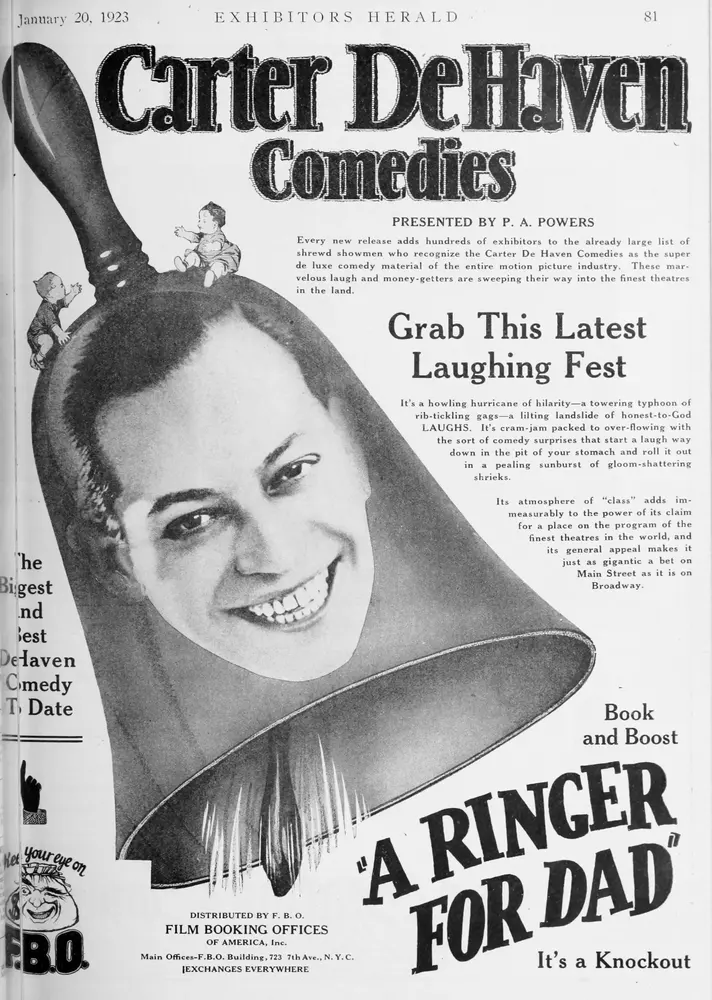
In the pantheon of silent-era comedic duos, few possessed the rhythmic synchronicity of Carter and Flora Parker DeHaven. Their 1916 effort, A Ringer for Dad, stands as a testament to an era where the nuance of a raised eyebrow or the frantic pacing across a parlor floor conveyed more than a thousand lines of dialogue ever could. While many contemporaries were leaning into the heavy-handed melodrama found in works like Within the Cup, the DeHavens were perfecting the art of the light-hearted domestic stratagem.
The plot of A Ringer for Dad is deceptively simple, yet it functions with the precision of a Swiss timepiece. The narrative centers on a daughter’s audacious decision to hire a stand-in for her father, a premise that invites a deconstruction of the patriarchal figure. Unlike the somber exploration of family duty seen in The Turn of the Road, this film treats the father-figure as a modular entity, something to be swapped, replaced, and performed. This subversion of the traditional household hierarchy provides the engine for the film's most successful comedic sequences.
Ethel Foreman and Monte Brice, the architects of the screenplay, demonstrate a profound understanding of situational irony. Their collaboration here is reminiscent of the witty scenarios found in The Other Girl, yet it maintains a distinct focus on the absurdity of social expectations. The 'ringer' is not just a body in a chair; he is a catalyst for chaos. As the imposter attempts to navigate the minefield of familial history and personal quirks, the tension between the known and the fabricated creates a delightful friction that sustains the film’s brief runtime.
Flora Parker DeHaven is the true standout here, displaying a range of facial expressions that oscillate between sheer panic and calculating brilliance. Her performance is far more grounded than the histrionics often associated with the period, offering a modern sensibility that feels remarkably fresh. In many ways, her screen presence mirrors the charm found in Her New York, yet she possesses a sharper, more satirical edge. Carter DeHaven, playing the foil with his usual aplomb, complements her energy perfectly, ensuring that the physical comedy never descends into mere buffoonery.
The film’s direction utilizes the limited interior sets to emphasize the claustrophobia of the lie. The camera remains mostly static—a hallmark of the time—but the blocking is dynamic. Characters dart in and out of frames, creating a sense of frantic movement that mirrors the protagonist’s internal state. It is this mastery of the frame that separates A Ringer for Dad from more static productions like Niobe. There is a palpable sense of stakes, however low they may be in the grand scheme of cinema, because the actors treat the deception with life-or-death intensity.
To fully appreciate A Ringer for Dad, one must look at the broader cinematic landscape of 1916. While European cinema was experimenting with darker, more existential themes—exemplified by the haunting Homunculus, 2. Teil - Das geheimnisvolle Buch—American shorts were doubling down on the relatability of the middle-class experience. Even when exploring social issues, as seen in Our Leading Citizen, the American style tended toward a certain optimism or, at the very least, a belief that any problem could be solved with enough ingenuity and a bit of luck.
The film also avoids the more overt theatricality of Shadows of the Moulin Rouge, opting instead for a domestic intimacy. It shares a certain DNA with the light-hearted mystery of A Lady Bell Hop's Secret, where the humor is derived from characters operating out of their depth. This 'fish out of water' trope is executed with surgical precision in the scenes where the ringer must interact with those who supposedly know him best. The resulting dramatic irony is the film’s greatest asset, inviting the audience to become co-conspirators in the daughter’s scheme.
Monte Brice’s influence on the script cannot be overstated. Known for his later work with some of the biggest names in comedy, his early contributions here show a nascent genius for the 'slow burn' gag. The way the ringer is introduced, the subtle clues that he isn't who he says he is, and the eventual collision of truth and fiction are all handled with a sophistication that belies the film's age. It lacks the sentimentality of The Locked Heart, choosing instead to lean into the absurdity of the situation.
Furthermore, the film’s pacing is relentless. In an era where some features like On the Fighting Line or the Finnish Salainen perintömääräys could feel bogged down by their respective agendas, A Ringer for Dad remains light on its feet. It doesn't overstay its welcome, nor does it attempt to be anything other than a high-quality diversion. The inclusion of technological anxieties, perhaps slightly less overt than in The Wireless Wire-Walkers, still points to a world in transition, where the old ways of verifying identity are being challenged by the speed of modern life.
Looking back at A Ringer for Dad from a modern perspective, it is easy to see how it paved the way for the sitcom structures of the 1950s and beyond. The 'fake relative' trope has become a staple of television, but seeing its early iteration here is a fascinating exercise in media archaeology. It lacks the grotesque caricatures often found in Uncle Tom's Caboose, opting instead for a more sophisticated, if still broad, comedic palette. The film also avoids the somewhat repetitive slapstick of The Night of the Dub, focusing more on the psychological tension of the ruse.
Ultimately, A Ringer for Dad is a sparkling reminder of the DeHavens' contribution to the art of the short film. It is a work that values cleverness over cruelty and performance over spectacle. While it may not have the philosophical weight of the era’s grandest dramas, it possesses a structural integrity and a comedic soul that many of its more 'serious' contemporaries lack. For those interested in the evolution of American humor, it remains an essential piece of the puzzle—a vibrant, flickering window into a world where a daughter’s wit was the ultimate currency.
In conclusion, the film succeeds because it understands its own limitations. It doesn't reach for the stars; it reaches for the funny bone, and in doing so, it hits its mark with unerring accuracy. The collaboration between Foreman, Brice, and the DeHavens resulted in a piece of entertainment that is as resilient as the ruse at its center. It is a charming, albeit chaotic, exploration of the lengths we go to for social survival, and it remains a highlight of 1916's cinematic output.
IMDb 5.5
1935
Community
Log in to comment.