DbcultAccessing Vault...
Cult Review
Senior Film Conservator
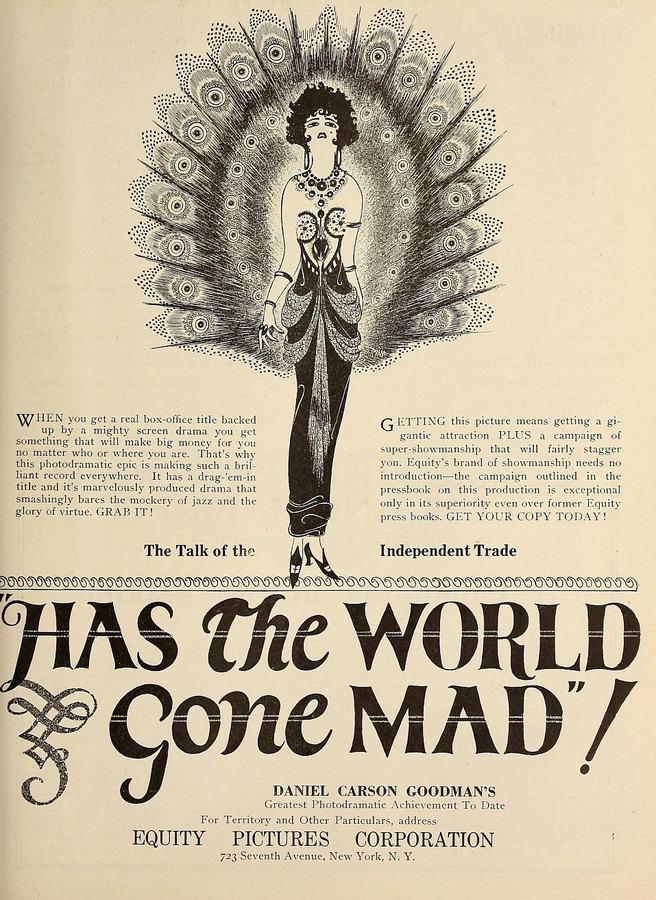
When the title Has the World Gone Mad! flashes across the intertitle cards, the audience is instantly thrust into a moral tableau that feels both of its time and oddly prescient. The film, a 1926 melodrama penned by Daniel Carson Goodman, navigates the turbulence of generational conflict, the intoxicating allure of modernity, and the fragile architecture of familial loyalty.
The plot unfurls with a deliberate slowness, allowing each character’s internal landscape to breathe. Mrs. Adams (Hedda Hopper) embodies the archetype of the dignified matriarch, yet Goodman injects a subversive streak by granting her a secret yearning for the jazz-infused freedom that defines the Roaring Twenties. Her decision to relocate to a modest apartment—an act that, in a silent film, must be conveyed through gestures, set design, and the rhythmic accompaniment of the theater orchestra—signifies a rupture from the domestic sphere that once defined her identity.
The affair with Mr. Bell (Charles Richman) is not merely a scandalous subplot; it functions as a catalyst that exposes the brittle veneer of propriety. Miss Bell (Elinor Fair), the daughter of the lover, becomes the inadvertent detective, her discovery of the clandestine meetings serving as the narrative fulcrum. The film’s climax—Mrs. Adams’ realization of the anguish she has wrought and her subsequent quest for reconciliation—mirrors the classic moral restitution structure found in contemporaneous works such as The Leavenworth Case and Puritan Passions.
Hedda Hopper, better known to later generations as a gossip columnist, delivers a performance that is simultaneously restrained and electrifying. Her eyes, widened just enough to betray curiosity, convey the intoxicating pull of the jazz age without a single spoken word. Hopper’s physicality—her measured steps across the apartment’s parquet, the lingering touch on a cigarette holder—creates a visual lexicon that speaks louder than dialogue.
Charles Richman, as the tormented Mr. Bell, balances the role of respectable patriarch with a simmering undercurrent of desire. His gestures are measured; a hand placed gently on Mrs. Adams’ shoulder during a secretive meeting suggests both comfort and complicity. Elinor Fair’s Miss Bell is the moral compass of the story. Her discovery scene is a masterclass in silent-era suspense: a gasp, a hand covering her mouth, a swift retreat into the shadows—all underscored by a tremolo of violins that heightens the tension.
Supporting actors—Lyda Lola, Vincent Coleman, Mary Alden, and Robert Edeson—populate the world with credible textures. Alden’s portrayal of the elder family member, for instance, offers a counterpoint to Hopper’s rebellion, his stoic demeanor reminding viewers of the weight of tradition.
Goodman’s direction, though constrained by the technical limitations of the era, demonstrates a keen eye for composition. The use of chiaroscuro lighting accentuates the moral ambiguity of Mrs. Adams’ nocturnal rendezvous. In one striking tableau, a single streetlamp casts a narrow beam onto the couple, the surrounding darkness suggesting society’s disapproving gaze.
Set design plays a pivotal role. The contrast between the opulent family parlor—rich wood paneling, heavy drapes, a fireplace that crackles with the warmth of convention—and the modest apartment, stripped down to a single chair and a small table, visually articulates the protagonist’s internal conflict. The jazz club scene, rendered with flickering neon signs and a bustling dance floor, immerses the viewer in the era’s cultural upheaval, echoing the kinetic energy found in The Fire Cat.
The cinematographer employs a series of rapid cuts during the jazz sequences, mirroring the syncopated beats that drive the narrative forward. These moments are interspersed with lingering long takes that allow the audience to contemplate the emotional stakes. The editing rhythm subtly shifts as Mrs. Adams transitions from rebellion to remorse, a visual echo of the film’s thematic arc.
While the film itself is silent, contemporary screenings often feature a live jazz ensemble that underscores the protagonist’s awakening. The brass sections swell during moments of illicit passion, while a solitary piano motif accompanies Mrs. Adams’ solitary contemplation. This auditory layering enriches the viewing experience, aligning the film with modern interpretations of silent cinema that seek to restore its original sensory intent.
When juxtaposed with The Martinache Marriage, which also examines marital fidelity under societal pressure, Has the World Gone Mad! distinguishes itself through its focus on an older woman’s sexual agency—a narrative choice rarely afforded to women of Hopper’s age in the 1920s. The film’s resolution, a collective reconciliation, aligns with the moral closure typical of the period, yet it does so without sacrificing the complexity of its characters.
In contrast to Suspense, where tension is built through external threats, the tension here is internal, a psychological suspense that relies on the audience’s empathy for the characters’ concealed desires.
The film’s exploration of generational clash and the lure of modernity resonates in today’s discourse on age, autonomy, and gender expectations. Mrs. Adams’ pursuit of personal fulfillment, despite societal censure, anticipates later feminist narratives. The jazz motif, representing cultural rebellion, mirrors contemporary movements that challenge entrenched norms.
Moreover, the film’s treatment of reconciliation—where all parties engage in open dialogue and forgiveness—offers a timeless blueprint for conflict resolution, a lesson that transcends its silent-era origins.
Costume design deserves particular commendation. Hopper’s wardrobe transitions from heavy, layered fabrics to lighter, more fluid dresses that echo the liberated spirit of the Jazz Age. The sartorial shift visually signals her internal metamorphosis. The set pieces, especially the jazz club’s art deco décor, are rendered with meticulous attention to period detail, providing an immersive backdrop that rivals the production values of later talkies.
Although not as widely circulated as some of its contemporaries, the film has survived in several archives, allowing modern audiences to experience its nuanced storytelling. Restoration efforts have focused on enhancing the contrast of the original nitrate prints, ensuring that the chiaroscuro lighting retains its dramatic potency.
Film scholars frequently cite Has the World Gone Mad! when discussing early representations of female sexual autonomy. Its inclusion in retrospectives alongside works like The Poor Boob and When the Whale Was Jonahed underscores its importance within the silent canon.
In sum, Has the World Gone Mad! stands as a compelling study of desire, duty, and the inevitable reckoning that follows when personal liberty collides with collective expectation. Its layered performances, astute direction, and evocative visual language coalesce into a work that rewards repeated viewings. For cinephiles seeking a window into the complexities of 1920s melodrama—complete with jazz-infused rebellion and a restorative denouement—this film offers a richly textured experience that remains startlingly relevant.
IMDb —
1926
Community
Log in to comment.