DbcultAccessing Vault...
Cult Review
Senior Film Conservator
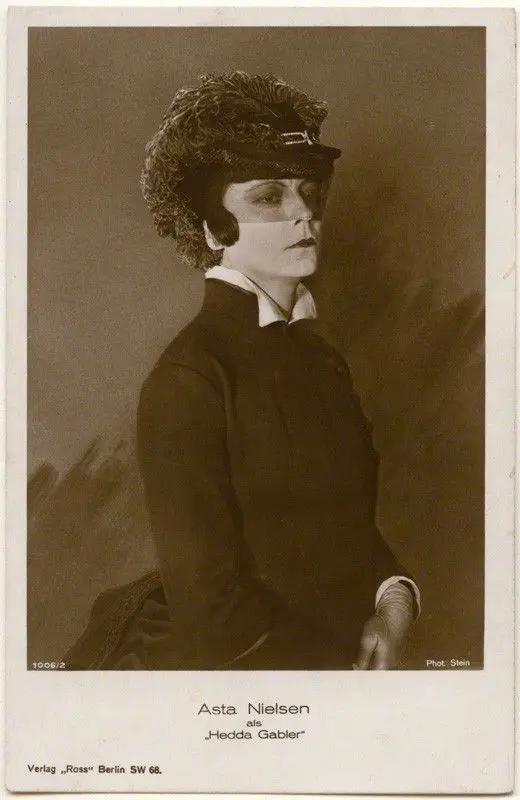
The 1925 adaptation of Hedda Gabler stands as a monumental achievement in the Weimar era’s exploration of psychological interiority. While many contemporary works of the mid-twenties, such as the whimsical Sally of the Sawdust, sought to provide audiences with escapist levity, Franz Eckstein and Rosa Porten delved into the marrow of Ibsen’s naturalistic tragedy. At the center of this vortex is Asta Nielsen, an actress whose face was a landscape of unspoken anguish and glacial disdain. To watch Nielsen is to witness the evolution of screen acting from the histrionics of the early silent era into a nuanced, modernistic vulnerability.
Hedda Gabler is a character defined by her contradictions: she is a general’s daughter who fears scandal, yet she is consumed by a desire for a reckless, Dionysian beauty. The film captures this tension through a visual language that feels remarkably claustrophobic. The drawing room, though ostensibly a space of comfort and status, is framed with a geometric rigidity that mirrors Hedda’s own internal cage. Unlike the expansive, aquatic fantasies found in Queen of the Sea, the world of Hedda is one of shadows, heavy drapes, and the oppressive weight of mahogany furniture. Every frame feels saturated with the smell of stale tea and the dust of academic papers.
One of the most striking aspects of this 1925 production is its parsimonious use of intertitles. The filmmakers understood that Ibsen’s power lies not just in the dialogue, but in the subtext—the glances, the sighs, and the pregnant pauses. Nielsen’s Hedda does not need to speak her contempt for Tesman; her eyes, rimmed with a dark, expressionistic intensity, convey a world of disappointment. Albert Steinrück portrays Tesman with a bumbling, well-meaning mediocrity that makes Hedda’s repulsion visceral. He is not a villain, which is precisely why he is so unbearable to a woman of Hedda’s temperament. He represents the slow, agonizing death of the spirit through domestic comfort.
The narrative arc follows the arrival of Eilert Løvborg, played with a haunting fragility by Gregori Chmara. Løvborg is the shadow of what Hedda could have been—a creature of intellect and passion who has dared to live outside the boundaries of social propriety. When compared to the lighthearted antics of His First Car, the stakes in Hedda Gabler feel almost cosmic. The manuscript that Løvborg has written, his "child" with Thea Elvsted, becomes the catalyst for the film’s most harrowing sequence. The burning of the manuscript is staged with a ritualistic fervor, as Hedda seeks to destroy the creative fruit of a union she could never possess.
In the broader context of 1920s cinema, Hedda Gabler serves as a fascinating counterpoint to the burgeoning American studio system. While Hollywood was perfecting the narrative flow of films like Love Letters, the German production of Hedda Gabler remained rooted in the Kammerspielfilm tradition. This "chamber film" style prioritizes psychological depth over external action. Even when compared to other international psychological dramas like the Russian Sumerki zhenskoy dushi, Eckstein’s direction feels uniquely focused on the spatial relationship between the characters and their environment.
The film’s exploration of gender roles and the marital contract is far more cynical than the moralistic queries found in Why Divorce?. Hedda’s predicament is not one that can be solved by legal separation or social reform; it is an ontological crisis. She is a woman born out of time, possessing a masculine drive for power but restricted to the feminine sphere of influence. Her pistols, inherited from her father, are not merely props; they are phallic symbols of a lost authority, the only tools she has left to assert her will over a reality that has rendered her obsolete.
Visually, the film employs a chiaroscuro lighting scheme that anticipates the film noir movement of the following decades. The interplay of light and shadow on Nielsen’s face creates a mask-like effect, suggesting that Hedda is a woman who has become a stranger even to herself. There is a specific scene involving Judge Brack (Paul Morgan) where the shadows of the window panes stretch across the floor like the bars of a cell. Brack, with his predatory charm, recognizes Hedda’s secret and attempts to use it to blackmail her into a sordid arrangement. This sequence is far more chilling than the overt thrills of The Red Circle, as it deals with the slow tightening of a social noose.
The supporting cast provides a rich tapestry of the society Hedda so despises. Käthe Haack as Thea Elvsted offers a perfect foil to Hedda; where Hedda is cold and destructive, Thea is warm and generative. Their interactions are a masterclass in tension, as Hedda oscillates between a patronizing affection and a desire to see Thea’s world burn. This dynamic is far more complex than the simplistic character archetypes found in Polly Redhead or the broad characterizations in Fool Days. In this film, every character is a victim of their own social conditioning, yet only Hedda is fully conscious of the tragedy.
As the film hurtles toward its inevitable conclusion, the pacing takes on a feverish quality. The news of Løvborg’s death—not with the "vine leaves in his hair" as Hedda had envisioned, but in a squalid accident—strips away her last remaining illusion of beauty. The world is not grand; it is merely ugly and pathetic. The realization that she is under the thumb of Judge Brack is the final catalyst. In a world where she cannot be the master of her own life, she chooses to be the master of her own death.
The final shot of the film is hauntingly composed. It eschews the dramatic flourishes of contemporary adventures like Her Dangerous Path for a quiet, devastating finality. Hedda’s suicide is not an act of cowardice, but a final, desperate reclamation of her own narrative. By removing herself from the board, she wins the only game she was ever allowed to play. It is a ending that leaves the viewer with a sense of profound unease, a far cry from the resolution of more conventional fare like When Do We Eat?.
Reflecting on Hedda Gabler (1925) nearly a century later, its power remains undiminished. It is a testament to the fact that great drama transcends the limitations of its medium. While the film lacks the synchronized sound that would come just a few years later, the silence actually enhances the sense of isolation that defines Hedda’s character. The viewer is forced to inhabit her headspace, to feel the weight of the silence that fills the Tesman household. It is a far more sophisticated psychological study than the era's more experimental shorts, such as Bobby Bumps and the Hypnotic Eye, which, while innovative in their own right, do not attempt the same level of emotional depth.
The screenplay by Rosa Porten and Franz Eckstein manages to condense Ibsen’s dense dialogue into visual metaphors that resonate with a modern sensibility. They understand that the true horror of Hedda’s life is not any single event, but the cumulative effect of a thousand small indignities. The film avoids the pitfalls of being a mere "filmed play," instead utilizing the unique properties of cinema—the close-up, the lighting, and the editing—to expand upon Ibsen’s themes. It is a work of art that demands much from its audience, but offers in return a profound meditation on the human condition.
In the pantheon of silent cinema, Nielsen’s Hedda Gabler is a figure that looms large. She is the ancestor of the modern anti-heroine, a woman who refuses to be likable, who refuses to be a victim, and who ultimately refuses to be. For those interested in the history of film as a serious art form, this 1925 production is essential viewing. It serves as a bridge between the theatrical traditions of the 19th century and the psychological realism of the 20th, proving that even in the absence of words, the human soul can find a way to scream. It is a stark, beautiful, and deeply disturbing piece of cinema that continues to haunt the viewer long after the final frame has faded to black. Whether compared to the domestic dramas of Common Ground or the rugged narratives of The Medicine Hat, Hedda Gabler stands alone in its uncompromising vision of spiritual decay. It is, quite simply, a masterpiece of the silent screen.
Reviewer Note: This analysis considers the 1925 version as a pivotal moment in the transition from expressionism to psychological realism in European cinema.
IMDb —
1924
Community
Log in to comment.