DbcultAccessing Vault...
Cult Review
Senior Film Conservator
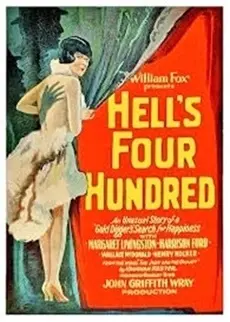
Does Hell's Four Hundred offer enough narrative meat to satisfy a modern cinephile? Short answer: No, unless you are a dedicated archivist or a fan of the specific brand of 'vamp' melodrama that Margaret Livingston perfected.
This is a film that exists in the amber of 1926, capturing a very specific anxiety about the blurring lines between the high-society 'Four Hundred' and the criminal underworld. It is a curiosity, a historical footnote that provides a glimpse into the early career of the 'other' Harrison Ford, but it lacks the universal emotional resonance found in the era's truly great works.
This film works because Margaret Livingston delivers a performance of such icy, calculated ambition that she makes the surrounding melodrama feel almost dangerous.
This film fails because the script by Vaughn Kester and Bradley King relies on a series of convenient coincidences that strip the characters of their agency, making them feel like puppets of the plot.
You should watch it if you want to study the archetype of the 1920s 'gold digger' in its purest, least-sanitized form, or if you are tracking the evolution of the American legal thriller.
The heart of Hell's Four Hundred isn't the romance between John North and Barbara Langham. That subplot is a dry, cardboard affair that serves as little more than a moral anchor for the audience. The real energy pulses from Evelyn Vance, the chorus girl played with predatory grace by Margaret Livingston. While films like The Other Woman often painted these characters as victims of circumstance, Livingston’s Vance is a shark.
There is a specific moment in the second act where Evelyn realizes that Marshall Langham is not just a mark for a scandal, but a ticket to a permanent social upgrade. The way Livingston shifts her expression from faux-seduction to a cold, business-like assessment of her target is chilling. It is the highlight of the film. It elevates the movie from a standard morality play into something more cynical and, frankly, more interesting.
The film struggles to balance this cynicism with the earnestness of Rodney Hildebrand’s John North. North is the quintessential silent-era DA: stiff-collared, square-jawed, and utterly predictable. When he is on screen, the film slows to a crawl. His internal conflict—protecting the law versus protecting the woman he loves—is handled with all the subtlety of a sledgehammer.
Modern audiences often do a double-take when they see Harrison Ford in the credits of a 1926 film. This is, of course, the silent film star who shared the name, and his performance as Marshall Langham is a reminder of why he was a reliable leading man of the period. Ford brings a genuine sense of weakness to Marshall. He doesn't play him as a villain, but as a man whose spine has been dissolved by easy money and bad habits.
Compared to the high-energy antics in The Human Tornado, Ford’s work here is restrained. He allows himself to be overshadowed by Livingston, which is the correct choice for the character. Marshall is a man being swallowed by the forces around him, and Ford portrays that slow dissolution with a quiet, pathetic dignity.
Marceline Day as Barbara is unfortunately given very little to do. She is the 'reward' for the hero, a trope that was already feeling tired by the mid-20s. Her performance is competent, but she lacks the magnetic screen presence that Livingston commands. When the two women share a scene, it’s like watching a house cat try to negotiate with a panther.
Visually, Hell's Four Hundred is a product of the Fox Film Corporation's house style. The cinematography is competent, emphasizing the contrast between the brightly lit, sterile offices of the District Attorney and the smoky, cluttered atmosphere of John Gilmore’s café. The café scenes are where the film finds its visual identity.
The use of shadows in the café creates a sense of claustrophobia. It feels like a place where secrets are the primary currency. One specific shot—a low-angle look at Gilmore as he explains his plan to Evelyn—uses lighting to turn his face into a mask of pure greed. It’s a technique we see used more effectively in films like The Dream Cheater, but it works here to establish the stakes.
However, the pacing is a significant hurdle. Like many dramas of this period, the middle section is bloated with repetitive title cards and scenes that reiterate points already made. The transition from the gambling debt plot to the marriage plot feels clunky, as if two different scripts were stitched together at the last minute.
If you are looking for a gripping, fast-paced thriller, then Hell's Four Hundred will likely disappoint you. It is a slow burn that often forgets to stay lit. However, if you are interested in the sociology of silent film—how the era viewed class mobility and female agency—it is a fascinating artifact.
The film’s portrayal of the legal system is particularly revealing. It suggests that the law is not a shield, but a weapon that can be easily blunted by personal scandal. This cynical view of authority was becoming more common in the mid-20s, reflecting a post-war disillusionment that would eventually lead to the Noir era.
Pros:
Cons:
What stays with you after watching Hell's Four Hundred isn't the triumph of the law, but the ease with which the 'Four Hundred'—the elite—can be infiltrated. The film presents a world where the only difference between a socialite and a chorus girl is a marriage license and a bit of luck. This subtext is far more interesting than the primary plot about gambling debts.
In many ways, it shares a thematic DNA with The Moral Sinner, exploring how easily 'good' people can be pulled into the muck. But where that film finds a sense of tragedy, Hell's Four Hundred finds a sense of inevitability. It’s a cold film. It doesn’t seem to like its characters very much, and that distance makes it difficult for the audience to fully engage.
The dialogue—conveyed through those ubiquitous title cards—is often functional rather than poetic. It lacks the wit found in Just Off Broadway. Everything is played straight, which only highlights the absurdity of some of the plot twists.
Hell's Four Hundred is a competent, if uninspired, silent drama that is saved from total obscurity by a single, sharp performance. It works. But it’s flawed. It serves as a stark reminder that even in the golden age of the silents, the 'B-movie' was alive and well. Watch it for Livingston, stay for the historical context, but don't expect it to change your life. It is a three-star film in a five-star era.
IMDb —
1925
Community
Log in to comment.