DbcultAccessing Vault...
Cult Review
Senior Film Conservator
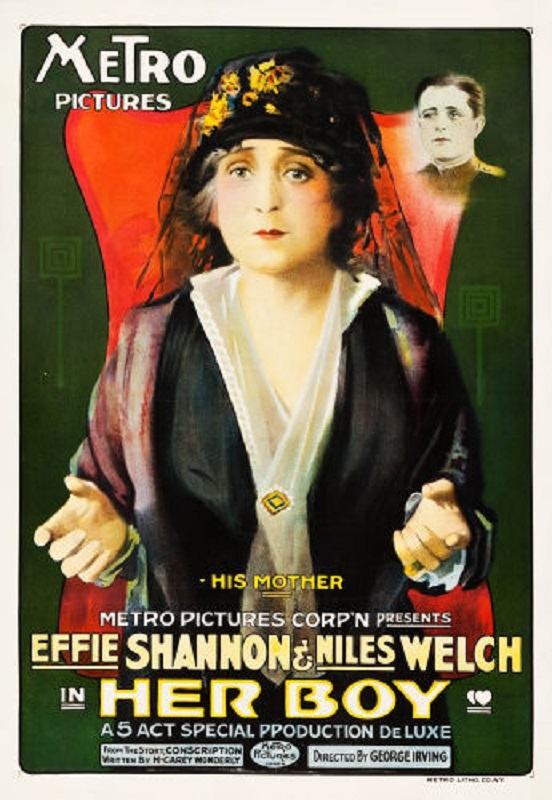
The year is 1918. The global stage, already a maelstrom of unprecedented conflict, finds the United States fully embroiled in the Great War, a crucible that would forever reshape national identity and individual destinies. Amidst this epochal upheaval, Her Boy emerges as a stark, intimate portrait of familial devotion pushed to its absolute breaking point, a silent film that dares to scrutinize the suffocating power of maternal love against the backdrop of patriotic fervor. This isn't merely a story of enlistment; it's a profound psychological examination of a mother's desperate stratagems to preserve her only son, regardless of the ethical cost. Directed with a keen eye for human frailty, the film, penned by W. Carey Wonderly and Albert S. Le Vino, navigates the treacherous waters of duty, deception, and ultimate forgiveness, offering a surprisingly nuanced take on a period often characterized by overt jingoism. It posits a timeless question: what boundaries will a parent transgress in the name of love, and what are the irreparable consequences of such profound breaches of trust?
At the heart of Her Boy lies Helen, a widow portrayed with palpable anguish by Effie Shannon, whose entire existence seems to coalesce around her only son, David (Pat O'Malley). The narrative establishes Helen's terror early on: the looming shadow of World War I, threatening to snatch away the sole anchor of her life. This isn't an abstract fear of national loss; it's a deeply personal, visceral dread of individual bereavement. Her love for David, while ostensibly nurturing, carries an almost suffocating intensity, a possessiveness born of profound vulnerability. It's a love that, when confronted with the inexorable demands of war, metastasizes into an act of desperation that verges on the pathological. Shannon’s performance, relying solely on gesture and expression, eloquently communicates this internal struggle, making Helen's eventual actions understandable, if not justifiable. Her pleas to David, though silent, resonate with the universal cry of a mother facing an unbearable sacrifice, echoing the protective instincts seen in countless narratives of maternal devotion, though few push the boundaries quite as far as Helen does here.
David, having just attained the age of twenty-one, finds himself caught in an agonizing bind. Pat O'Malley imbues David with a youthful idealism, initially demonstrating a robust patriotic fervor, encouraging his factory peers to enlist in the national cause. This initial zeal positions him as a model citizen, ready to answer the call of duty, a common trope in wartime propaganda films of the era. However, this burgeoning sense of national responsibility is immediately pitted against the immense emotional weight of his mother's pleas. Helen's desperate entreaties, her silent tears and unspoken fears, prove a formidable opponent to David's burgeoning patriotism. He reluctantly capitulates, choosing to remain at home, a decision that highlights the profound societal pressures and personal conflicts of the time. This internal struggle is a central pillar of the film, showcasing the emotional toll exacted by war not just on the battlefield, but within the domestic sphere. The tension between public duty and private obligation is masterfully rendered, creating a dynamic that feels both specific to its time and universally resonant. The film here touches upon similar themes of personal sacrifice against a larger backdrop, albeit with a different conflict, as seen in The Scarlet Drop, where characters must weigh their individual desires against the demands of a tumultuous world.
The true dramatic pivot arrives when David receives his draft notice. This concrete threat shatters the fragile peace Helen had meticulously constructed. Her response is an act of breathtaking, if deeply misguided, desperation: she alters David's birth certificate. This isn't a minor tweak; it’s a fundamental rewriting of his identity, pushing his birth date forward to render him underage and thus ineligible for military service. The horrifying implication, however, is that this later date would brand him illegitimate, tarnishing his very origins. This moment is the film's darkest, revealing the extent of Helen's terror and her willingness to sacrifice her son's honor for his safety. The film doesn't shy away from the ethical horror of this act; it’s a profound betrayal of trust and an assault on David’s sense of self. His reaction is immediate and visceral: disgusted by his mother’s dishonesty and the shame it casts upon him, he defiantly enlists under an assumed name. This act of rebellion is a desperate reclaiming of his own identity and agency, a severance from the suffocating embrace that has now become a source of profound dishonor. The emotional chasm that opens between mother and son is vast, a testament to the destructive power of fear-driven deception. This familial fracturing, born from a desperate act of protection, bears a haunting resemblance to the complex intergenerational conflicts explored in films like Little Women, where societal expectations and personal desires often clash within the family unit, though `Her Boy` plunges into a far darker ethical territory.
As a silent film from 1918, Her Boy relies heavily on visual storytelling, exaggerated expressions, and intertitles to convey its intricate emotional landscape. The direction, while not groundbreaking in its technical innovation, effectively uses close-ups to capture the raw emotion on the faces of Shannon and O'Malley. The pacing builds tension steadily, escalating from domestic anxiety to profound moral crisis. The use of symbolism, though subtle, is present; the uniform, initially a symbol of David's patriotism, later becomes a defiant assertion of his individual will against his mother's control. The film's aesthetic, typical of the era, might seem melodramatic to contemporary audiences, but within its historical context, it was a powerful means of communicating complex psychological states without the benefit of spoken dialogue. The film doesn't merely show the events; it strives to convey the internal turmoil, the unspoken accusations, and the desperate hopes of its characters. This reliance on visual narrative to convey deep emotional currents is a hallmark of the period, a technique that masterful silent films like Yakko no kôsan also employed to great effect, allowing universal feelings to transcend language barriers.
The themes explored in Her Boy – the personal cost of war, the complexities of familial love, and the moral compromises made under duress – resonate far beyond its immediate historical context. While the specific conflict is World War I, the underlying human drama is timeless. Films continue to grapple with these issues, from the harrowing realism of modern war dramas to intimate family sagas. The film's portrayal of a mother's desperate attempt to protect her son from the draft, even at the cost of his honor, finds echoes in countless stories of parental sacrifice, albeit usually with less ethically dubious methods. The raw fear embodied by Helen is a primal emotion that transcends generations and conflicts. The concept of a son choosing duty over a mother's pleas, or vice versa, is a narrative wellspring that filmmakers continue to tap into. Consider the patriotic fervor and the individual choices made in other wartime narratives like Jan Vermeulen, der Müller aus Flandern, where individual lives are irrevocably altered by the sweep of global conflict. Her Boy, in its silent, stark manner, lays bare these universal anxieties with surprising clarity.
The success of a silent film hinges almost entirely on the expressive capabilities of its cast, and Her Boy is fortunate in its lead performers. Effie Shannon, as Helen, delivers a performance of profound emotional depth. Her face is a canvas of torment, fear, and misguided love. She conveys the escalating panic, the desperate plotting, and the eventual public shame with a nuanced physicality that avoids mere caricature. One can almost feel the weight of her maternal burden through her gestures and her eyes. Pat O'Malley, as David, manages to convey both his initial patriotic enthusiasm and his subsequent revulsion with equal conviction. His transformation from dutiful son to disgusted, defiant soldier is rendered with a quiet power, making his eventual enlistment under an assumed name a moment of understandable, if heartbreaking, rebellion. The supporting cast, including William Bechtel, J.C. Bates, and Pauline Curley, contribute to the film’s emotional texture, creating a believable small-town community that witnesses Helen’s tragic downfall. Each actor, within the confines of silent cinema, manages to articulate complex internal states, demonstrating the power of non-verbal storytelling. This ability to communicate profound emotion without dialogue is a testament to the skill required in the silent era, much like the evocative performances in The Explorer, where character depth is conveyed through action and reaction.
The film culminates in a deeply uncomfortable, yet ultimately poignant, resolution. Helen, having publicly confessed her dishonesty to the townspeople – an act of profound humility and self-immolation – awaits the return of her son. The scene of her confession is pivotal, a moment where her private anguish spills into the public sphere, forcing her to confront the full ramifications of her actions. David, now in uniform, eventually returns. His forgiveness, though granted, is not easily won. It's a forgiveness tinged with the lingering scars of betrayal and the weight of a rewritten past. The film doesn't offer a facile, saccharine ending. Instead, it suggests a fragile peace, a tentative step towards mending a deeply fractured bond. The visual of David in uniform, embracing his shamed mother, is powerful precisely because it acknowledges the pain that precedes it. It’s a forgiveness that speaks to the enduring, if sometimes complicated, nature of familial love, even when tested by the most egregious of errors. This resolution, while offering a semblance of closure, leaves the audience contemplating the permanent marks left by such a profound transgression. It’s a far cry from the unbridled optimism sometimes found in films like Little Miss Optimist, instead offering a more bittersweet, earned reconciliation.
Her Boy, despite its age and the inherent limitations of silent cinema, remains a compelling watch for those interested in the social history of film and the enduring power of human drama. It serves as a valuable artifact, reflecting the anxieties and moral quandaries of a nation at war, viewed through the intensely personal lens of a mother-son relationship. The film’s exploration of themes like duty, sacrifice, identity, and forgiveness continues to resonate, proving that fundamental human struggles are timeless. While some might find its melodramatic flourishes dated, its core emotional truth remains remarkably intact. It’s a testament to the power of early cinema to tackle complex ethical dilemmas with sensitivity and depth. The film encourages us to consider the often-overlooked domestic battles fought in the shadow of grand historical events, reminding us that war impacts not just soldiers on the front lines, but also the families left behind, grappling with their own forms of sacrifice and survival. The film, in its quiet intensity, offers a profound meditation on how far love can bend before it breaks, and the arduous path towards redemption. It stands as a significant piece in the tapestry of WWI-era cinema, offering a unique perspective on the home front’s emotional landscape, a landscape often as tumultuous as the battlefields themselves, much like the broader societal anxieties captured in films such as The Day or even the epic scale of The Battle of Trafalgar, though focused on a different conflict. This film, in its quiet power, continues to speak volumes about the human heart under pressure.
IMDb 5.4
1925
Community
Log in to comment.