DbcultAccessing Vault...
Cult Review
Senior Film Conservator
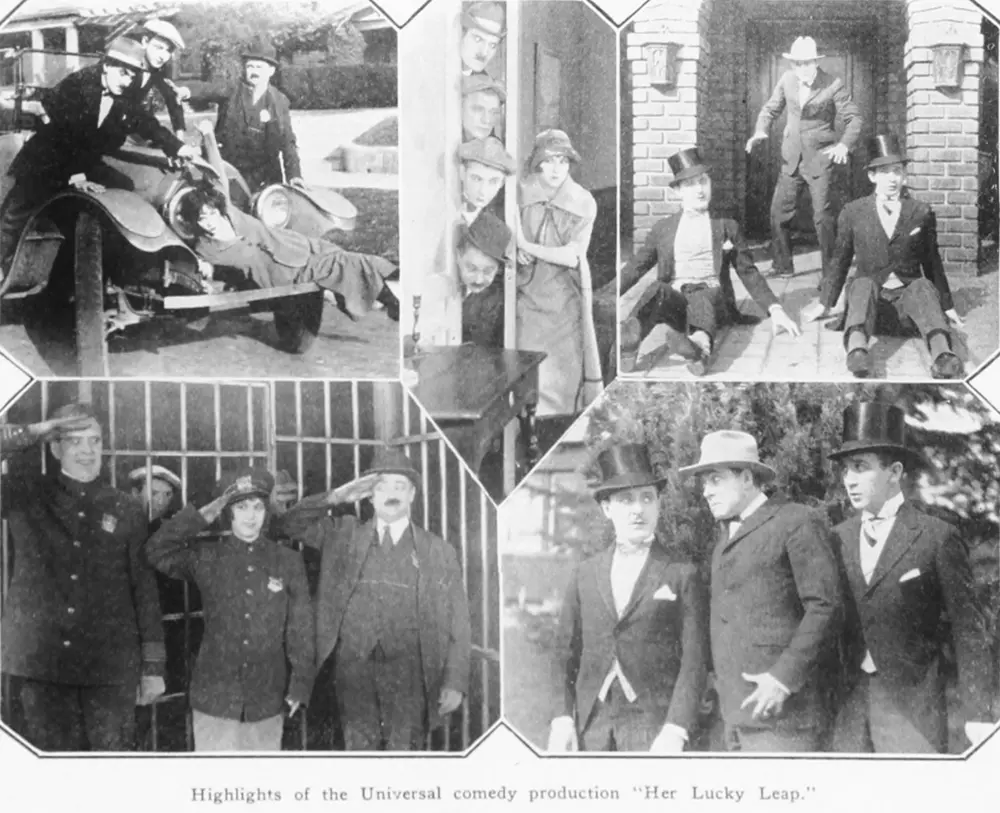
So, is Her Lucky Leap worth watching today? Short answer: yes, but with significant caveats. This early silent comedy is a fascinating artifact for cinephiles and an absolute delight for anyone who appreciates the raw, unadulterated energy of physical comedy from a bygone era, but it will undoubtedly test the patience of viewers accustomed to modern narrative complexities.
This film is unequivocally for those who cherish silent cinema's unique rhythm, the artistry of practical stunts, and the sheer, unbridled joy of a well-executed chase sequence. It is definitively NOT for audiences seeking profound character development, intricate plot twists, or sophisticated humor, nor for those who find the technical limitations of early 20th-century filmmaking distracting.
This film works because of its relentless pacing, Wanda Wiley’s magnetic physical performance, and its commitment to pure, unadulterated slapstick.
This film fails because its plot is wafer-thin, its characters are mere archetypes, and its humor, while often effective, occasionally feels dated and repetitive.
You should watch it if you're a student of film history, a fan of silent-era physical comedy, or simply looking for a brisk, unpretentious slice of cinematic escapism.
Her Lucky Leap, directed by Edward Ludwig, unfurls as a masterclass in escalating comedic chaos, a narrative framework built entirely around the principle of perpetual motion. The premise is deceptively simple: a necklace, three crooks, an accidental fall, and an innocent woman caught in a maelstrom of mistaken identity and relentless pursuit. What begins on the turbulent waves of a seasick-inducing ship quickly spirals into an urban odyssey of frantic escapes and near-misses.
The film's plot, or rather, its excuse for a plot, is a testament to the era's focus on spectacle over substance. It’s not about why the necklace is valuable, or who these crooks truly are, but solely about the kinetic energy generated by the chase. Wanda, our accidental heroine, finds herself a pawn in a game she didn't ask to play, and her reactions drive the entire narrative forward.
One of the film's most striking elements is its seamless transition between environments. The initial shipboard setting, with its swaying decks and disoriented passengers, provides a unique backdrop for the initial crime and the fateful tumble that sets everything in motion. The visual gag of pervasive seasickness, while simple, grounds the opening in a relatable, if exaggerated, reality.
Once on shore, the chase accelerates, transforming into a series of urban vignettes. The repeated cab escapes, for instance, are not just instances of evasion; they are mini-narratives of quick thinking and physical dexterity. Wanda's ability to not just flee, but to actively outmaneuver her pursuers, demonstrates a surprising level of agency for a character thrust into such a predicament.
The narrative’s escalation reaches its zenith with Wanda’s audacious climb up a telephone wire, a moment of pure, unadulterated silent film spectacle. It’s a visual gag that transcends its time, eliciting genuine admiration for its inventiveness and the physical demands it must have placed on the performer. This sequence, in particular, perfectly encapsulates the film’s spirit: improbable, exhilarating, and utterly committed to its own brand of comedic absurdity.
At the heart of Her Lucky Leap is the indefatigable performance of Wanda Wiley. In an era dominated by male physical comedians like Chaplin, Keaton, and Lloyd, Wiley carves out her own distinct niche with a performance that is both athletic and charmingly frantic. She is not merely running; she is reacting, strategizing, and improvising with every single frame.
Wiley's physicality is the film's undeniable standout element. Her movements are precise, yet imbued with a sense of desperate urgency that sells the comedic stakes. Whether she’s battling the crooks inside a moving cab, scrambling across rooftops, or clinging to a passing motorcycle, her commitment to the physical demands of the role is absolute. This isn't just acting; it's a full-body performance that speaks volumes without a single line of dialogue.
Consider her expressions during the cab sequences. We see not just fear, but a flicker of exasperation, a spark of cunning as she devises her next escape. She’s not a damsel in distress; she’s a woman pushed to her limits, finding ingenious ways to survive. This nuanced portrayal elevates what could have been a one-note character into someone genuinely engaging.
While not as widely remembered as some of her male contemporaries, Wiley’s work here suggests a talent for physical comedy that deserves greater recognition. Her ability to command the screen through sheer kinetic energy and expressive pantomime is a testament to the power of silent film acting. She embodies the spirit of the 'lucky leap' – a character who, through sheer force of will and a little bit of accidental good fortune, navigates an impossible situation.
The supporting cast, particularly Joe Bonner and Les Bates as the bumbling crooks, provides an excellent foil for Wiley’s quick-witted protagonist. They are caricatures, of course, but effective ones, their increasing frustration and incompetence serving to amplify Wanda’s triumphs. Their broad, exaggerated movements and expressions are perfectly suited to the film’s slapstick tone, ensuring that the audience consistently roots for Wanda while enjoying the villains' misfortunes.
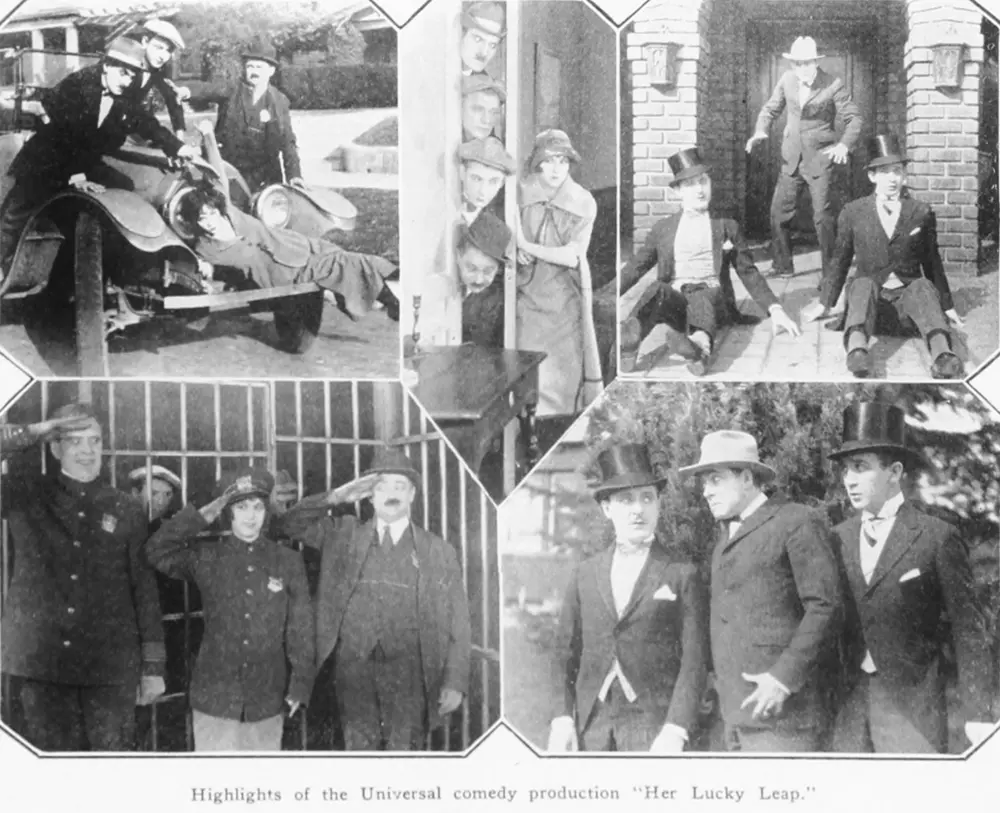
Edward Ludwig’s direction of Her Lucky Leap is a masterclass in early cinematic rhythm and spatial awareness. For a film of its era, Ludwig demonstrates a keen understanding of how to build and sustain excitement through continuous action. He rarely allows the camera to linger, preferring to keep the narrative propulsion at a consistent, breakneck pace.
Ludwig's use of location is particularly effective. He doesn’t just place the action in a generic setting; he leverages the unique characteristics of each environment to create new comedic opportunities. The cramped interior of the cab, for instance, becomes a battleground, while the open street allows for broader, more dynamic chase sequences. The sequence where Wanda pulls herself into her aunt's home via a telephone wire is not just a gag, but a clever manipulation of vertical space, adding another dimension to the pursuit.
The editing, while rudimentary by today's standards, is surprisingly fluid. Ludwig understands the power of the cut to convey urgency and to punctuate comedic beats. The rapid succession of shots as Wanda evades the crooks, jumping from one cab to another, creates a palpable sense of speed and desperation. It’s a technique that keeps the audience visually engaged, preventing any lulls in the action.
There's an unpretentious efficiency to Ludwig's filmmaking here. He’s not attempting grand artistic statements; he’s focused squarely on delivering entertainment through dynamic motion. This directness is, in itself, a form of artistry, showcasing how early filmmakers learned to communicate complex sequences through visual storytelling alone. The film feels remarkably modern in its commitment to action, a precursor to many chase films that would follow.
The pacing of Her Lucky Leap is its most defining characteristic. It is relentless, almost exhausting in its commitment to non-stop action. From the moment the accomplice tumbles overboard, the film rarely pauses for breath. This intensity is a hallmark of early slapstick, where the humor often derived from the sheer accumulation of absurd events and the protagonists' desperate attempts to keep up.
This unwavering pace can be both a strength and a potential deterrent for modern viewers. For those who appreciate the historical context, it’s a fascinating glimpse into how narratives were constructed without dialogue, relying almost entirely on visual gags and physical comedy to maintain engagement. The film is a masterclass in showing, not telling, and its rapid succession of events is a testament to this principle.
The tone, despite the criminal element and the constant danger, remains light and overtly comedic. There’s never a genuine sense of threat, even when Wanda is literally battling two men. The film operates within the safe confines of slapstick, where injuries are minor and consequences are temporary. This allows the audience to fully immerse themselves in the absurdity without fear of genuine harm to the characters.
One could argue that the film's simplicity is its greatest asset. It doesn't overcomplicate things; it establishes a clear goal (Wanda escaping, crooks getting the necklace) and then dedicates every frame to the pursuit of that goal. This singular focus creates a remarkably streamlined viewing experience, making it a perfect example of a 'pure' chase film. It works. But it’s flawed.
The lack of character depth, while understandable for the genre, sometimes leaves you wanting more. We know Wanda is resourceful, but we don't know anything about her beyond her immediate predicament. The crooks are just that: crooks. This stripped-down approach prioritizes action over emotional investment, a trade-off that was common in early comedies but can feel a bit hollow today.
Yes, Her Lucky Leap is worth watching for specific audiences. It’s a vital piece of silent film history.
It's highly recommended for enthusiasts of early cinema and physical comedy. The film offers a unique look at a female lead in a high-octane chase.
However, if you prefer intricate plots, deep character studies, or modern comedic sensibilities, this film might not resonate. Its charm lies in its historical context and its raw, kinetic energy.
Do not expect a profound narrative. Expect a fun, fast-paced, and surprisingly acrobatic performance from Wanda Wiley. It’s a brisk, enjoyable experience for those willing to engage with its unique style.
Her Lucky Leap is more than just a historical curiosity; it’s a vibrant, if slight, testament to the enduring appeal of physical comedy and the raw ingenuity of early filmmaking. While it certainly doesn't boast the narrative sophistication of later classics like The Last Laugh or the character depth of A Doll's House, it offers a different kind of cinematic pleasure: pure, unadulterated kinetic fun.
Wanda Wiley's performance is the undeniable highlight, a whirlwind of acrobatic escapes and comedic timing that truly anchors the film. Her energy is infectious, making even the most outlandish scenarios feel grounded in a desperate, yet charming, reality. It's a shame she isn't more widely celebrated, as her work here is genuinely compelling.
Ultimately, Her Lucky Leap is a film that demands to be viewed through the lens of its time, appreciating its technical achievements and comedic sensibilities within that context. It’s a brisk, entertaining ride that proves the universal language of laughter and movement transcends generations. It’s a minor classic. And it’s absolutely worth a look if you’re curious about the roots of cinematic action-comedy.

IMDb —
1931
Community
Log in to comment.