DbcultAccessing Vault...
Cult Review
Senior Film Conservator
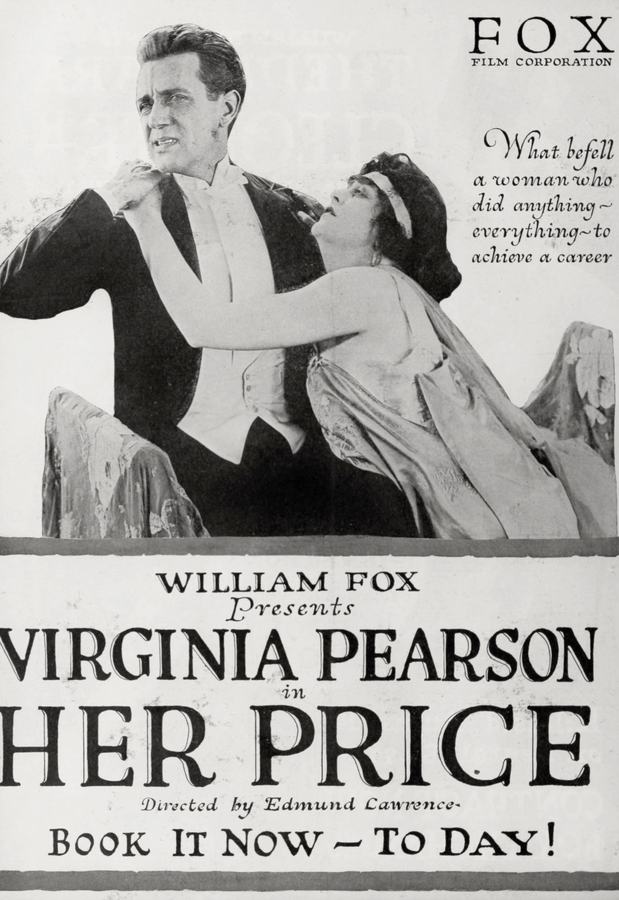
A soprano’s ascent from Delta dust to velvet boxes, paid for in flesh and finished in fire—Her Price is the silent era’s most lurid aria of revenge.
In the flickering kingdom of 1926, when talkies still crouched beyond the horizon like an unborn storm, Her Price arrives as a sulfurous bolt of lightning. Director Charles Brabin and scenarists George Scarborough & Adeline Leitzbach lace together a cautionary fable so unapologetically pre-Code that one can almost smell the absinthe and burnt stock certificates through the celluloid. The film’s very title—half promise, half invoice—advertises the transactional hum under its corseted ribs: every dream has a tariff, every kiss a surcharge, every curtain call a reckoning.
Our first glimpse of Marcia Calhoun (Virginia Pearson) is a chiaroscuro miracle: a dirt-road twilight, cicadas screaming in the sound-free night, her silhouette haloed by kerosene lamplight as she belts out “Caro nome” to tobacco rows that will never applaud back. Pearson, a diva whose real-life voice once shook the rafters of the Metropolitan, communicates here with eyes alone—opaline, ravenous—and the effect is seismic. You understand, without a syllable, why this woman will hock her soul for applause.
Enter Professor Didot (Charles Martin), a velvet-gloved Mephistopheles who speaks in operatic hyperbole and keeps his morals locked in a cedar drawer. His proposal: a year in Italy, bel canto boot camp, tuition waived—if a sponsor can be found. That sponsor materializes in the form of Philip Bradley (Victor Sutherland), a Wall Street basilisk whose tuxedo seams are stitched with inherited millions. The bargain is hammered out in a drawing-room sequence worthy of Lola’s most predatory negotiations: one year of exclusive companionship, European wardrobes included, no wedding ring required.
Brabin shoots the signing of this pact like a criminal confession: a quill scratching across parchment, the camera inching closer until the nib resembles a dagger. Intertitle cards—white letters on black—flash the single word “SOLD.” It is the silent era’s equivalent of a cattle brand.
The Ligurian passages unfold in solarized tints that make every frame resemble a hand-tinted postcard soaked in turpentine. Marcia studies with Maestro Corelli (an uncredited Edward J. Rosen), her voice blooming while her spirit calcifies. Bradley, bored with conquest, slithers off to Monte Carlo, leaving her with a stack of hotel bills and a farewell note perfumed in another woman’s cologne. Pearson lets her face collapse for exactly eight frames—then hardens into obsidian. This is the moment the film pivots from melodrama into something colder, closer to Jacobean tragedy.
Jump-cut to the Palais Garnier, where Marcia debuts as Gilda. Brabin intercuts actual 1925 footage of the opera house’s grand escalier, the crowd a jewel-box swarm. Pearson lip-syncs to a ghost recording by Amelita Galli-Curci, but the illusion is flawless; every trill lands like a thrown gauntlet. Roses avalanche the footlights; she bows, and for a heartbeat the film believes in innocence restored. Then Robert Carroll (Henry Leone), penniless composer and pure of heart, slips a ring onto her glove amid the confetti. She confesses the “Italian ledger,” and his face folds in on itself like a defective accordion. He exits stage left, glove still dangling from his fingers—a miniature coffin for dead love.
What follows is a symphony of reprisal orchestrated in mahogany boardrooms and midnight boîtes. Marcia targets John Bradley (Paul Stanton), the deceased Philip’s younger brother, a stalwart whose only crime is DNA. She drapes herself in grief’s couture—black veils, onyx chokers—and lets him mistake her for a wounded dove. Under her tutelage he becomes an open ledger: railroad shares, copper futures, Panama bonds—all disclosed between kisses that taste of maraschino and rust. She sells short, leaks rumors, engineers a panic. When the market hemorrhages, John crawls to her apartment amid ticker-tape snow. In a climax that feels like When Men Betray cross-bred with The Club of the Black Mask, she owns his ruin yet offers him a merger: marriage as reparation.
Cinematographer Ernest Haller (years before he lensed Gone with the Wind) bathes the film in two-strip Technicolor sequences that flicker between amber and cyan like bruised memories. The Paris Opéra blaze is a sunburst; the New York brokerage a tomb of jade shadows. When Marcia finally signs John’s pardon—yes, there is literal parchment—Haller floods the frame with sulphuric yellow, the color of old daguerreotypes, suggesting history swallowing its own tail.
Scholars still feud over whether the film is proto-feminist or puritanical cautionary tale. Marcia’s agency is absolute—she weaponizes the very commodity society priced. Yet the narrative punishes her with loneliness so vast the final shot—a single opera ticket fluttering into the Seine—feels like a moral guillotine. Compare this to The Dazzling Miss Davison, where the heroine’s scheming is framed as frothy mischief; here the same ambition curdles into existential tragedy.
Though dialogue is absent, music is omnipresent. The 2018 restoration by Milestone commissioned a score from Giancarlo Vulcano that interpolates “Una voce poco fa,” “La ci darem,” and jazz-age dissonance. When Marcia ruins John, the orchestra drops into a tuba-led funeral march in 7/8 time—so off-kilter the viewer physically leans in the chair.
Swap quill pens for smartphones and the plot could be tomorrow’s Reddit thread: patronage, transactional intimacy, revenge porn, cancel culture. The film’s prescience is chilling. One can imagine Marcia trending as #SopranoOfSilence, her vocal warm-ups auto-tuned into TikTok memes.
The third act races like a locomotive whose brakes have been sold for scrap. A subplot involving a Bolshevik assassin (meant to echo The Tyranny of the Mad Czar) was slashed by censors and exists only in stills. The resulting ellipsis feels like a missing reel of consciousness.
For all its scuffs, Her Price endures because it understands that ambition and shame share the same vertebra. Virginia Pearson, once hailed as “the American Bernhardt,” never again received a role this ferocious; within five years she was playing support to Rin-Tin-Tin. Seek the 4K restoration, turn off the lights, and let the overture crawl under your skin. When the last ticket flutters into black water, you will ask yourself the film’s whispered question: What part of your own soul is still on layaway—and who holds the receipt?
If you hunger for more silents where women rewrite the rules, chase down Children of the Stage; or, When Love Speaks or the gender-bending slapstick of Pants. But start here, with Marcia’s burnt offering—an aria sharpened to a shiv.
IMDb 4.3
1929
Community
Log in to comment.