DbcultAccessing Vault...
Cult Review
Senior Film Conservator
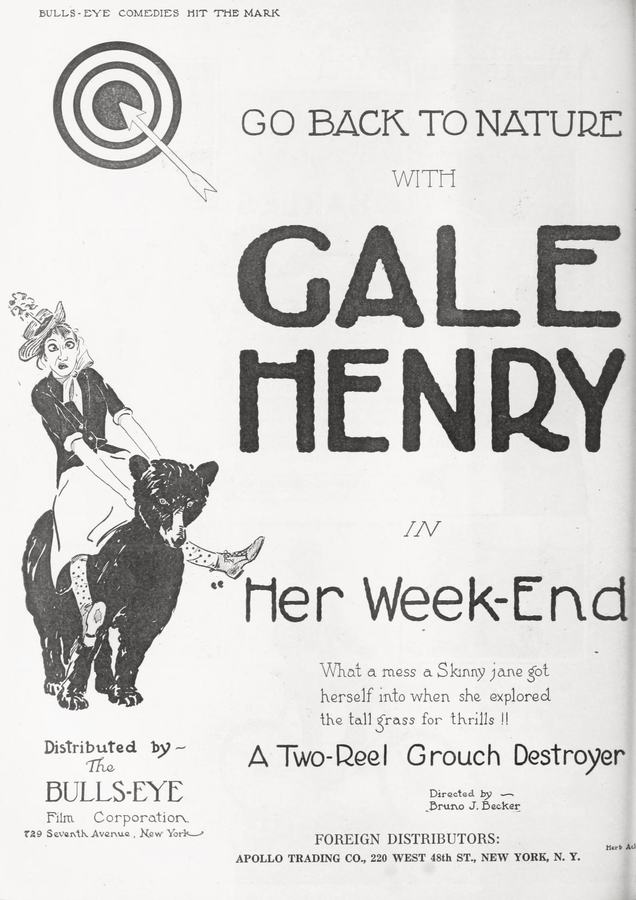
In the pantheon of silent cinema, the names Chaplin, Keaton, and Lloyd are etched into the cultural zeitgeist with the permanence of stone. Yet, lurking in the celluloid shadows is the tall, angular, and profoundly gifted Gale Henry, whose 1919 effort, Her Week-End, serves as a poignant reminder of the era's expansive comedic vocabulary. To watch Henry is to witness a rejection of the traditional ingenue; she does not possess the soft curls of Mary Pickford or the tragic eyes of Lillian Gish. Instead, she offers a skeletal, expressive kineticism that anticipates the avant-garde movements of the coming decade. Her Week-End is not merely a short subject; it is a frantic deconstruction of the American dream of leisure, a theme explored with varying degrees of cynicism in contemporary works like Happiness.
The premise is deceptively simple, a trope that would become a staple of the genre: the catastrophic vacation. However, under the direction of the uncredited but clearly capable hands behind the Bulls Eye production, the film eschews sentimentality for a raw, almost surrealist approach to slapstick. The interaction between Henry and her co-stars, including the reliable Milburn Morante and Eddie Baker, creates a friction that fuels the film’s momentum. While films like Jazz Monkey leaned into the animalistic whimsy of the era, Her Week-End finds its humor in the mechanical and the domestic, transforming everyday objects into instruments of torture and hilarity.
The brilliance of Her Week-End lies in its spatial awareness. In 1919, the camera was beginning to break free from the proscenium arch, and here we see a burgeoning understanding of how depth and framing can enhance a joke. When Ray Hampton and Louis King enter the frame, they aren't just bodies; they are obstacles in Henry’s chaotic orbit. The film’s rhythmic pacing mirrors the industrial pulse of the time, a relentless drive toward efficiency that inevitably collapses into absurdity. This collapse is what makes the film so enduring. It captures the anxiety of a world recovering from the Great War, seeking solace in the domestic sphere only to find it equally fraught with peril.
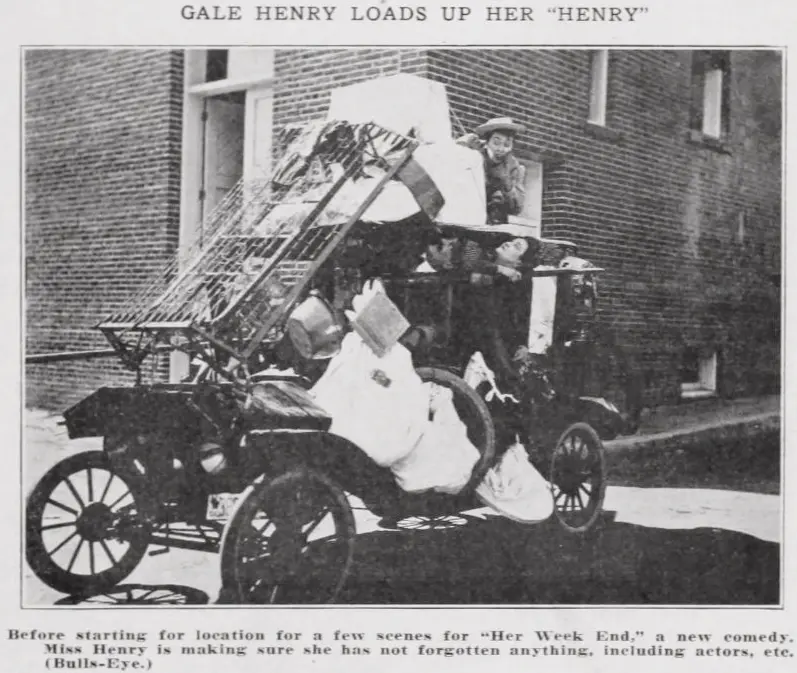
Consider the sequence involving the preparation for the trip. It is a ballet of errors that rivals the sophisticated construction seen in European imports such as Der Lumpenbaron. Where the latter might focus on social hierarchy, Her Week-End focuses on the sheer physicality of existence. Gale Henry’s limbs seem to operate on a different plane of reality, folding and stretching in ways that defy the corseted expectations of 1910s womanhood. She is an agent of chaos in a world trying desperately to maintain order. This subversion of gender roles is subtle but pervasive, placing Henry at the center of the narrative as both the victim and the perpetrator of her own misfortune.
To fully appreciate the nuance of this film, one must look at the surrounding landscape of 1919. The industry was in a state of flux, transitioning from the primitive shorts of the early decade to the sophisticated features of the 1920s. Her Week-End occupies a middle ground, possessing the raw energy of the nickelodeon era with the refined characterizations of the burgeoning studio system. It lacks the melodrama of Come Through or the gothic undertones of Eye of the Night, opting instead for a bright, sun-drenched hysteria. The cinematography, though utilitarian, captures the dusty California landscapes that would define the look of silent comedy for years to come.
When compared to the exoticism of The Chinese Musketeer or the high-society intrigue of The Purple Lady, Her Week-End feels grounded, almost gritty in its depiction of the middle class. Yet, it shares a certain DNA with the international cinema of the time. The dream-like logic of its gags bears a passing resemblance to the experimental spirit of Zakovannaya filmoi, suggesting a global conversation about the limits of the frame and the potential of the human body as a comedic vessel. Even the more traditional narratives like Kathleen Mavourneen or the tension of Udar v spinu feel distant from the immediate, visceral joy found in Henry's performance.
While Henry is the undisputed sun around which this comedy revolves, the supporting cast provides the necessary gravity. Hap Ward and the rest of the ensemble play their roles with a committed stoicism that heightens the absurdity of Henry's antics. In silent comedy, the 'straight man' is as vital as the clown, and in Her Week-End, the straight men are the very structures of society itself—the car, the house, the expectations of a 'pleasant' time. This is a film where objects have as much personality as the actors. A stubborn door or a recalcitrant stove becomes a character in its own right, a technique later perfected by Keaton but already visible here in a more embryonic, feverish form.
The writing, though uncredited, displays a keen understanding of escalation. Each scene builds upon the wreckage of the previous one, creating a cumulative effect that is both exhausting and exhilarating. This structural integrity is something often missing in the more episodic comedies of the period. It shares a thematic kinship with Blind Man's Eyes in its exploration of perception and the ways in which we misinterpret our surroundings—though here, the misinterpretation leads to a face full of soot rather than a dramatic revelation.
Technically, Her Week-End is a testament to the efficiency of the Bulls Eye Film Corporation. The lighting is remarkably consistent for a low-budget short, utilizing the natural California sun to create sharp contrasts that emphasize Henry's expressive features. The editing is brisk, favoring the action over unnecessary intertitles. This visual storytelling is a hallmark of the era's best work, allowing the film to transcend language barriers, much like the international appeal of Az éjszaka rabja or the Turkish intrigue of Casus. In an era where many films relied heavily on stage-bound aesthetics, Her Week-End feels breathlessly cinematic.
The film also touches upon the burgeoning car culture of the United States. The automobile, a symbol of freedom and modernity, is treated with a healthy dose of skepticism. It is a fickle beast, prone to breakdown and betrayal. This skepticism of technology is a recurring theme in silent film, often used to highlight the fragility of human progress. While When a Man Sees Red deals with more primal human emotions, Her Week-End deals with the modern frustration of being at the mercy of one's own inventions. It is a remarkably prescient take on the 'joys' of the road trip that still resonates with anyone who has ever faced a flat tire in the middle of nowhere.
It is impossible to discuss Her Week-End without lamenting the relative obscurity of Gale Henry in the modern era. She was a woman who ran her own production company—a rarity then and now—and possessed a comedic voice that was entirely her own. She did not rely on being 'cute' or 'dainty'; she was a powerhouse of physical comedy who could take a fall as well as any of her male contemporaries. Her performance here is a masterclass in timing and facial contortion. She uses her entire body to convey a sense of mounting desperation that is as relatable today as it was in 1919.
Compared to the romanticized heroines of A Viuvinha, Henry’s character is a refreshingly jagged pill. She is messy, she is loud (in a silent way), and she is utterly unapologetic about her presence. Her Week-End captures her at the height of her powers, before the consolidation of the film industry into a few major studios made it harder for independent voices like hers to thrive. The film is a vital piece of the puzzle in understanding the evolution of the American comedy, providing a bridge between the chaotic 'slapstick' of the early 1910s and the sophisticated 'screwball' of the 1930s.
In the final analysis, Her Week-End is a triumphant explosion of comedic energy. It manages to pack more invention and character into its brief runtime than many modern features do in two hours. It is a film that demands to be seen not just as a historical curiosity, but as a living, breathing piece of entertainment. The restoration of such works is crucial, as they provide a window into a time when the rules of cinema were still being written, and anything was possible. Gale Henry’s weekend may have been a disaster for her character, but for the audience, it is an absolute delight.
The film's legacy is found in every comedian who uses their body as a punchline and every director who finds humor in the breakdown of the domestic machine. It is a sharp, witty, and profoundly human look at the chaos that lies just beneath the surface of our everyday lives. Whether you are a scholar of the silent era or a casual viewer looking for a laugh, Her Week-End offers a rewarding journey into the heart of slapstick. It stands as a vibrant testament to the enduring power of visual comedy and the singular genius of Gale Henry.
IMDb 5.8
1932
Community
Log in to comment.