DbcultAccessing Vault...
Cult Review
Senior Film Conservator

The flickering shadows and grand gestures of silent cinema often possess a profound resonance, a capacity to articulate the deepest human emotions without uttering a single word. 'We'll Take Her Children in Amongst Our Own' stands as a testament to this power, a masterful cinematic endeavor that plunges into the very core of human suffering, sacrifice, and the unyielding strength of maternal love. Inspired by the profound social consciousness of Victor Hugo, this film, starring the incomparable Lottie Lyell, transcends its era to deliver a narrative that remains startlingly relevant, a poignant examination of societal structures that often leave the most vulnerable adrift.
From its opening frames, the film establishes a stark dichotomy between the grim reality of urban industrial blight and the fragile hope of human connection. We are introduced to Elara, a character etched with the indelible marks of tragedy. Her husband, a victim of the era's relentless industrial machinery, leaves her with two young children and an insurmountable mountain of destitution. Lyell's portrayal of Elara is nothing short of breathtaking; her every glance, every subtle shift in posture, communicates an ocean of grief, an unspoken battle against the encroaching tide of despair. The film, in its quiet intensity, evokes the spirit of Hugo's 'Les Misérables,' not just in its depiction of poverty, but in its profound empathy for those caught in its merciless grip. One cannot help but draw parallels to the stark social commentary found in films like Only a Factory Girl, which similarly dissected the harsh realities faced by the working class, though 'We'll Take Her Children in Amongst Our Own' elevates the personal tragedy to an almost mythic dimension.
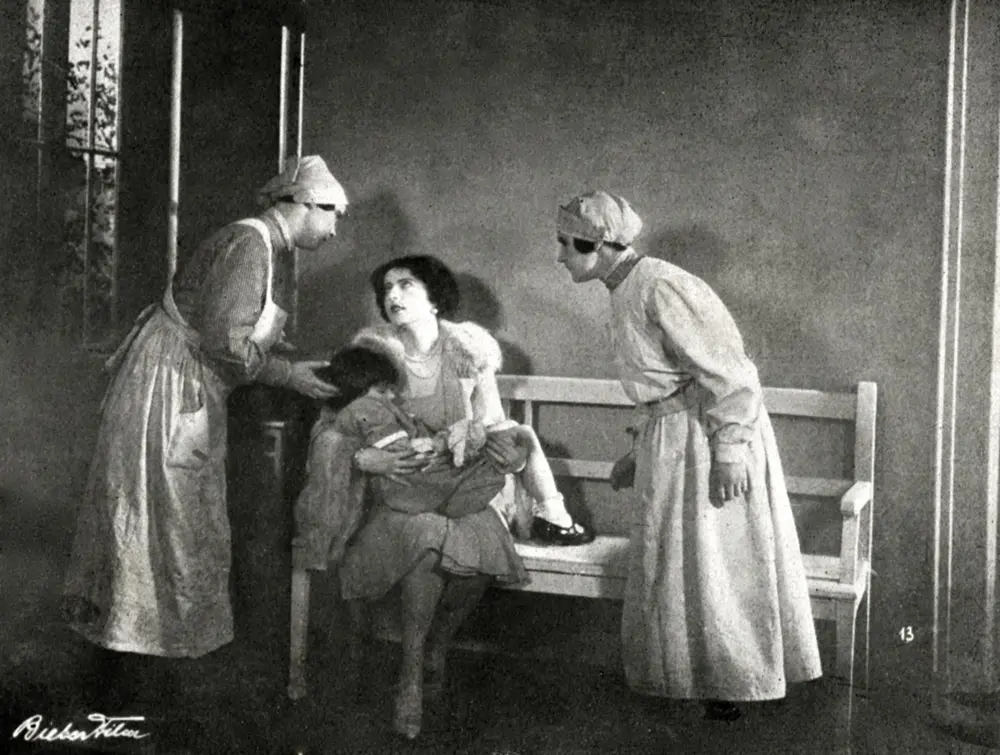
The film's central conflict crystallizes when Elara, facing the unimaginable choice between her children starving or enduring the cold, impersonal embrace of an orphanage, makes the ultimate sacrifice. She entrusts them to the Ashtons, a childless, affluent couple from the tranquil countryside, who promise to 'take her children in amongst their own.' This pivotal decision is not merely a plot device; it is the beating heart of the narrative, a crucible where love, desperation, and moral ambiguity are forged. The Ashtons, initially presented as benevolent saviors, gradually reveal a more complex motivation. Their compassion, while genuine, is tinged with a possessiveness that subtly begins to erase Elara's memory from the children's lives. This nuanced exploration of human nature—where good intentions can inadvertently inflict new wounds—is a hallmark of sophisticated storytelling, rarely seen with such profound clarity in films of this period.
Lyell’s performance during these agonizing sequences is particularly noteworthy. Her silent cries, her furtive glances back at her departing children, are etched with a raw, visceral emotion that bypasses intellectual understanding and pierces directly to the soul. It is a masterclass in the art of non-verbal communication, a testament to her profound understanding of character and the medium itself. The directorial choices, even without a credited director readily available, demonstrate an astute grasp of visual metaphor. The stark contrast between the sooty industrial backdrop of Elara's struggle and the pastoral serenity of the Ashton's estate is not merely a change of scenery; it is a visual representation of the chasm between two worlds, and the profound social inequalities that defined the era. The cinematography, though perhaps rudimentary by today's standards, uses composition and lighting to heighten the emotional stakes, drawing the viewer into Elara's internal turmoil.
As Elara embarks on her arduous journey to regain financial independence, the film becomes a powerful testament to resilience. Her struggle against the odds is depicted with an unflinching realism, highlighting the societal barriers faced by women, particularly widowed mothers, in an age devoid of robust social safety nets. This aspect of the narrative resonates with the themes of perseverance against adversity found in films like Shore Acres, which often celebrated the indomitable spirit of individuals facing overwhelming personal and economic challenges. However, 'We'll Take Her Children in Amongst Our Own' adds a layer of profound moral complexity, questioning the very nature of charity and the rights of a birth mother versus adoptive parents. The film doesn't offer easy answers, instead inviting the audience to grapple with these difficult ethical dilemmas alongside its characters.
The character of the Ashtons, initially presented with almost angelic altruism, evolves into a more ambiguous figure. Their love for the children is genuine, yet their actions, particularly in subtly distancing the children from their biological mother, raise uncomfortable questions about ownership, memory, and the true meaning of family. This delicate balancing act, where no character is purely villainous or purely saintly, is where the film truly shines. It avoids simplistic moralizing, opting instead for a portrayal of human beings driven by complex, often contradictory, impulses. This psychological depth, even in the silent era, speaks volumes about the sophistication of the storytelling.
The emotional crescendo of the film arrives with the inevitable confrontation, a scene charged with years of unspoken longing, sacrifice, and burgeoning resentment. Lyell’s performance here is nothing short of iconic. Her face, a canvas of raw emotion, conveys the agony of a mother yearning for her children, yet understanding the comfortable life they now lead. The children, caught between two worlds, embody the film's central conflict, their innocent confusion reflecting the profound moral quandary at hand. The film's resolution, without giving too much away, is deeply affecting, choosing poignancy over simplistic sentimentality. It leaves a lasting impression, prompting introspection on the nature of unconditional love and the sacrifices parents make.
Beyond its powerful narrative, 'We'll Take Her Children in Amongst Our Own' serves as a crucial historical document, offering a glimpse into the social fabric and moral anxieties of the early 20th century. It speaks to the burgeoning awareness of child welfare, the stark realities of poverty, and the evolving roles of women in society. The film’s thematic richness is undoubtedly influenced by Victor Hugo, whose literary masterpieces consistently explored the darker undercurrents of society, advocating for justice and compassion. One can see echoes of Hugo's profound humanism in every frame, a persistent plea for understanding and empathy in a world often devoid of both. While not a direct adaptation, the spirit of his work, particularly his focus on the plight of the downtrodden, is undeniably present.
The film's enduring legacy lies in its ability to transcend its historical context and speak to universal themes. The dilemma faced by Elara, though framed by the specific socio-economic conditions of her time, is one that resonates across generations: the agonizing choices parents sometimes must make for the welfare of their children, the complexities of adoption, and the indelible bond between a mother and her offspring. It challenges the viewer to consider what truly constitutes a family, whether it is blood, circumstance, or an act of profound, selfless love. This nuanced approach to such sensitive subjects is what elevates this film beyond mere melodrama, positioning it as a significant work of early cinematic art.
In an era where many films relied on broad strokes and overt theatricality, 'We'll Take Her Children in Amongst Our Own' distinguishes itself through its psychological depth and subtle characterizations. Lottie Lyell's performance, in particular, anchors the film, imbuing Elara with a dignity and resilience that makes her struggles profoundly relatable. Her ability to convey intense emotion through expression and gesture, without the aid of spoken dialogue, is a testament to the power of early screen acting. This mastery of visual storytelling is a reminder of the foundational artistry upon which all subsequent cinematic achievements have been built. It’s a performance that stands proudly alongside the most memorable portrayals of the silent era, showcasing the raw, untamed talent that defined its stars.
The film's exploration of societal responsibility also merits significant attention. It implicitly critiques a system that, despite its charitable intentions, often failed to provide adequate support for those in dire need, forcing individuals into impossible positions. This social commentary, though subtle, is potent, echoing the reformist spirit that permeated much of the literature and art of the period. It’s a film that doesn't just tell a story; it asks uncomfortable questions about the world it depicts and, by extension, our own. The plight of Elara is not an isolated incident but a microcosm of broader societal failings, a narrative thread common in Hugo's works. The film serves as a powerful reminder that while individual acts of kindness are crucial, systemic change is often necessary to truly alleviate suffering.
Stylistically, the film adheres to many conventions of its time but manages to inject them with fresh vitality. The use of intertitles is judicious, serving to advance the plot and provide crucial emotional context rather than merely narrating events. The pacing, while deliberate, builds a steady emotional momentum, drawing the viewer deeper into Elara's world. The visual composition often places characters within vast, imposing landscapes or confined, claustrophobic interiors, mirroring their internal states. This thoughtful approach to visual storytelling ensures that the film's message is conveyed with maximum impact, even without the benefit of sound. It’s a masterclass in how to use the silent medium to its fullest expressive potential, a lesson in economy and impact that many modern filmmakers could still learn from.
Comparing it to other films of the era, one might find thematic similarities with works like The Fifth Commandment, which delves into familial duties and moral obligations, or even the broader sweep of human struggle depicted in In the Days of the Thundering Herd, albeit in a vastly different setting. However, 'We'll Take Her Children in Amongst Our Own' distinguishes itself through its laser focus on the psychological and emotional toll of a mother’s sacrifice, making it an intensely personal and deeply moving experience. It is less about grand historical events and more about the quiet, heroic battles fought within the human heart.
The film's title itself is a poignant encapsulation of its core theme. 'We'll Take Her Children in Amongst Our Own' carries an initial ring of benevolence, but as the narrative unfolds, it reveals the complex layers beneath such an act—the unspoken assumptions, the potential for erasure, and the inherent power dynamics at play. It forces the audience to question whether taking children 'in amongst your own' truly means integrating them while honoring their past, or absorbing them to the point of effacing their origins. This ambiguity is one of the film's greatest strengths, allowing for multiple interpretations and fostering a rich, ongoing dialogue about its themes long after the credits roll.
In conclusion, 'We'll Take Her Children in Amongst Our Own' is far more than a historical artifact; it is a timeless exploration of human resilience, the complexities of love, and the profound sacrifices made in the name of family. Lottie Lyell delivers a performance that transcends the limitations of the silent screen, infusing Elara with an unforgettable blend of vulnerability and strength. Its thematic depth, inspired by the social realism of Victor Hugo, ensures its place not just in the annals of early cinema, but as a compelling piece of storytelling that continues to provoke thought and stir the emotions of contemporary audiences. It reminds us that some stories, told with enough heart and insight, echo across the decades, their messages as potent today as they were a century ago. This film is a powerful testament to the enduring human spirit and the intricate, often painful, tapestry of family bonds. It is a cinematic experience that stays with you, prompting reflection on the societal constructs that shape our lives and the unwavering power of a mother's love.
The lasting impact of 'We'll Take Her Children in Amongst Our Own' cannot be overstated. It is a film that demands to be seen, not just for its historical significance, but for its raw emotional power and its unflinching look at the human condition. It serves as a powerful reminder of the foundational artistry of early cinema and the timeless appeal of stories that delve into the profound depths of human experience. The film’s quiet intensity and the depth of its characterizations contribute to its enduring power, making it a critical piece for anyone interested in the evolution of dramatic storytelling on screen. Its influence, though perhaps not as overtly celebrated as some contemporaries, is undeniable in the subtle ways it shaped the narrative potential of film. The emotional resonance of Elara's journey, brought to life so vividly by Lyell, is a cinematic triumph that continues to reverberate, a testament to the universal language of suffering and love.
Community
Log in to comment.