DbcultAccessing Vault...
Cult Review
Senior Film Conservator
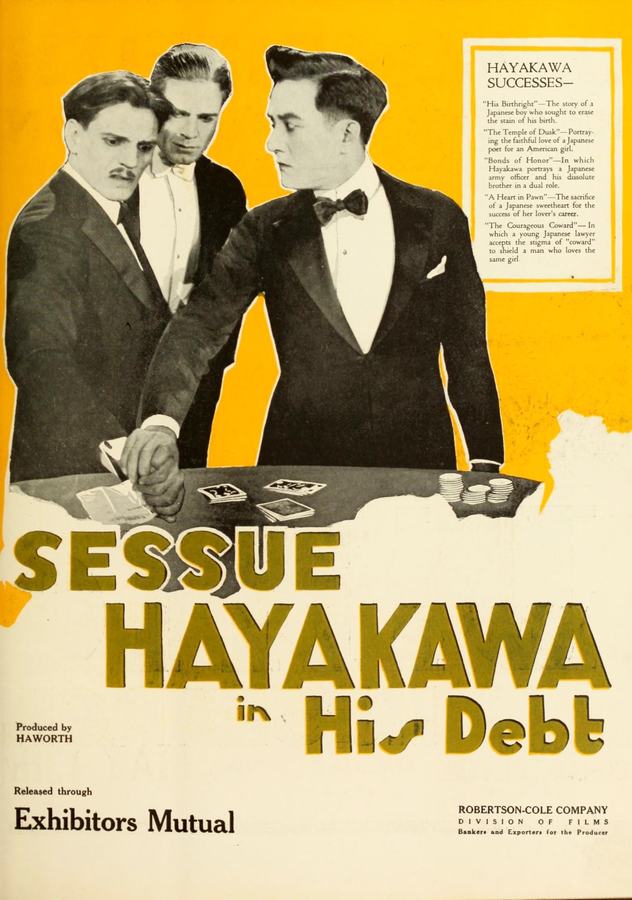
Stepping into the shadowy, morally ambiguous world of His Debt (1919) is to confront a cinematic relic that, despite its century-old vintage, still pulsates with an uncomfortable relevance. This silent drama, a vehicle for the incomparable Sessue Hayakawa, delves into the intricate tapestry of honor, prejudice, and the often-unseen costs of societal norms. It's a film that demands more than passive viewing; it requires an engagement with its challenging themes, an understanding of the era's racial landscape, and an appreciation for the nuanced craft of its star.
At its core, the narrative penned by L.V. Jefferson and Frances Guihan presents us with Goro Mariyama, a figure of intriguing contradictions. Hayakawa imbues Goro with a quiet dignity, a man who operates a gambling house, yet funnels its profits into altruistic ventures, a sort of Robin Hood of the back alleys. This ethical tightrope walk immediately sets Goro apart, positioning him not merely as a gambler, but as a complex moral agent navigating a world that often refuses to see beyond surface appearances. His principled approach to an inherently illicit enterprise is a fascinating character beat, one that hints at a deeper philosophical struggle within him. He is a man attempting to carve out a space for good in a system that often thrives on exploitation, an outsider striving for an internal code of ethics in a world that often judges him by external markers.
The film’s inciting incident, a high-stakes poker game, introduces us to Blair Whitcomb, played with a suitably villainous sneer by Francis McDonald. Whitcomb, a man devoid of Goro's moral compass, accuses Goro of cheating, a charge that escalates swiftly into violence. The ensuing gunshot, leaving Goro with a punctured lung, is not merely an act of physical aggression but a symbolic assault on Goro's carefully constructed world of benevolent self-governance. It strips him of his agency, rendering him vulnerable, dependent on the very society that often marginalizes him. This moment is pivotal, forcing Goro out of his self-contained world and into the care of others, specifically, nurse Gloria Manning.
Jane Novak, as Gloria, embodies the archetype of the compassionate caregiver, her performance radiating a quiet strength and empathy. Her diligent efforts are what pull Goro back from the brink, a life-saving act that forms the bedrock of a profound, albeit tragically unrequited, connection. Hayakawa's portrayal of Goro's burgeoning affection for Gloria is a masterclass in silent film acting. His eyes, his subtle gestures, convey a depth of emotion that transcends dialogue. It’s a love born of vulnerability and gratitude, a connection forged in the crucible of suffering. The subsequent revelation of Gloria’s engagement to Blair Whitcomb, the very man who nearly ended Goro's life, lands with the force of a physical blow, a cruel twist of fate that underscores the film's tragic sensibilities.
The narrative then pivots, transforming from a story of survival and nascent romance into a compelling exploration of justice, vengeance, and the titular concept of 'debt.' Goro, having recovered, discovers Blair's $10,000 wager was paid with a bad check, adding financial deceit to attempted murder. This double betrayal fuels Goro's resolve, leading him to demand a personal confrontation with Blair. When Blair complies, Goro, with a calculated precision, has him arrested for attempted murder. This act is not simply about revenge; it's about a demand for accountability, a yearning for a form of justice that has, until this point, eluded him. It's a statement that even a man operating on the fringes of society deserves the protection and rectitude of its laws.
Here, the film introduces its most potent and, for contemporary audiences, most challenging theme: racial prejudice. Gloria, desperate to secure Blair's release, confronts Goro, pleading for leniency. It is during this emotionally charged exchange that she delivers the crushing blow, revealing that she can never reciprocate Goro's love because he is of a different race. This declaration, delivered with a raw honesty that stings even across the decades, encapsulates the pervasive and unyielding racial barriers of the era. It's a stark reminder that even acts of heroism and profound personal connection were often secondary to the entrenched prejudices of the time. This moment is the film's true turning point, shifting Goro's personal quest for justice into a profound commentary on systemic injustice.
Hayakawa's reaction to this revelation is heartbreaking. His performance here, a silent maelstrom of disappointment, resignation, and profound sadness, is arguably the film's most powerful moment. It's a testament to his incredible skill that he conveys the weight of this societal rejection without a single spoken word. The external wound of the gunshot pales in comparison to the internal laceration inflicted by Gloria's words. It’s a moment that resonates with the struggles faced by many actors of color in early Hollywood, including Hayakawa himself, who often found their romantic aspirations on screen curtailed by racial biases. His characters, like Goro, were frequently denied the conventional happy ending afforded to their white counterparts, a reflection of the societal limitations of the time.
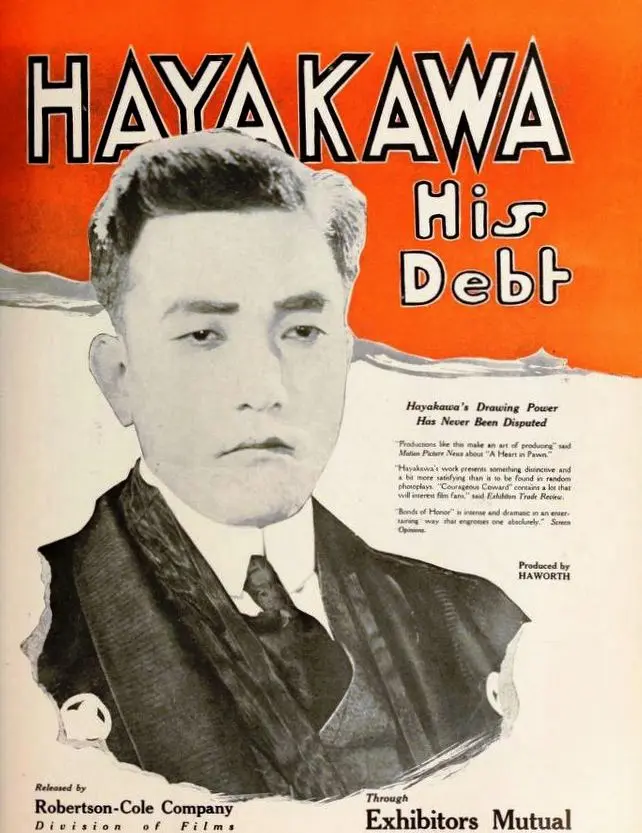
The climax of the film sees Goro making a monumental decision. The disappointed Goro enables Blair's escape, not out of forgiveness for Blair, but as a profound, albeit painful, payment to Gloria for saving his life. This act of self-sacrifice is complex. It is Goro fulfilling his 'debt' to Gloria, a life for a life, but it also highlights the tragic reality that his personal happiness and desire for justice are secondary to the societal demands placed upon him. He gives up his claim to justice, and to Gloria, in an act of ultimate, unrequited devotion. It's a poignant end, leaving the audience to grapple with the bitter taste of a justice denied and a love unfulfilled, all in the shadow of racial intolerance.
His Debt is more than just a melodrama; it's a social document, reflecting the anxieties and prejudices of its time. The film’s exploration of racial barriers, particularly through the lens of romantic love, was groundbreaking, if not entirely progressive, for its era. Hayakawa, a superstar of the silent screen, consistently challenged stereotypes through his intense, dignified portrayals, even within the confines of often problematic narratives. His screen presence was undeniable, a magnetic force that drew audiences in, making him one of the highest-paid actors of his time. This film, like many of his works, showcases his ability to infuse even the most constrained roles with a profound humanity.
The direction, while not overtly flashy, effectively builds tension and emotion, relying heavily on the actors' expressive performances. The use of close-ups on Hayakawa’s face, in particular, allows the audience to access Goro's inner turmoil, making his silent suffering palpable. The supporting cast, including Fred Montague in a role that perhaps offered less screen time but contributed to the narrative's texture, helps to flesh out the world Goro inhabits. The film's pacing, characteristic of silent era productions, allows for moments of quiet contemplation, letting the emotional beats land with significant impact.
Comparing His Debt to other films of the period illuminates its unique position. While films like The Combat might showcase Hayakawa in more action-oriented roles, His Debt leans into the psychological drama, exploring the internal battles rather than just external conflicts. Unlike the lighter fare of Peppy Polly or the adventure of Seven Keys to Baldpate, this film grapples with weighty social issues, positioning itself closer to the dramatic intensity of films like I Accuse in its moral seriousness, albeit with a distinct cultural lens. The thematic resonance with the ethical dilemmas found in Nurse Cavell, though in a vastly different context, lies in the profound personal sacrifices made in the face of larger societal forces. Both films present protagonists who, against great personal cost, adhere to a higher moral code or principle, even if it means denying their own desires or safety.
The concept of 'debt' itself is multifaceted in the film. There's the financial debt Blair owes Goro, a tangible wrong. Then there's the moral debt Goro feels towards Gloria for saving his life, a profound obligation. And finally, there's the societal debt, the burden of prejudice and discrimination that Goro carries simply because of his race. The film suggests that while financial and moral debts can be repaid or atoned for, the debt imposed by societal bias is far more insidious and, ultimately, unresolvable within the narrative's confines. Goro's final act, while seemingly a magnanimous gesture, is tinged with the bitter knowledge that he is paying a debt he never asked for, a price for existing outside the accepted racial boundaries of the time.
The writers, L.V. Jefferson and Frances Guihan, deserve credit for crafting a narrative that, while rooted in the melodramatic conventions of the era, dares to touch upon such sensitive subjects. Their script, though silent, speaks volumes about the human condition and the enduring power of prejudice. The ending, far from offering a simplistic resolution, forces the audience to confront the harsh realities of the characters' world, leaving a lasting impression that lingers long after the final fade to black. It challenges the viewer to consider what true justice looks like when personal desires clash with ingrained societal biases.
In retrospect, His Debt stands as a compelling testament to Sessue Hayakawa's enduring legacy and the silent film era's capacity for profound storytelling. It’s a film that, despite its age, continues to provoke thought and discussion, offering a window into a past where heroism and love often found themselves tragically entangled with the immutable forces of prejudice. It reminds us that cinematic history is not just about entertainment, but also a vital record of societal evolution, or in some cases, its painful stagnation. This film, with its intricate portrayal of a man caught between his own moral compass and the unforgiving dictates of society, remains a powerful, if melancholic, viewing experience. It's a poignant piece that, even today, encourages a deeper reflection on the debts we owe, the debts we collect, and the debts society unjustly imposes.
IMDb —
1920
Community
Log in to comment.