DbcultAccessing Vault...
Cult Review
Senior Film Conservator
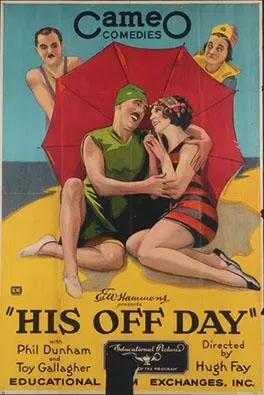
Short answer: No, unless you are a dedicated historian of silent-era slapstick or a completionist of the L-KO Kompany catalog. For the casual viewer, the humor in 'His Off Day' has aged into a frantic, somewhat repetitive relic that lacks the sophisticated choreography of a Keaton or the pathos of a Chaplin. It is a film for those who enjoy the raw, unrefined energy of early 20th-century physical comedy, but it is certainly not for those looking for a cohesive narrative or modern pacing.
This film exists in a vacuum of high-velocity gags that often feel more like an endurance test than a comedy. While it offers a fascinating glimpse into the domestic anxieties of 1918, its reliance on generic 'knock-out' humor means it fails to transcend its era in the way that Mighty Like a Moose eventually would. It works as a museum piece, but as entertainment, it’s a tough sell.
1) This film works because it captures the pure, chaotic id of the L-KO studio style, prioritizing movement over logic.
2) This film fails because it lacks a central emotional anchor, making the slapstick feel hollow after the first ten minutes.
3) You should watch it if you want to see the technical evolution of domestic comedy before the genre became polished.
'His Off Day' is a textbook example of the 'Lehrman Knock-Out' style, a brand of comedy that was famously faster and more violent than Mack Sennett’s Keystone. The plot is a mere skeleton designed to support a series of collisions. Phil Dunham, an underrated workhorse of the silent era, plays a man whose attempt to enjoy a day of rest is systematically dismantled. The film opens with a sequence of domestic mundanity that quickly spirals. Unlike the nuanced character work in The House of Toys, this film treats its characters like billiard balls.
The pacing is relentless. From the moment Dunham’s character tries to settle into his chair, the environment conspires against him. There is a specific scene involving a breakfast table that highlights the era's obsession with mechanical failure. A simple task—pouring coffee or reading a paper—becomes a stunt. The cinematography, handled with the static efficiency typical of 1918, focuses on the wide shot to ensure every tumble and fall is captured in its entirety. It’s functional, not artistic. But it works. But it’s flawed.
Phil Dunham was never going to be a leading man in the traditional sense, but his physicality in 'His Off Day' is impressive. He possesses an elastic quality, a willingness to be thrown across a room that defines the 'off day' experience. Toy Gallagher and Elfie Fay provide the necessary counterweights. In many ways, their performances are more interesting than Dunham’s because they represent the domestic pressure cooker. They aren't just characters; they are obstacles. This is a recurring theme in films of the period, such as My Girl Suzanne, where the female lead is often the catalyst for the protagonist's descent into madness.
However, the acting is also where the film shows its age most prominently. The pantomime is broad—excessively so. Every surprise is met with a full-body recoil; every frustration involves literal hair-pulling. While this was standard for the L-KO brand, it lacks the 'wink' to the audience that made later silents more palatable. When compared to the charm of A Youthful Affair, 'His Off Day' feels aggressive. It’s a comedy of assault rather than a comedy of errors.
The tone of 'His Off Day' is one of sustained hysteria. There are no quiet moments. In modern cinema, we look for 'beats'—moments where the audience can breathe. Here, the director (likely Dunham himself or an uncredited L-KO regular) refuses to let the pressure valve release. This results in a film that feels much longer than its actual runtime. It lacks the rhythmic sophistication found in Shoe Palace Pinkus, which understood that comedy requires a buildup of tension before the release.
One surprising observation is the film’s use of space. The domestic interior is treated as a trap. The furniture is placed specifically to be tripped over. The doors are timed to hit people in the face. This 'hostile architecture' is a fascinating, if unintentional, commentary on the claustrophobia of early 20th-century urban life. It shares a certain DNA with A One Cylinder Love Riot, where technology and environment are the primary antagonists.
Yes, 'His Off Day' is significant because it represents the transition point of American comedy. By 1918, the industry was moving away from the pure 'knock-out' violence of the mid-1910s toward more sophisticated narratives. This film is a holdout. It’s a dinosaur in its own time, clinging to the rough-and-tumble roots of the nickelodeon era while the rest of the world was looking toward features like Captain Swift. It is a vital piece of the puzzle for understanding how slapstick evolved from chaotic movement into the structured storytelling of the 1920s.
The film offers a raw look at 1918 production values. The stunt work, while unpolished, is genuinely dangerous and impressive to witness. It also features a strong ensemble cast of character actors who were the backbone of the short-subject industry. If you want to see the 'meat and potatoes' of early cinema, this is it.
The lack of a coherent story makes it difficult to stay engaged. The print quality of surviving versions is often poor, which can make the fast-paced action hard to follow. Furthermore, the gender dynamics are typical of the era—which is to say, they are dated and often involve the domestic sphere being treated as a place of purely negative conflict.
'His Off Day' is a fascinating failure. It is a high-energy, low-intellect exercise in physical destruction that perfectly encapsulates the 'Knock-Out' philosophy of its studio. While it doesn't have the soul of a masterpiece, it has the sweat of a hard-working production. It’s a film that tries very hard to make you laugh by hitting itself in the face with a hammer. Sometimes that’s enough. Usually, it isn't. If you’ve already exhausted the works of the 'Big Three' (Keaton, Lloyd, Chaplin), then by all means, dive into Dunham’s day off. Just don't expect to come away with anything more than a slight headache and a new appreciation for how far comedy has come. It’s an artifact, not a movie. It works as a punchline, but not as a story.
IMDb 6.4
1936
Community
Log in to comment.