DbcultAccessing Vault...
Cult Review
Senior Film Conservator
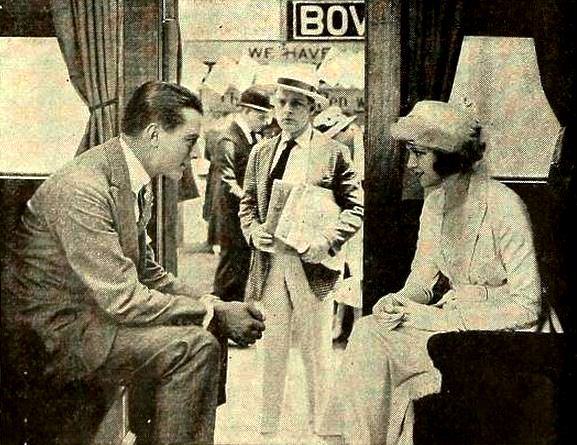
The silent screen has often served as a canvas for the most intricate of social negotiations, yet few films of the late 1910s navigate the precarious intersection of commerce and courtship with as much nuanced dexterity as His Official Fiancée. Directed with a keen eye for the performative nature of class, this 1919 gem offers a fascinating glimpse into a world where the heart is frequently secondary to the ledger. While many films of the era, such as The Railroad Raiders, focused on the externalized propulsion of industrial progress, this narrative retreats into the interiority of the office and the drawing room, exploring the machinery of human relationships.
At the center of this celluloid tapestry is Monica Trant, portrayed with a radiant, albeit restrained, energy by Vivian Martin. In an era where female agency was often depicted through the lens of martyrdom or domestic bliss—think of the moral weight found in The Apostle of Vengeance—Monica represents a burgeoning modern archetype: the working woman who views her labor as a means to an end. Her decision to accept William Waters’ five-hundred-pound proposition is not born of a flighty desire for luxury, but from a pragmatic necessity to support her brother. This economic motivation grounds the film in a realism that was quite revolutionary for 1919.
William 'Still' Waters, played by Forrest Stanley, is the quintessential London businessman of the period. His nickname, 'Still,' is an apt descriptor for a character who has seemingly submerged his emotional life beneath the icy surface of corporate responsibility. Stanley’s performance is a masterclass in subtlety; he manages to convey a mounting internal conflict through the slightest adjustments in posture and the lingering gaze of a man who has forgotten how to be vulnerable. The chemistry between Martin and Stanley is not immediate—and it shouldn't be. It is a slow, agonizing thaw that mirrors the transition from the cold corridors of London commerce to the warmth of a family hearth.
The film’s second act moves to the Waters’ family home, a setting that functions as a theatrical stage for Monica’s performance. Here, the cinematography captures the stifling elegance of the upper-middle class, creating a visual contrast with the utilitarian aesthetics of the opening office scenes. Monica’s success in charming the matriarch (played by Mollie McConnell) and the rest of the household is bittersweet. As viewers, we are forced to grapple with the irony that her most 'perfect' social behavior is entirely fraudulent. This theme of social masks is a recurring motif in silent cinema, often explored with more gothic undertones in films like Alraune, but here it is handled with the lightness of a comedy of manners.
The supporting cast, including Hugh Huntley and Katherine Van Buren, provides a necessary buffer to the central tension. They represent the 'audience' within the film, their genuine affection for Monica serving as the catalyst for Waters' eventual realization that his 'official' fiancée is far more than a business asset. The direction by Robert G. Vignola (though often uncredited in contemporary shorthand, his influence is felt) ensures that the pacing never falters, even as the narrative delves into the psychological toll that such a deception takes on Monica.
When placed alongside its contemporaries, His Official Fiancée stands out for its avoidance of melodrama. While a film like At Piney Ridge might rely on more overt theatricality, this story finds its power in the quiet moments of realization. There is a sophistication to Edith M. Kennedy’s screenplay (adapted from Berta Ruck’s novel) that anticipates the screwball comedies of the 1930s. It lacks the sheer kinetic absurdity of Out of the Inkwell, yet it possesses a grounded wit that makes the characters feel remarkably human.
Furthermore, the film’s exploration of the 'fake relationship' trope is a fascinating precursor to modern romantic tropes. Unlike the rugged individualism seen in The Iron Strain, Waters’ struggle is one of social entanglement. He is trapped by the very systems of business he seeks to master. The foreign client who demands a marital alliance represents the old world's intrusion into the new, a theme also explored with varying degrees of intensity in international works like A vörös Sámson or the Russian Nye dlya deneg radivshisya.
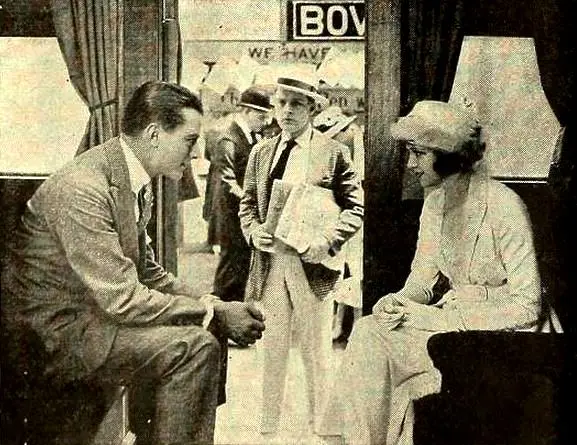
Visually, the film utilizes the limited technology of the time to great effect. The use of intertitles is sparing but impactful, allowing the actors’ expressions to carry the narrative weight. The lighting in the London office scenes is stark, emphasizing the 'business' of the proposition, whereas the lighting in the country estate is softer, more romanticized, reflecting the shift in Waters’ internal state. This visual dichotomy is as effective as the thematic shifts in Es werde Licht! 4. Teil: Sündige Mütter, though far less didactic in its execution.
One cannot overlook the costume design, which subtly tracks Monica’s transformation. As she moves from the drab attire of a stenographer to the elegant gowns of a fiancée, her physical presence expands. She becomes a figure of authority in her own right, no longer just a shadow in Waters’ office. This evolution of the female image is a hallmark of Vivian Martin’s career, often placing her in roles that required both vulnerability and a steely resolve, much like the characters found in A Pair of Cupids or the adventurous Me and Captain Kidd.
The turning point of the film—Monica’s departure—is handled with a refreshing lack of hysterics. Her resentment of the 'business nature' of the arrangement is a modern sentiment, a refusal to be commodified. This sequence is reminiscent of the social friction found in The Waybacks, where the expectations of the family unit clash with individual desires. When Waters finally tracks her down in London, the revelation of his true motive—avoiding a forced marriage for the sake of a business deal—recontextualizes his previous coldness. It wasn't that he didn't care for Monica; it was that he was so terrified of being a pawn himself that he inadvertently made her one.
The resolution, where Monica forgives him and they agree to an engagement 'in earnest,' is a satisfying conclusion that feels earned rather than forced. It is a moment of pure cinematic catharsis, comparable to the emotional payoffs in Les frères corses or the lighthearted resolutions of The Song and the Sergeant. The film successfully navigates the transition from a cynical contract to a sincere connection, suggesting that even in the most rigid of social structures, there is room for genuine human emotion.
In the broader canon of silent cinema, His Official Fiancée deserves a place of honor for its psychological depth and its nuanced portrayal of class and gender. It may not have the detective intrigue of Mistinguett détective, but it possesses a far more enduring resonance in its exploration of the human heart. The performances by Vivian Martin and Forrest Stanley remain compelling over a century later, proving that the complexities of love and money are timeless.
For the modern viewer, this film serves as a reminder that the 'romantic comedy' has always been a vehicle for exploring the most pressing social issues of the day. Through the lens of a fake engagement, we see the real struggles of a generation navigating the aftermath of a world war and the shifting tides of economic power. It is a sophisticated, charming, and ultimately moving piece of cinema that continues to shine with a quiet, persistent brilliance.
IMDb —
1936
Community
Log in to comment.