DbcultAccessing Vault...
Cult Review
Senior Film Conservator
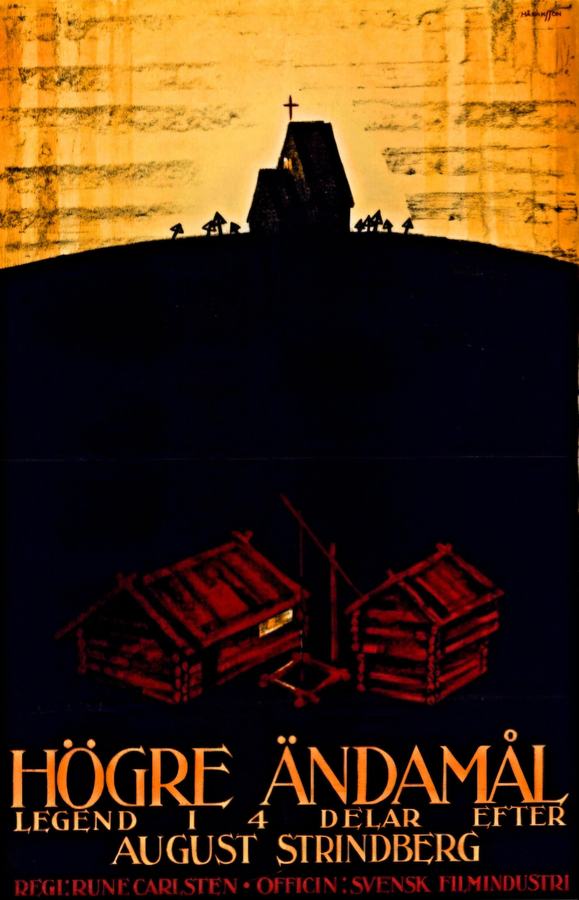
To witness Högre ändamål (Higher Purposes) is to step into a sepia-toned abyss where the spiritual and the carnal engage in a terminal wrestling match. Directed by Rune Carlsten and adapted from the biting prose of August Strindberg, this 1921 silent relic remains one of the most intellectually demanding explorations of institutional dogma ever committed to celluloid. While contemporary audiences might view the 13th-century decree of clerical celibacy as a dusty historical footnote, Carlsten breathes a terrifying, immediate life into the conflict, transforming a theological shift into a claustrophobic horror of the soul.
The pedigree of the writing—involving August Strindberg, Sam Ask, and Carlsten himself—ensures that the film avoids the simplistic moralizing often found in early cinema. Strindberg’s influence is palpable in the way the film treats the 'battle of the sexes' not as a romantic comedy, but as a Darwinian struggle for survival within the confines of societal expectation. Unlike the more adventurous, almost pulp-like sensibilities of The Ranger of Pikes Peak, which deals with external threats and rugged landscapes, Högre ändamål is an internal landscape of jagged edges and cold stone.
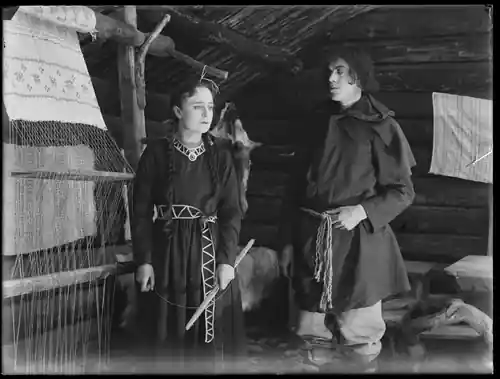
The narrative trajectory is deceptively simple but emotionally labyrinthine. Peder, portrayed with a haunting, wide-eyed despair by John Ekman, is a man whose faith is inextricably linked to his humanity. When the Church votes for celibacy, they aren't just asking for a change in lifestyle; they are demanding the amputation of his heart. The scenes where Peder must confront his wife, played by the luminous Edith Erastoff, are staged with a funereal weight. Every frame feels heavy with the scent of incense and the chill of unheated cathedrals.
Visually, the film is a masterclass in early Swedish expressionism. The use of shadow is not merely a stylistic choice but a thematic one. The darkness that creeps into the corners of Peder’s home mirrors the encroaching reach of the Vatican. While films like A Daughter of the City might utilize urban sprawl to depict isolation, Carlsten uses the very architecture of the church to imprison his characters. The high, vaulted ceilings don't point toward heaven; they loom like the ribs of a giant beast that has swallowed the protagonists whole.
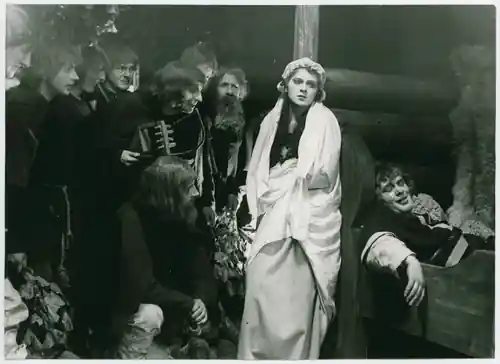
The pacing is deliberate, almost liturgical. It demands a patience that rewards the viewer with a deep, resonating pathos. We see the slow erosion of Peder’s resolve. The 'higher purpose' promised by the title becomes an increasingly hollow justification for what is essentially a bureaucratic cruelty. This thematic density elevates it far above the standard melodrama of the era, such as The Unwelcome Mrs. Hatch, which, while poignant, lacks the metaphysical weight found here.
Edith Erastoff’s performance is nothing short of revolutionary for 1921. In an era where silent acting often leaned toward the histrionic, Erastoff finds a quiet, devastating stillness. Her portrayal of the discarded wife is a study in betrayal. It is the betrayal of a woman who followed the rules of her time, only to have the rules changed mid-game by men in distant rooms. Her chemistry with Ekman is vital; without it, the central conflict would feel like an academic exercise. Instead, it feels like a murder.
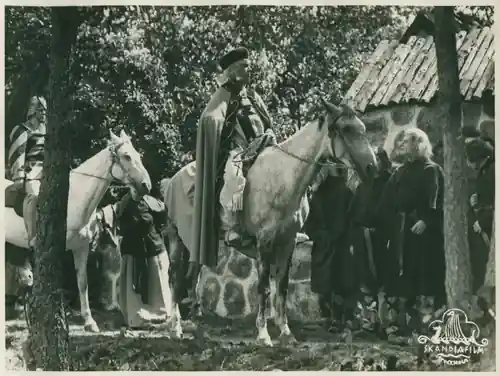
John Ekman, conversely, captures the agonizing paralysis of the 'middle man.' He is neither a hero nor a villain; he is a cog in a divine machine that has begun to grind him to dust. His performance reminds me of the moral ambiguity found in Within the Cup, where the struggle between personal desire and societal duty takes center stage. However, in Högre ändamål, the stakes are not merely social standing, but eternal salvation.
One cannot ignore the cynical irony that Strindberg likely intended. The 'higher purpose' is a political stratagem disguised as spiritual purity. The film subtly critiques the way institutions weaponize faith to consolidate power. By forcing priests to abandon their families, the Church ensures that their only loyalty is to the institution. It is a bleak, almost nihilistic view of organized religion that feels startlingly modern. Even lighter fare like A Lady Bell Hop's Secret or the comedic relief of Monkey Stuff seems to exist in a different universe than the grim, ascetic reality of Peder’s world.
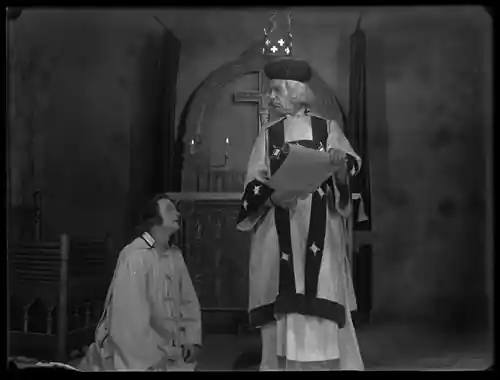
The supporting cast, including Ivar Nilsson and Jessie Wessel, provides a textured backdrop of a society in flux. We see the ripples of the celibacy decree as it affects the entire community. It is a collective trauma, a forced reordering of the medieval social fabric. The film doesn't shy away from the collateral damage—the children who become illegitimate overnight, the wives who are turned into social pariahs.
Comparing Högre ändamål to the American westerns of the time, like A Daughter of the West, reveals a fascinating cultural divide. While the American films were often preoccupied with the expansion of the frontier and the triumph of the individual, Swedish cinema was looking inward, dissecting the rot within the establishment and the tragedy of the soul. There is no 'frontier' for Peder; there is only the cell and the altar.

The film’s technical prowess for the early 20s is evident in its set design. The recreations of 13th-century interiors are not merely decorative; they are functional parts of the storytelling. The coldness of the stone is almost palpable. You can almost feel the draft coming through the slits in the monastery walls. This immersion is what separates a great film from a merely good one. It doesn't feel like a costume drama; it feels like a documentary of a forgotten sorrow.
Ultimately, Högre ändamål is a meditation on the fragility of human happiness when faced with the juggernaut of ideology. It asks the question: what do we owe to the structures we serve, and what do we owe to the people we love? The film offers no easy answers. Peder’s eventual submission to the church’s will is not portrayed as a victory of faith, but as a tragic defeat of the human spirit. It is a surrender that leaves him a hollow shell, a 'holy' man who has lost his holiness by sacrificing his humanity.
For those who appreciate cinema that challenges the intellect and stirs the deepest, most uncomfortable emotions, this film is essential viewing. It lacks the escapism of The Yankee Way or the whimsical charm of The Little Clown, but it possesses a gravity that those films cannot hope to achieve. It is a somber, beautiful, and ultimately devastating work of art that proves that the most profound conflicts are not fought on battlefields, but in the quiet corners of the human heart.
In the final analysis, Carlsten and Strindberg have created a cinematic liturgy for the broken. The film stands as a testament to the power of silent cinema to convey complex theological and psychological states without the need for a single spoken word. The faces of Ekman and Erastoff tell us more about the 13th century—and about ourselves—than a thousand history books. It is a masterpiece of light, shadow, and unutterable grief.
Note: For those interested in other explorations of moral fortitude and the harshness of life, consider comparing this work to the gritty realism of The Prospector's Vengeance or the social commentary of A Taste of Life. Each offers a unique perspective on the human struggle against an indifferent world.
IMDb —
1915
Community
Log in to comment.