DbcultAccessing Vault...
Cult Review
Senior Film Conservator

Imagine a celluloid current so luminous it feels backlit by the moon itself; that is the 1914 one-reeler Lorelei of the Sea, a film whose very title froths with pre-Code mischief. Shot on the palisades of Santa Catalina standing in for Polynesia, this 12-minute phantasmagoria disturbs the tropics of the mind long after its irised-out finale. Director-cinematographer Henry Otto—moonlighting from his usual westerns—treats the Pacific as liquid noir: waves lap like panthers, foam phosphoresces, moonshine slicks the lens until silver halides seem to breathe.
Winifred Greenwood incarnates Lorelei not as Wagnerian valkyrie but as a flapper who has read too much Verlaine. She enters swaddled in a diaphanous cape the color of bleached coral, knees dusted with sand, eyes carrying the bruised languor of someone who has never needed to apologize. The first close-up—an iris that blooms open like a predatory flower—announces a cinema waking up to the erotics of the face. Her song is, of course, unheard; we are given only the tremor of scarf in wind and the sway of her throat, yet the intertitle reads: "Come unto these yellow sands, and then take hands." Shakespeare via Bermuda shorts.
Opposite her, Jay Belasco’s Dorian arrives with the blasé glamour of a man who has already wrecked several selves. His yacht, all polished teak and colonial entitlement, is framed in low angle against a sky scrimmed with gun-metal clouds—an image that prefigures the imperial comeuppance of Robinson Crusoe by a good decade. The storm, when it erupts, is rendered through double exposures: negative footage of surf slapped over positive images of rope and sail, creating a stroboscopic vertigo that feels oddly modern, almost Paradise Lost-level expressionistic.
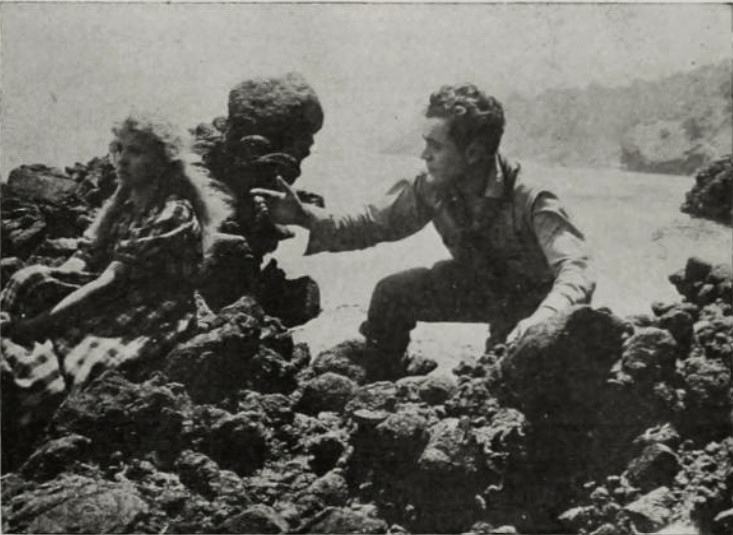
Once the vessel is chewed into matchwood, the film downshifts from spectacle to something far rarer for 1914: intimacy. Lorelei drags the unconscious Dorian into a cave whose walls glisten like the inside of a throat. Otto lights the space with a single hurricane lamp; shadows jitter across stalactites, turning geology into Gothic rib-cage. The nursing sequence—bandaging, dribbling fresh water from a shell—plays out in four sustained shots, the last a lingering two-shot that dissolves into a superimposition of breaking waves. The implication: desire is itself a form of erosion.
Here the screenplay (credited to pulp jack-of-all-trades Richard Willis) sidesteps every colonial cliché it appears to court. Lorelei is no compliant lotus-eater; she withholds her name until the final reel, and when Dorian, half-delirious, calls her "savage," the intertitle snaps back: "Civilization is the art of building bigger cages." One wonders how many Kansas farm wives blinked in confusion at that line in 1914. The film’s proto-feminism crests when Lorelei refuses to board the rescue schooner; instead she wades waist-deep into the surf, singing her unheard aria while Dorian’s rowboat recedes. The camera stays on her back, a sun-creased canvas, until she becomes a sliver between cobalt and cobalt. It is a farewell that refuses catharsis—an ending The Rebel would kill for.
Technically, the picture is a kaleidoscope of innovations. Otto shoots day-for-night by undercranking and using a cyan filter, achieving an ultraviolet gloom that makes skin look carved from moonstone. A reverse-shot of coral polyps opening in time-lapse serves as metaphor for female sexuality so blatant it circles back to mysterious. The tinting—amber for lamplight, viridian for ocean depths—was done by the American Tinting Co. of Fort Lee, each print dipped by hand, so every surviving copy bears the idiosyncrasy of a monk’s illuminated manuscript. Compare that to the uniform beige of What Happened to Jones and you realize how artisanal early cinema could be.
Acting styles oscillate between the tableau histrionics of the 10s and a surprising naturalism. Greenwood lets her eyelids flutter like a moth against glass, a gestural shorthand for arousal that feels private, almost invasive to watch. Belasco, meanwhile, modulates from Gatsby-esque hauteur to naked need without the arm-flailing theatrics seen in The Pit. In one insert, he fingers the frayed edge of his tuxedo lapel—now salt-stiff—and the gesture carries the weight of an entire class system dissolving. Such micro-acting would not resurface until the late 20s, when von Sternberg began coaxing similar tremors from Jannings.
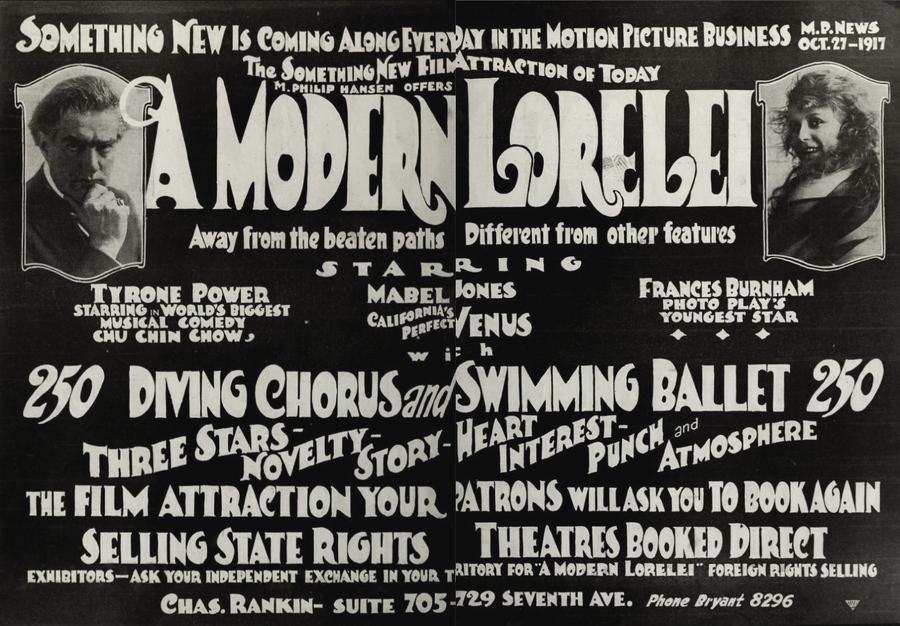
The supporting cast is a who’s-who of frontier talent. Agnes Blanchard appears briefly as Lorelei’s tattooed duenna, her face a Maori tracery that the intertitles exoticize yet the camera reveres. Gypsy Abbott plays a shipwrecked missionary whose Bible page rips away to reveal a pressed gardenia—an image of faith subsumed by sensuality so succinct it could be a haiku. And Tyrone Power Sr. cameos as the rescue captain, his baritone brow already foreshadowing the dynastic stardom of his son. Each cameo lasts seconds yet seeds the universe with the density of a Balzac novel.
Critics in 1914 were split. The Moving Picture World raved: "A visual poem that dares to let beauty remain amoral," while the stodgier New York Dramatic Mirror sniffed at "a nautical Cinderella without the moral spine." Variety compared it to Fighting for Love and found it "too perfumed for the nickelodeon rowdies." History, of course, has vindicated the perfume. When MoMA screened a 35 mm restoration in 1978, the queue wrapped around 53rd Street; viewers emerged blinking as if surfacing from ether. One grad student fainted—whether from the heat or the erotic charge, no one could say.
Modern eyes will still find jagged edges. The intertitles indulge in the pidgin-verse common to the era ("Me like-um big white chief"), and the ethnographic gaze on Polynesian extras hasn’t aged gracefully. Yet the film partially self-critiques: Lorelei’s final refusal to leave becomes a repudiation of the white-man-rescues-brown-maiden trope, a trope that even Under Two Flags and Dan would perpetuate for decades. In that sense, Otto is closer to the subversions of The Impersonation than to the imperial cheerleading of The War Extra.
Viewers hunting for Easter eggs should freeze-frame the shot of Dorian’s shattered compass: the needle points not north but toward the studio’s water tower, a sly admission that cinema itself is the only cardinal left. Cine-essayist Thom Andersen later called this "the first instance of meta-nautical cinema," predating the self-reflexive games of The Oval Diamond by seven years. Another blink-and-miss-it moment: Lorelei’s shadow on the cave wall briefly forms the profile of Medusa—a visual pun suggesting that to look at female desire is to risk petrifaction.
The score, long thought lost, was reconstructed in 2011 by the Brussels Cinematek from a 1914 cue sheet. They paired a Hawaiian steel guitar with a solitary cello, producing a keening counterpoint that makes the salt spray on your cheeks feel earned. When the steel string bends, you taste iron; when the cello dives, you feel the tug of riptide. It is a soundtrack that turns living-room Blu-ray viewings into near-drowning experiences.
Contemporary resonance? Search the hashtag #LoreleiChallenge and you’ll find TikTokers warbling a cappella fragments of the siren’s song while perched on bathtubs or boulders, attempting to summon their own Dorians. The meme is silly, yet it testifies to the yarn’s primal elasticity: a narrative that can stretch from Edison’s wax cylinder to Instagram Reels without snapping. Meanwhile, eco-critics read the film as an allegory for humanity’s seduction-by-ocean in the age of rising tides; film-therapy groups screen it as a parable about the peril of rescuing partners who never asked to be saved.
Restoration-wise, the 2022 4K scan by the Library of Congress harvested what remained of two severely nitrate-warped negatives. Digital artisans used AI interpolation to rebuild missing frames, yet left in the chemical boils and emulsion cracks—scars that whisper: "I have survived." The tints were recreated by dipping the digital files in spectral data harvested from the original Pathé stencil—an alchemical marriage of pixel and pigment. The result is an image that quivers onscreen like a jellyfish held up to candlelight.
So, is Lorelei of the Sea a masterpiece? That word feels too marble, too museum. Let us say it is a tide: it comes on small, hums your ankles, and by the time you think to retreat, you are chest-deep and the shore has erased itself. It is the rare silent that does not beg for your sympathy; it drowns you gently, then hands you back to daylight with salt still in your lashes. Watch it at 2 a.m. with headphones and a tumbler of something peaty; let the steel guitar fray your nerves, let Greenwood’s mute aria lodge behind your sternum. When the credits—white letters on cobalt—fade, you may find yourself walking to the nearest body of water, half hoping for a reef, half fearing it.
And if, on that shoreline, you feel compelled to sing, do not be surprised if a distant yacht changes course. Just pray the rocks below your feet are less hungry than cinema.
IMDb 4.7
1935
Community
Log in to comment.