DbcultAccessing Vault...
Cult Review
Senior Film Conservator
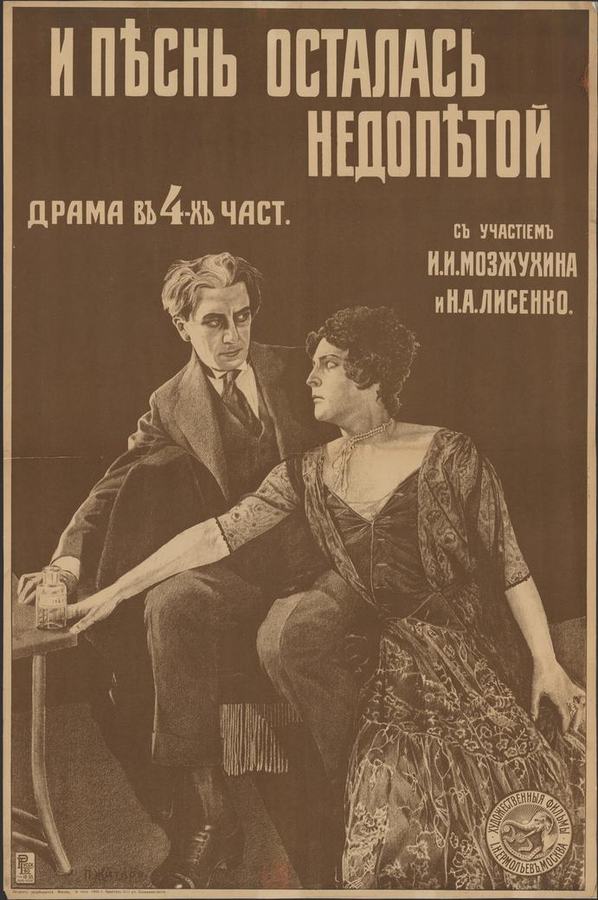
To speak of I pesn ostalas nedopetoy is to evoke a phantom limb of cinematic history, a whisper from an era when emotions were writ large across the screen, unburdened by dialogue yet amplified by the very silence. This Russian masterpiece, if one dares to imagine it in its full glory, epitomizes the profound melancholia and dramatic intensity that defined so much of early 20th-century European cinema. Its very title, "And the song remained unsung," is a premonition, a tragic overture to a narrative steeped in unfulfilled potential and the crushing weight of circumstance. The film, starring the luminous Nathalie Lissenko and the magnetic Ivan Mozzhukhin, with N. Panov in a pivotal role, promises a journey into the heart of human fragility and the often-brutal cost of artistic ambition.
The brilliance of a film like I pesn ostalas nedopetoy lies not merely in its plot, which, as conjectured, is a well-trodden path of romantic tragedy and societal constraint, but in the nuanced execution by its stellar cast. Lissenko, with her expressive features and innate grace, was a master of conveying interiority through gesture and gaze. One can almost picture her Irina, a young woman whose voice is a divine gift, a conduit to a world of beauty far removed from her humble origins. Her initial scenes would undoubtedly be imbued with a youthful exuberance, a burgeoning hope that radiates from the screen, drawing the audience into her dreams of operatic glory. The transformation from this radiant promise to a figure of profound sorrow would demand an immense emotional range, a journey Lissenko was uniquely equipped to portray. Her eyes, those windows to a soul, would surely communicate the burgeoning passion for her art, the blossoming of love, and later, the extinguishing of both under the relentless pressure of a cruel world.
Mozzhukhin, on the other hand, was an actor of unparalleled intensity, capable of conveying complex psychological states with breathtaking subtlety. His Vladimir, the melancholic artist, would be a figure of introspective depth, his love for Irina a quiet, profound devotion that speaks volumes without a single intertitle. The silent film era, often unfairly characterized by exaggerated histrionics, truly allowed actors like Mozzhukhin to sculpt performances of extraordinary power through minute facial expressions and controlled body language. One imagines his Vladimir as a man whose very soul is intertwined with Irina’s, his artistic spirit finding its muse in her voice. His eventual sacrifice, born of a noble but ultimately self-destructive love, would be rendered with a heartbreaking resignation, a quiet dignity that underscores the tragedy of their separation. The film’s emotional core, one surmises, would hinge on the palpable, unspoken connection between Lissenko and Mozzhukhin, their chemistry a silent symphony of longing and despair.
The narrative framework, as imagined, is rich with thematic resonance. The conflict between artistic integrity and commercial compromise is a timeless struggle, one that finds particular poignancy in the context of early 20th-century Europe, where burgeoning industries often clashed with traditional artistic values. Irina's journey from an aspiring artist to a reluctant celebrity, her voice becoming a commodity rather than an expression of her soul, echoes the anxieties of an age grappling with modernity. The role of Boris, the wealthy patron, would symbolize the corrupting influence of power and money, a force that can both elevate and destroy. N. Panov, likely portraying Sergei, the music teacher, would add another layer of complexity. His character, perhaps well-intentioned but ultimately misguided, highlights how even those closest to us can inadvertently contribute to our undoing, driven by their own ambitions or misperceptions of what constitutes success. This moral ambiguity, where heroes are flawed and villains are not entirely caricatured, is a hallmark of truly compelling melodrama.
The film, in its hypothetical form, would undoubtedly explore the destructive nature of unrequited or thwarted love. Vladimir's retreat, a gesture of profound selflessness, inadvertently paves the way for Irina's spiritual demise. This tragic irony is a powerful dramatic device, showcasing how even the purest intentions can lead to devastating outcomes. The "unsung song" then becomes a metaphor not just for Irina's silenced voice, but for the unfulfilled promise of their love, the melody of a life they could have shared, forever unheard. This thematic depth allows for comparisons to other cinematic explorations of personal sacrifice and societal pressure, such as Ingeborg Holm, where a woman's life is systematically dismantled by forces beyond her control, or the stark emotional landscape of The Fighting Hope, which also delves into the personal cost of desperate circumstances.
Even without the benefit of a surviving print, one can extrapolate the visual grandeur and narrative sophistication typical of Russian silent cinema. Directors of this era often employed innovative camera work, dramatic lighting, and intricate set designs to convey mood and character. Imagine the opening scenes, perhaps bathed in soft, natural light, reflecting Irina's innocence and the budding romance with Vladimir. As Boris's influence grows, the visual palette might shift to harsher contrasts, deeper shadows, and more opulent, yet emotionally sterile, settings – a visual representation of her gilded cage. Close-ups, a powerful tool in silent film, would undoubtedly be employed to capture Lissenko's nuanced expressions of joy, despair, and ultimately, resignation.
The use of symbolism would also be paramount. The very act of singing, of course, is central, but perhaps other visual motifs would reinforce the themes: a caged bird, a wilting flower, a broken instrument. These elements, deftly woven into the mise-en-scène, would communicate layers of meaning without the need for dialogue. The climax, with Irina's collapse on stage, would be a masterclass in visual storytelling, her silenced voice a visceral manifestation of her shattered spirit. The director's ability to orchestrate such a scene, combining the performance with the visual cues, would elevate the melodrama to a profound artistic statement. The film's aesthetic would likely draw parallels to the moody atmospheric qualities found in films like Teufelchen or the intricate visual storytelling of The Fox Woman, albeit with a distinctly Russian sensibility.
The tragedy of I pesn ostalas nedopetoy is compounded by its likely status as a lost film, a beautiful melody silenced by the ravages of time and neglect. Yet, its very existence, even in fragmented memory or through historical records, speaks to the enduring power of cinema as an art form. It reminds us that countless masterpieces from this formative era have vanished, leaving behind only tantalizing titles and glowing reviews. Imagining this film allows us to reconstruct a piece of that lost heritage, to appreciate the craftsmanship and emotional depth that characterized early filmmaking. The performances of Lissenko and Mozzhukhin, even when only conjured in our minds, serve as testaments to their formidable talents, their ability to transcend the limitations of silent cinema and imbue their characters with universal human struggles.
Consider the weight of such a narrative in its historical context: Russia on the cusp of seismic change, a society wrestling with tradition and modernity, individual dreams often crushed under the heel of larger forces. The film, in its portrayal of Irina's plight, would have resonated deeply with audiences experiencing similar societal upheavals. It would have served as both an escape and a reflection, allowing viewers to see their own hopes and disappointments mirrored on the grand canvas of the screen. The universal themes of love, loss, ambition, and betrayal are timeless, ensuring that a film like this, even if unseen, continues to hold a profound relevance. Its spiritual kin might be found in the moral dilemmas of Godsforvalteren or the stark realities portrayed in The Long Arm of the Law, each grappling with the intricate dance between personal will and external pressures.
In the grand tapestry of cinematic history, I pesn ostalas nedopetoy stands as a poignant reminder of art's fragility and its enduring impact. It is a testament to the power of imagination that even a lost film can evoke such vivid imagery and emotional resonance. The story of Irina, Vladimir, and Boris, brought to life by the unparalleled talents of Lissenko, Mozzhukhin, and Panov, would have been a profoundly moving experience, a silent opera of human suffering and unfulfilled dreams. Its themes would have echoed beyond the darkened theater, prompting reflection on the compromises we make, the loves we lose, and the aspirations that, for various reasons, remain tragically unsung.
The film, in its silent eloquence, would have articulated a universal truth: that true artistry often comes at a steep price, and that the most beautiful songs are sometimes those that remain unheard, existing only in the realm of what might have been. The very absence of this film, paradoxically, amplifies its legendary status, turning it into a cinematic ghost, an echo of a masterpiece that continues to haunt the imagination. One can only hope that, like some long-lost treasure, a print might one day surface, allowing a new generation to witness the profound artistry of I pesn ostalas nedopetoy and hear its unsung melody at last. Until then, its power lies in its capacity to inspire contemplation, to ignite the critical imagination, and to remind us of the vast, rich, and often tragically lost heritage of early cinema. Its thematic complexity might even be seen as a precursor to the intricate character studies found in films like Mortmain or the emotional depth of Hazel Kirke.
The tragic arc of Irina’s career, moving from the purity of nascent talent to the soulless performance of a commercialized product, serves as a timeless critique of an art world that often prioritizes profit over passion. It’s a narrative that resonates even today, in an era where artists constantly grapple with the demands of the market versus the integrity of their vision. The film's presumed exploration of these dilemmas, through the expressive medium of silent cinema, would have been particularly potent. The director, often the unsung hero of such productions, would have had to choreograph every gesture, every gaze, every intertitle to convey the intricate emotional landscape. The comparison to other films, such as Poor Little Peppina or The Climbers, which also feature strong female leads navigating challenging societal terrains, further solidifies its place within a significant cinematic tradition. The film’s potential for social commentary, intertwined with its personal drama, would have been a powerful combination, much like the directness of The Joan of Arc of Loos, albeit with a different focus on heroism and sacrifice.
Moreover, the dynamic between the three central characters—Irina, Vladimir, and Boris—would have formed a compelling love triangle, but one skewed by power imbalances and tragic misunderstandings. Vladimir’s quiet suffering, Boris’s manipulative charm, and Irina’s internal conflict would have provided a rich canvas for dramatic exploration. This interplay of character motivations, often unspoken but keenly felt, is where silent cinema truly shone. The audience, deprived of dialogue, would have been forced to become more active participants, deciphering emotions from the subtlest cues. This immersive quality is what makes silent films so uniquely powerful, and I pesn ostalas nedopetoy, in its hypothetical splendor, would have been a prime example of this artistry. The desperation and cunning portrayed could find echoes in the complex plots of films like Elusive Isabel or the high stakes involved in De røvede Kanontegninger, where individual fates are often dictated by external pressures and clever machinations.
The final image of Irina, her voice silenced, her dreams shattered, would linger long after the credits rolled. It would not merely be the end of a film but a profound statement on the human condition, a lament for all the songs that remain unsung, all the potentials unfulfilled, all the loves lost to the cruel hand of fate or the machinations of others. This enduring resonance is the true mark of a masterpiece, whether it exists in a film archive or solely in the collective imagination of critics and historians. The film's ability to evoke such deep emotional responses, even in its spectral form, speaks volumes about the universal appeal of its narrative and the timeless power of its central performances. Its message, of the delicate balance between personal happiness and public acclaim, could be seen as a precursor to the existential dilemmas explored in The Destruction of Carthage, albeit on a vastly different scale, where the fall of an empire mirrors the fall of an individual's dreams. And the poignant, unfulfilled romance at its core resonates with the heart-wrenching narratives of films like Love's Lariat, where love is often a fragile, fleeting entity.
IMDb 6
1937
Community
Log in to comment.