DbcultAccessing Vault...
Cult Review
Senior Film Conservator
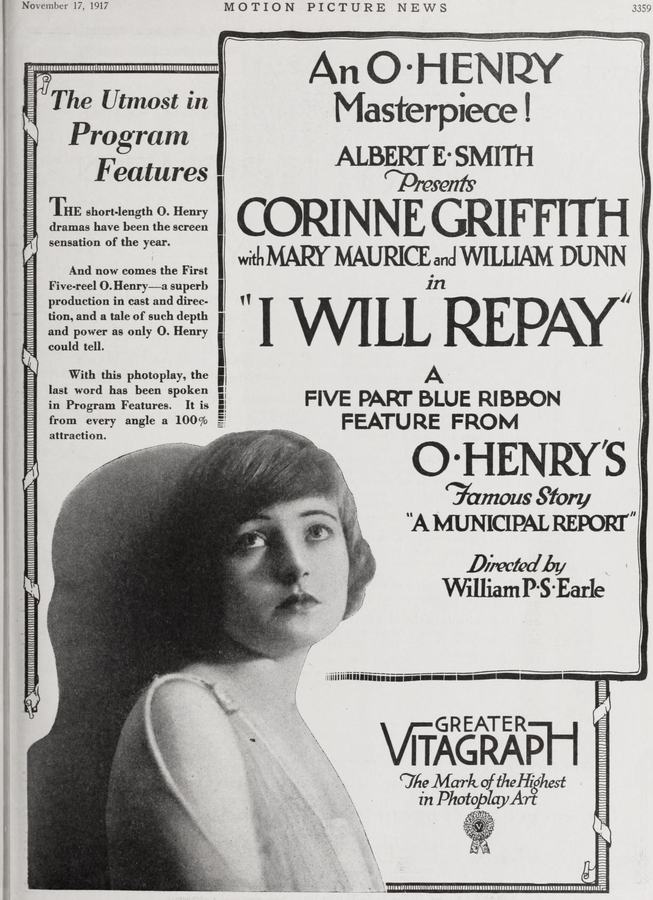
Stepping back into the silent era often feels like entering a different dimension of storytelling, a realm where grand gestures and stark visual metaphors convey emotions far more potent than any spoken word. I Will Repay, a 1917 cinematic endeavor, plunges us into such a world, adapting O. Henry’s poignant narrative with a visceral intensity that transcends its century-old vintage. This isn't merely a historical curiosity; it's a profound exploration of human resilience, the insidious grip of oppression, and the unexpected catalysts for liberation. The film, in its stark black and white, paints a canvas of human suffering and the burgeoning spirit of defiance, making it a compelling watch for anyone interested in the foundational narratives of American cinema and the enduring power of a well-told story.
At the heart of this compelling drama lies Azalea Adair, portrayed with a haunting fragility by Corinne Griffith, whose luminous presence manages to convey a world of unspoken anguish. Azalea is introduced not as a damsel in distress in the conventional sense, but as a woman of profound talent and intellect, a writer whose creative spirit is suffocated by the grim realities of her existence. Her Nashville home is less a sanctuary and more a prison, a testament to the crushing weight of poverty and the brutal hand of her husband, Major Caswell. Eulalie Jensen imbues Caswell with a chilling authenticity, depicting him not just as a drunkard, but as a predatory force, a black hole of avarice and cruelty that consumes every shred of Azalea's hard-won earnings. The film does not shy away from depicting the stark economic realities of its time, where a woman’s financial independence, even through her own creative labor, could be instantly nullified by a domineering spouse. This portrayal of domestic abuse, while necessarily muted by the conventions of silent film, is nonetheless palpable, etched in Azalea's downcast eyes and the weary slump of her shoulders. It’s a powerful, if uncomfortable, reminder of the systemic vulnerabilities faced by women in an era where legal recourses were often scant and societal expectations rigid. The narrative skillfully establishes Azalea's desperate situation, making her plight instantly empathetic and setting the stage for the dramatic intervention that is to come.
The narrative brilliance of I Will Repay is perhaps best exemplified by its ingenious use of a torn dollar bill as a central motif. This isn't just a prop; it's a character in itself, a silent witness to the economic exploitation that underpins Azalea's suffering. When Roger Kendall, the magazine editor’s emissary, arrives in Nashville, his initial objective is purely professional: to secure a contract for Azalea's writing at a paltry two cents a word. Yet, his encounter with Azalea, and his subsequent observations, quickly transform his mission. William R. Dunn’s portrayal of Kendall is nuanced; he isn't merely a hero, but a man whose innate sense of justice is stirred by the stark inequality he witnesses. His initial act of generosity – giving the torn dollar to Azalea’s loyal former slave, Caesar (George J. Forth) – unwittingly sets in motion a narrative device that illuminates Caswell’s depravity with chilling clarity. We follow this humble bill as it navigates the transactional landscape of poverty, ultimately, and tragically, finding its way into Caswell’s grasping hands. This symbolic journey of the dollar bill serves as a powerful visual metaphor for the cyclical nature of Azalea’s oppression. Every cent she earns, every shred of financial autonomy she might hope for, is inevitably seized by her parasitic husband. The film masterfully uses this simple object to underscore the economic injustice, making the audience keenly aware of the relentless drain on Azalea’s spirit and resources. It’s a narrative technique that resonates deeply, highlighting the systemic issues that trap individuals in cycles of abuse and poverty, a theme that, regrettably, remains pertinent even today. This element of the story could draw parallels with other films that explore economic hardship and its impact on personal freedom, such as the social commentary often found in early European cinema like O Crime de Paula Matos or even the stark realities depicted in works like El último malón, though the direct context differs.
Kendall’s character arc shifts from a detached professional to an active participant in Azalea’s fate. His discovery of her abject poverty and Caswell’s exploitation ignites a moral imperative within him. It’s a moment of awakening, a realization that his role extends beyond mere business. He recognizes the inherent value in Azalea’s talent and, more importantly, her inherent dignity as a human being. His subsequent actions are pivotal: convincing his editor to dramatically increase Azalea’s stipend to eight cents a word – a fourfold increase – and securing a crucial $30 advance. This act of genuine benevolence is more than just financial aid; it’s a restoration of hope, a tangible demonstration that someone believes in her worth, both as a writer and as an individual. This intervention is a turning point, not only for Azalea but for the narrative itself, shifting from a chronicle of suffering to a burgeoning tale of potential liberation. It highlights the power of external support in breaking cycles of abuse, a theme that resonates across many dramatic works, including those exploring social advocacy. The film, through Kendall's actions, suggests that sometimes, the most profound changes begin with a simple act of kindness and a willingness to challenge the status quo. His encounter with Virginia Rodney, portrayed by Mary Maurice, further expands this network of compassion. Virginia, the semi-invalid daughter of a local judge and a steadfast friend to Azalea, represents another facet of benevolent support, providing emotional solace and a potential haven, reinforcing the idea that community and friendship are vital in overcoming adversity. This network of support is crucial, illustrating how collective empathy can begin to dismantle deeply entrenched personal and societal problems.
The narrative builds towards an almost inevitable climax, a moment of explosive violence that, while shocking, feels tragically earned. Caesar, Azalea’s former slave, is a character imbued with a quiet dignity and an unwavering loyalty. His presence throughout the film is a testament to the deep bonds forged in the crucible of shared experience, transcending the harsh realities of their societal positions. When Caswell, in a fit of drunken rage, violently seizes Azalea’s hard-won $30 advance, it represents the final straw. This isn't just theft; it’s a symbolic act of utter degradation, a complete disregard for Azalea’s efforts and Kendall’s compassionate gesture. Caesar, witnessing this heinous act, is driven to a desperate, visceral response. His strangulation of Major Caswell is a moment of raw, primal justice, a sudden eruption of long-suppressed fury and protective instinct. It’s a scene that challenges the audience morally, forcing a contemplation of vigilante justice and the limits of endurance. Is Caesar's act justifiable? The film, through its subsequent events, leans towards an affirmative answer, framing it as a necessary evil to break the cycle of abuse.
The aftermath of Caswell’s death is handled with a remarkable swiftness and a subtle acknowledgment of the societal power dynamics at play. Kendall, along with Virginia’s father, the local judge, orchestrates a cover-up, shielding Caesar from the legal repercussions of his actions. This intervention, while morally ambiguous in a strict legal sense, is presented within the film’s ethical framework as an act of profound mercy and a rectification of a greater injustice. It underscores the film’s thematic exploration of justice beyond the letter of the law, suggesting that true justice sometimes requires unconventional means. This plot point is particularly intriguing as it highlights the complexities of morality and the lengths to which individuals will go to protect those they deem worthy. The swift resolution of the legal ramifications, however, also speaks to the romanticized nature of some silent film narratives, where poetic justice often takes precedence over realistic legal processes. One might draw a thematic comparison to films like Sin or A Woman's Fight, where characters grapple with societal expectations and moral compromises in pursuit of a perceived greater good or personal liberation, though the specific circumstances of the "crime" and its aftermath differ.
With Caswell’s tyranny irrevocably ended, Azalea’s liberation is immediate and profound. She is finally free, not just from her abusive husband, but from the crushing weight of her circumstances. Her move to live with Virginia signifies more than just a change of address; it represents a transition into a life of safety, respect, and mutual support. This newfound freedom allows Azalea to reclaim her agency, to nurture her talent without fear of exploitation, and to finally live a life unburdened by constant dread. The film culminates in a resolution that, while born from violence, ultimately champions love and partnership. Virginia and Kendall’s engagement seals the narrative with a sense of hopeful closure. Their union is not merely a romantic pairing; it symbolizes the triumph of decency and compassion over cruelty and greed. Kendall, having journeyed from a detached observer to an active agent of change, finds his reward in a loving relationship with a woman who shares his empathetic spirit. The ending, while perhaps a touch idealistic, provides a satisfying emotional arc, suggesting that even in the face of profound adversity, redemption and happiness are attainable. It’s a classic Hollywood resolution, yet one that feels earned through the preceding narrative's arduous journey.
I Will Repay, as a product of the silent film era, offers a fascinating glimpse into the nascent stages of cinematic storytelling. The acting, while sometimes perceived as melodramatic by modern audiences, was perfectly suited to the conventions of its time, relying on exaggerated expressions and gestures to convey complex emotions without the aid of dialogue. Corinne Griffith, in particular, delivers a performance that transcends mere pantomime, imbuing Azalea with a quiet strength that resonates. The cinematography, though limited by early 20th-century technology, effectively uses composition and lighting to enhance the dramatic tension and highlight the stark contrast between Azalea’s meager existence and the promise of a better future. The use of intertitles is artful, providing necessary exposition while allowing the visual narrative to dominate.
The film’s adaptation of O. Henry’s work is a testament to the enduring appeal of his distinct narrative style, often characterized by surprise endings and a profound understanding of human nature, particularly those on the fringes of society. While the exact O. Henry story isn't explicitly named in the plot synopsis, the themes of unexpected turns, social commentary, and a strong sense of poetic justice are hallmarks of his literary output. This adaptation effectively translates his sensibilities to the screen, demonstrating the power of early cinema to bring beloved literature to a broader audience.
In conclusion, I Will Repay is far more than a historical artifact. It is a potent drama that tackles themes of domestic abuse, economic exploitation, and the quest for justice with a surprising directness for its time. Its characters, from the suffering Azalea to the morally conflicted Kendall and the fiercely loyal Caesar, are etched with memorable strokes. The film reminds us that the struggles for personal freedom and dignity are timeless, and that the courage to intervene, even in the face of societal norms, can pave the way for profound change. Its legacy lies not just in its contribution to silent cinema, but in its unwavering portrayal of human resilience and the enduring hope for a world where compassion ultimately triumphs over cruelty. It’s a film that, despite its age, still has much to say about the human condition and the eternal desire for a just world.
Comparing it to other melodramas of the era, one might see echoes of similar struggles for women's agency in films like The Banker's Daughter or even the dramatic shifts in fortune seen in The Luring Lights. The exploration of moral ambiguities and the fight against societal constraints also find resonance in titles such as When We Were Twenty-One, where youthful ideals confront harsh realities. While the specific narratives diverge, the underlying currents of personal struggle against external forces, and the eventual triumph (or tragic defeat) of the human spirit, connect these works across the silent film landscape. The film stands as a testament to the power of early cinema to not only entertain but to provoke thought and reflect the complex societal issues of its time, offering a window into the past that remains remarkably relevant today.
IMDb 6.8
1920
Community
Log in to comment.