DbcultAccessing Vault...
Cult Review
Senior Film Conservator
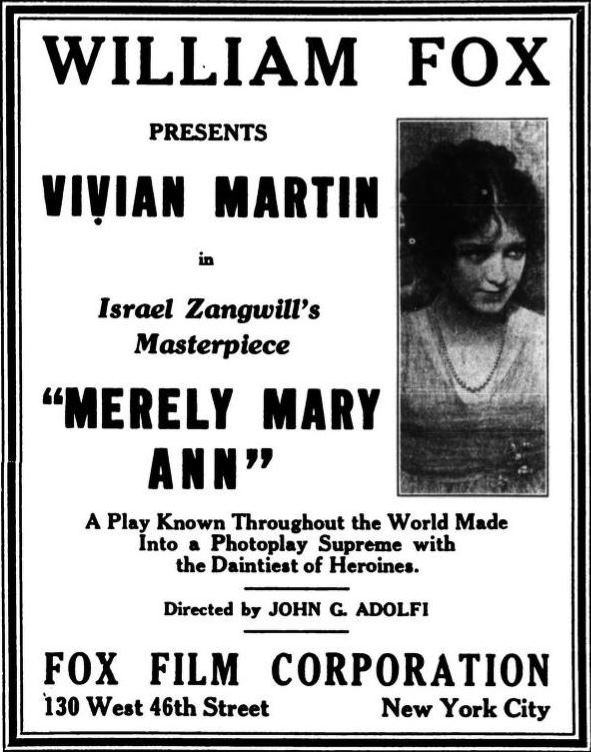
In an era when cinematic language was still in its infancy, when flickering images spoke volumes without uttering a single word, some films managed to etch themselves into the collective consciousness with an indelible grace. Among these treasures is the 1917 production, Merely Mary Ann, a poignant romantic drama that, even over a century later, retains a remarkable capacity to move and captivate. Adapted from Israel Zangwill's widely acclaimed 1904 play and novel, this silent film, directed by John G. Adolfi, transcends its origins to become a masterclass in visual storytelling, exploring themes of class, artistic ambition, and the tenacious spirit of love in the face of adversity.
At the heart of this narrative lies Mary Ann, played with an ethereal blend of innocence and resilience by the luminous Vivian Martin. Her existence is one of perpetual servitude, an orphan's lot in a bustling, indifferent London. We are introduced to her within the drab confines of a lodging house, where her days are a monotonous cycle of chores and thankless tasks. The film paints a vivid, if somber, portrait of her drudgery, emphasizing the physical and emotional toll exacted by her circumstances. Yet, despite the pervasive gloom, Mary Ann is no mere victim. Martin imbues her with an inner light, a quiet dignity that shines through the grime and the weariness. Her eyes, though often downcast, betray a soul yearning for something more profound than mere survival. She is a dreamer, finding solace in the simplest acts of kindness and nurturing a secret hope for a life beyond her station. This portrayal of an underdog fighting against the currents of fate resonates deeply, much like the struggles depicted in films such as Shadows from the Past, where protagonists are similarly tested by the harsh realities of their environment but refuse to be entirely extinguished.
"Martin's performance is a masterclass in silent expression, conveying a universe of unspoken emotions with a mere tilt of the head or a fleeting glance. She embodies the very essence of quiet fortitude, making Mary Ann an unforgettable figure."
Into Mary Ann's constrained world steps John Lonsdale, a promising but equally impoverished composer, portrayed by Niles Welch. John is the quintessential struggling artist: brilliant, passionate, but utterly devoid of the material means to realize his grand visions. He occupies a room in the same lodging house, a shared space of want that paradoxically brings them together. Welch portrays John with an earnest vulnerability, capturing the frustration of a creative spirit shackled by economic hardship. His scenes often depict him wrestling with his compositions, the music that fills his mind unable to manifest fully in the material world. This struggle for artistic validation against a backdrop of financial despair is a timeless theme, echoing the passionate, often tragic, pursuit of creative dreams seen in narratives like The Raven, where the artist's internal world is constantly at odds with external pressures. John Lonsdale is not just a romantic lead; he is a symbol of unfulfilled potential, a poignant reminder of how talent can languish without patronage or opportunity.
The burgeoning affection between Mary Ann and John is depicted with a tender subtlety characteristic of silent cinema's finest moments. Their initial interactions are marked by a quiet understanding, a mutual recognition of shared hardship and unspoken dreams. Mary Ann finds beauty in John's music, a melody that transcends her dreary existence, while John finds solace and inspiration in Mary Ann's unassuming presence and unwavering spirit. It is a love born not of grand gestures, but of shared glances, quiet empathy, and the profound connection forged between two souls adrift in a sea of societal indifference. The film masterfully builds this emotional intimacy, making their eventual separation all the more heart-wrenching. Their romance is a fragile entity, constantly threatened by the rigid class structures of Edwardian society. The audience is invited to witness the gradual blossoming of their affection, a process that feels organic and deeply human, making the obstacles they face feel truly formidable. This delicate dance of affection and societal barriers is reminiscent of the emotional complexities explored in The Battle of Love, albeit with its own distinct flavor of longing and eventual triumph.
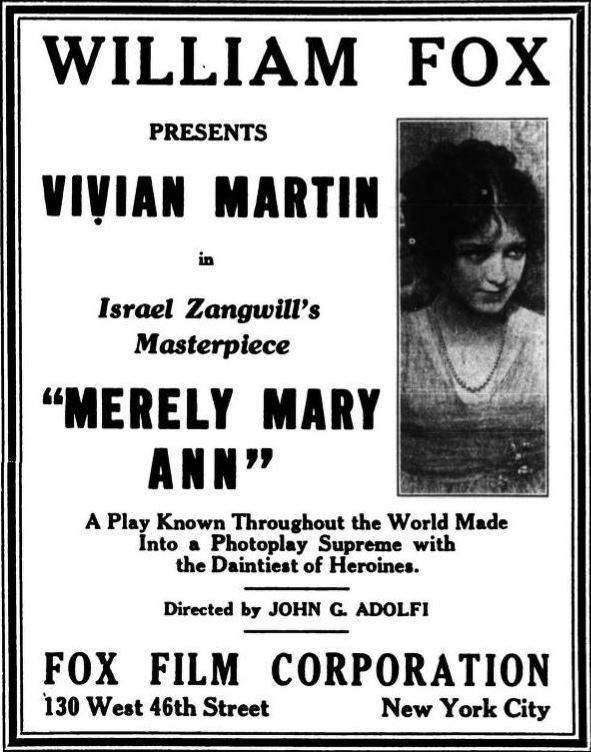
The narrative deftly navigates the class divide that separates them. Mary Ann, the orphan servant, and John, the struggling artist, are both on the fringes of polite society, yet their love attempts to bridge a chasm that society deems impassable. The screenplay, co-written by John G. Adolfi and John W. Kellette, based on Zangwill's work, excels at portraying these societal pressures without resorting to overt melodrama, instead relying on the understated performances and evocative visual cues. Every longing look, every hesitant touch, speaks volumes about the societal constraints they face and the depth of their burgeoning emotions. It’s a testament to the power of the original source material and its adaptation that such a simple premise can yield such profound emotional resonance.
Beyond the central romance, Merely Mary Ann delves into several compelling themes. Resilience, perhaps, is the most prominent. Mary Ann's steadfast optimism in the face of relentless hardship is a powerful message, suggesting that the human spirit can find light even in the darkest corners. Her journey from utter destitution to a more hopeful future is not merely a fairy tale trope; it’s a commentary on the enduring strength of character. This unwavering spirit is a recurring motif in cinema, often found in tales of individuals overcoming immense odds, a theme also explored with nuance in The Little Liar, where personal fortitude ultimately defines destiny.
The film also offers a keen observation of class distinctions in early 20th-century Britain. The stark contrast between Mary Ann’s meager existence and the implied opulence of those she serves highlights the rigid social stratification that defined the era. Love, in this context, becomes a revolutionary act, a defiance of established norms. The idea that genuine affection could transcend the chasm between a servant and a gentleman was, and often remains, a potent narrative device. It forces audiences to question the arbitrary barriers society erects and to ponder the true value of human connection over superficial status. This thematic undercurrent of societal barriers and personal ambition finds echoes in films like John Glayde's Honor, where reputation and social standing often dictate personal choices and relationships, though Merely Mary Ann approaches it with a more romanticized lens.
Furthermore, the film champions the redemptive power of art. John Lonsdale's music is not merely a background element; it is a character in itself, a source of inspiration, hope, and connection. It is through his compositions that the characters often express their deepest emotions, and it is the promise of his artistic success that drives a significant portion of the plot. The narrative suggests that art, particularly music, has the power to elevate, to unite, and to offer a path to transcendence, even for those trapped in mundane realities. This celebration of creativity as a transformative force is a beautiful aspect of the film, providing a counterpoint to the more grim aspects of their lives.
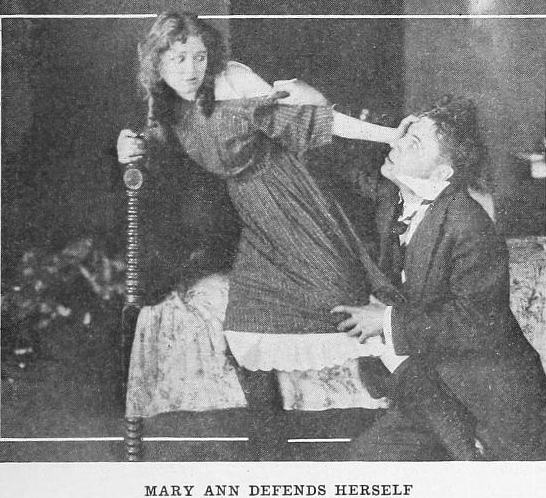
John G. Adolfi’s direction is marked by a clear understanding of silent film aesthetics. He utilizes close-ups effectively to convey the nuanced emotions of his lead actors, allowing their facial expressions and body language to tell the story without the need for excessive intertitles. The cinematography, though perhaps not groundbreaking for its time, is competent and serves the narrative well, creating a sense of intimacy in the lodging house scenes and a broader scope when the characters venture into the world. The pacing is deliberate, allowing the audience to fully absorb the emotional weight of each scene. Adolfi, along with his writers, understood how to translate the theatricality of Zangwill's play into a visual medium, focusing on character interaction and emotional beats. This careful attention to visual storytelling is a hallmark of effective silent cinema, allowing films like Vendetta or Sapho to similarly convey complex narratives through gesture and mise-en-scène.
The success of Merely Mary Ann also lies in its ability to evoke a specific time and place. The costumes, sets, and overall atmosphere transport the viewer to Edwardian London, a world both charming and rigidly stratified. The film serves as a valuable historical document, offering a glimpse into the social mores and daily lives of people from different societal strata. It is a world where an orphan’s fate could be dramatically altered by a twist of circumstance, and where a composer’s talent could remain undiscovered for years due to a lack of resources. This historical authenticity adds another layer of depth to the romantic narrative, grounding it in a believable, if harsh, reality.
Why does Merely Mary Ann continue to resonate with audiences today, even in its silent form? Perhaps it is the universality of its themes. The yearning for love, the struggle for self-improvement, the desire for recognition – these are emotions that transcend time and cultural boundaries. Vivian Martin's portrayal of Mary Ann, in particular, remains a standout performance from the silent era, a testament to her acting prowess and her ability to convey profound emotion without dialogue. Her character embodies a quiet strength that is both inspiring and deeply relatable. The film's message of hope, even in the bleakest of circumstances, offers a timeless comfort. It suggests that even when all seems lost, a flicker of possibility remains, and that true love, however challenged, can ultimately find its way.
In a cinematic landscape often dominated by spectacle and noise, the quiet elegance of Merely Mary Ann stands as a gentle reminder of the power of simplicity and heartfelt storytelling. It is a film that speaks directly to the soul, an understated classic that deserves to be rediscovered and cherished by new generations of film enthusiasts. Its legacy is not built on grand innovation or explosive action, but on the delicate, persistent whisper of a heart yearning for connection and a spirit refusing to be broken, making it a vital piece of early cinematic history that continues to enchant and enlighten.
IMDb —
1918
Community
Log in to comment.