DbcultAccessing Vault...
6.9/10
Senior Film Conservator
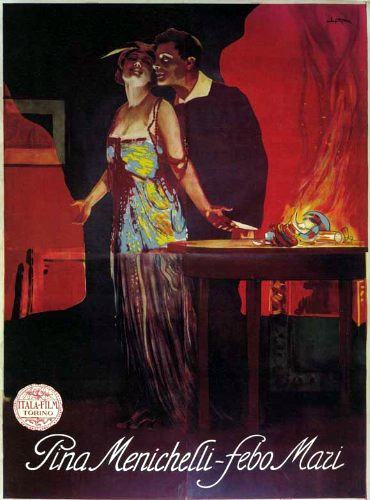
A definitive 6.9/10 rating for a film that redefined the boundaries of cult cinema. Il fuoco (la favilla - la vampa - la cenere) remains a cornerstone of transgressive art.
In the annals of early cinematic art, few films plunge the viewer into the maelstrom of psychological devastation with the unflinching intensity of Il fuoco (la favilla - la vampa - la cenere). This 1915 Italian silent masterpiece, deeply infused with the decadent, sensuous spirit of Gabriele D'Annunzio, transcends mere narrative to become a visceral exploration of the creative spirit's profound fragility when confronted by an overwhelming, destructive passion. It is less a story told than an emotional landscape rendered, an exquisite and harrowing depiction of an artist’s soul being systematically dismantled by the very force he believes inspires him. The film, co-written by D'Annunzio himself alongside Febo Mari and Giovanni Pastrone, and directed by Mari, stands as a testament to the silent era’s capacity for profound emotional complexity, challenging the simplistic melodramas often associated with the period. Its very title, 'The Fire (the Spark - the Blaze - the Ash),' encapsulates the entire tragic arc, promising an inferno of emotions that indeed consumes everything in its path.
At its core, Il fuoco meticulously charts the tragic arc of Mario, an aspiring painter portrayed with a fervent, almost feverish intensity by Febo Mari. Mario is a man poised on the precipice of artistic greatness, his inner world a vibrant tapestry of nascent visions and unexpressed genius, brimming with the potential to leave an indelible mark on the art world. His fateful encounter with a celebrated, married poetess, a figure of intoxicating charm and intellectual prowess brought to life by the mesmerizing Pina Menichelli, acts as the devastating catalyst for his undoing. This is not a gentle, blossoming romance, but rather a sudden, overwhelming conflagration, a destructive force that sweeps away all reason and artistic discipline. The poetess, embodying the D'Annunzian ideal of the femme fatale – a woman of both profound allure and chilling self-interest – possesses a magnetic presence that ensnares Mario completely, drawing him into a vortex of obsessive devotion. Her presence, initially perceived as a muse, swiftly morphs into a parasitic force, slowly but inexorably draining him of his creative essence, leaving him an empty vessel.
The film’s brilliance lies in its nuanced portrayal of this destructive dynamic. Mario’s artistic talent, once a wellspring of original thought and expressive power, begins to wither under the scorching heat of his infatuation. His canvases, once alive with his unique vision and bold strokes, become empty echoes, his palette barren of color and inspiration. The poetess, a creature of refined intellect and boundless ego, absorbs his very being, transforming him from a creator into a mere reflection of her own captivating persona. This psychological vampirism is depicted with a chilling precision, as the audience witnesses the gradual erosion of Mario's identity, his artistic vocation dissolving into the ashes of a consuming, unrequited, or perhaps, too intensely requited, passion. It’s a stark warning about the perils of allowing external forces, no matter how beautiful or compelling, to usurp one’s inner creative sovereignty. The narrative unflinchingly illustrates how the pursuit of an intoxicating, unattainable ideal can lead to the complete annihilation of the self, leaving only a husk where genius once resided.
Febo Mari, not only co-wrote and directed but also delivered a tour-de-force performance as Mario. His portrayal is a masterclass in silent film acting, conveying the character's initial artistic zeal, his subsequent infatuation, and his ultimate descent into creative paralysis through a potent combination of facial expressions, body language, and carefully choreographed gestures. One can almost feel the fervent spark of his initial genius in his wide-eyed enthusiasm and energetic movements, followed by the suffocating grip of his obsession as his posture slumps, his gaze becomes vacant, and his hands, once agile with a brush, become limp and uninspired. It's a performance that speaks volumes without uttering a single word, etching Mario’s tragedy deeply into the viewer’s consciousness, demonstrating the profound capacity of non-verbal communication.
Pina Menichelli, as the unnamed poetess, is equally captivating, her screen presence nothing short of electrifying. She embodies the very essence of the D'Annunzian ideal: beautiful, intelligent, manipulative, and ultimately, destructive. Menichelli’s performance is a delicate balance of alluring grace and cold detachment, making her character both irresistibly fascinating and profoundly terrifying. She moves through scenes with a languid elegance, her eyes conveying both profound depth and a chilling self-absorption, hinting at an inner world that remains tantalizingly out of Mario's reach. Her portrayal is crucial in lending credibility to Mario's complete surrender; one understands, through Menichelli’s sheer magnetism and the subtle power she exudes, why he would sacrifice everything – his art, his identity, his future – for her elusive affection. The supporting role of Mario Alberti, though less central, adds further texture to the film's emotional landscape, contributing to the rich tapestry of human interaction that defines the narrative's tragic framework.
The directorial vision shared by Febo Mari and Giovanni Pastrone, the latter a titan of early Italian cinema known for his epic Cabiria (a film that, while not on our comparative list, provides essential context for Pastrone's ambitious influence), imbues Il fuoco with a distinctive aesthetic. The film masterfully employs visual metaphors to communicate Mario’s internal state. Lighting, in particular, becomes a character in itself, shifting from the bright, hopeful illumination of Mario’s early artistic endeavors – scenes bathed in natural light, signifying clarity and inspiration – to the somber, encroaching shadows that reflect his creative decline and mental anguish. The compositions are often painterly, reflecting Mario’s profession, yet they also convey a sense of entrapment and psychological constriction, with characters frequently framed by doorways or dense foliage, mirroring their internal prisons. The camera lingers on faces, capturing the subtle shifts in emotion, and utilizes close-ups to draw the audience into the characters’ inner turmoil, making their unspoken struggles intensely palpable.
The visual language of the film feels remarkably modern for its time, eschewing static theatricality for a more dynamic and emotionally resonant approach. One can discern a clear influence from the broader European artistic movements of the era, particularly Symbolism and Decadence, which prioritized mood, atmosphere, and psychological depth over straightforward realism. This stylistic choice elevates Il fuoco beyond a simple melodrama, positioning it as an early example of psychological cinema, where the internal landscape of the characters is as vital as the external events unfolding around them. The deliberate pacing, the symbolic use of settings – from grand, opulent interiors hinting at the poetess's world to Mario's increasingly desolate studio – all contribute to a rich, layered cinematic experience that rewards careful observation.
Il fuoco is a profound meditation on the precarious balance between inspiration and destruction, particularly within the artistic temperament. The core thematic conflict revolves around the idea of the muse. Traditionally, a muse inspires and elevates, guiding the artist to new heights of creativity. Here, the muse, personified by the poetess, becomes an all-consuming fire, burning away the very essence it was supposed to ignite. This inversion of the muse archetype is a chilling and powerful commentary on the darker side of artistic passion and romantic entanglement, suggesting that devotion, when unchecked, can be a corrosive, rather than a constructive, force.
The film delves deep into the psychology of obsession, illustrating how an individual can become so utterly absorbed by another that their own identity dissipates. Mario's sacrifice of his artistic self is not a heroic act but a tragic immolation, a slow, agonizing surrender of his unique voice and purpose. This theme resonates with the grand, often melodramatic, narratives of the silent era, yet Il fuoco distinguishes itself through its unflinching focus on the internal, rather than external, consequences of such passions. While other films like Uncle Tom's Cabin or The Littlest Rebel focused on societal injustices or grand historical conflicts, Il fuoco turns its gaze inward, exploring the civil war raging within a single soul, a battle far more intimate and devastating than any external skirmish.
The power of charisma and intellect also stands as a central theme. The poetess’s ability to charm and ensnare Mario is not merely physical; it is deeply intellectual, a battle of wits and wills where Mario is clearly outmatched. She is a force of nature, her mind as captivating as her presence, which makes Mario’s subjugation all the more believable and tragic. This intellectual seduction is a hallmark of D'Annunzio's literary output, and its translation to the screen here is remarkably effective. The film implicitly critiques the dangers of unchecked ego and the destructive potential of an individual who wields their charm without empathy or restraint, reminiscent of the moral complexities explored in films like Hypocrites, though Il fuoco's focus remains intensely personal rather than broadly societal. The poetess, in her self-serving allure, becomes a symbol of the destructive siren, leading artists to their creative doom.
Furthermore, the film can be viewed as an allegory for the potential pitfalls of artistic collaboration or mentorship, especially when one party's personality overshadows or consumes the other's. The writer Gabriele D'Annunzio, a larger-than-life figure whose own relationships were often intense and controversial, infused this narrative with a deeply personal, almost autobiographical, resonance, making the film a fascinating window into the artistic psyche of its time. It’s a cautionary tale, warning that even the most fervent admiration can turn into a suffocating dependency, ultimately extinguishing the very flame it sought to worship.
One of the most remarkable aspects of Il fuoco is its profound ability to convey complex psychological states without the aid of spoken dialogue. The silent film medium, often underestimated in its capacity for nuance, here proves itself incredibly eloquent. The actors' expressions, the deliberate pacing, the evocative intertitles (which are themselves often poetic, reflecting D'Annunzio's literary hand), and the masterful use of visual symbolism all combine to create a deeply immersive and emotionally resonant experience. The film compels the audience to interpret, to feel, to connect with the characters on a primal, unspoken level, making the viewer an active participant in deciphering the intricate web of emotions.
This reliance on visual and performative storytelling pushes the boundaries of cinematic expression. It forces a certain active engagement from the viewer, an imaginative leap into the characters' minds that might be less pronounced in sound films. The subtle shifts in a character’s gaze, the tremor of a hand, the weight of a prolonged silence – these elements become powerful carriers of meaning, building a narrative richness that transcends the absence of audible words. In this regard, it shares a common ground with other silent tragedies that relied heavily on visual drama and powerful performances to convey emotional depth, such as Tess of the D'Urbervilles, where the tragic fate of the protagonist is meticulously built through visual narrative and the crushing weight of circumstance. Both films, in their respective ways, demonstrate the silent medium's immense power to explore the depths of human suffering and the crushing weight of fate or personal choices through a ballet of gestures and expressions.
Il fuoco (la favilla - la vampa - la cenere) holds a significant, if often overlooked, place in the history of Italian cinema. It stands as a powerful example of the diva film subgenre, characterized by the presence of a strong, often theatrical, female lead, but elevates it through its profound psychological depth and D'Annunzian intellectualism. It eschews the simpler moralities of many contemporary productions, offering instead a complex and unsettling portrait of human passion and its devastating consequences. This film was not merely entertainment; it was a psychological experiment, a cinematic poem exploring the darkest corners of the artistic soul.
Compared to other films of its era, such as the more straightforward dramatic narratives seen in A Girl of Yesterday or the more action-oriented The Outlaw's Revenge, Il fuoco's audacious dive into the internal world of its characters marks it as a truly groundbreaking work. It foreshadows later cinematic explorations of psychological realism and the darker facets of human relationships, paving the way for more introspective storytelling. Its influence, though perhaps not as overtly documented as some blockbusters of the period, can be felt in the subsequent development of Italian and European art cinema, particularly in its willingness to portray morally ambiguous characters and the complexities of human desire. The film’s boldness in depicting such raw, destructive emotions sets it apart, making it a crucial piece in understanding the evolution of cinematic expression.
Even today, over a century after its release, Il fuoco retains its potent emotional grip. Its themes of artistic vulnerability, the seductive power of charisma, and the destructive nature of obsession are timeless and universally resonant. It serves as a stark reminder that the flames of passion, while capable of illuminating and inspiring, can just as easily consume and reduce to ash, leaving only the bitter taste of regret and creative barrenness. For cinephiles and scholars alike, this film remains a compelling, unsettling, and ultimately unforgettable experience, a searing ember from the dawn of cinema that continues to cast its long, dark shadow. The intensity of Mario's internal struggle, his isolation within his own self-destructive passion, finds a strange echo in the thematic undertones of films like Alone in London, though the contexts are vastly different. Both, however, touch upon the profound solitude that can accompany profound emotional states, making Il fuoco a chilling and perpetually relevant exploration of the human condition.
Community
Log in to comment.