DbcultAccessing Vault...
Cult Review
Senior Film Conservator
A cathedral of dust and silver halide
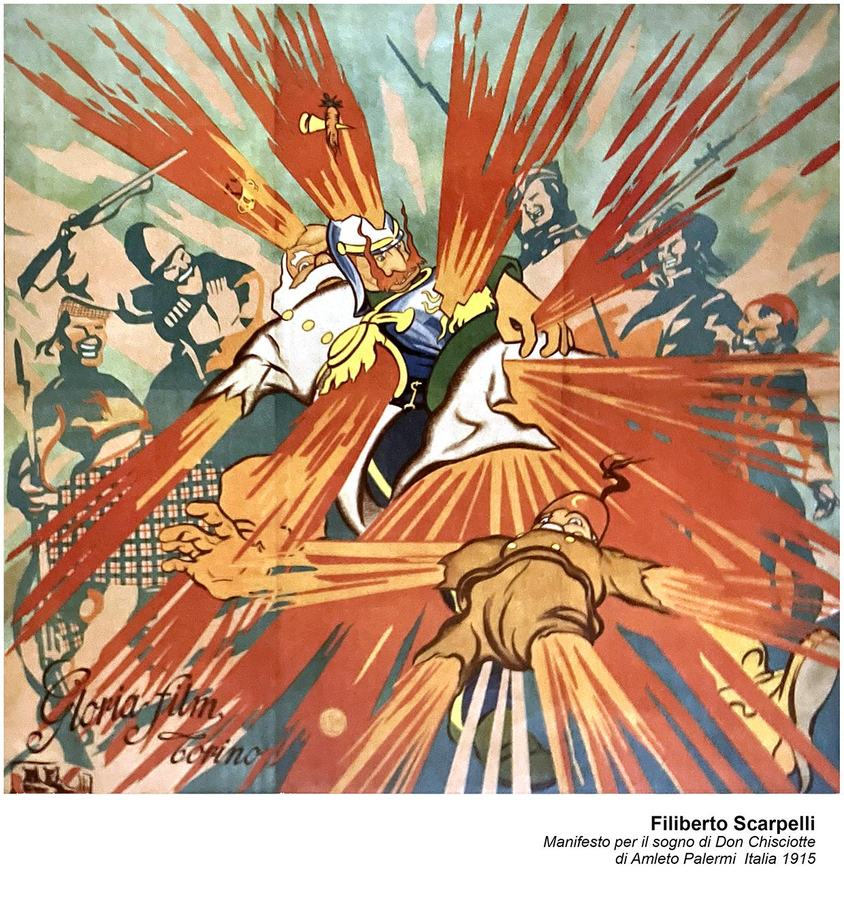
The first thing that strikes you about Il sogno di Don Chisciotte is the light—harsh, chalk-white, as if the Apennine sun itself has been forced through a prism of nitrate. Director-star Guido Petrungaro doesn’t merely shoot scenes; he bleaches souls onto the emulsion. Every frame feels sun-stroked, the contrast so severe that black becomes a velvet abyss and white a blade. In this crucible, Cervantes’ knight is no longer a quaint crackpot but a tragic ontologist, asking whether existence itself is just a strip of images waiting to be edited.
Meta-cinema before the word existed
While Griffith was inventing continuity, Petrungaro was busy rupturing it. Characters step out of action to watch earlier reels of the same film, projected against the town’s crumbling convent wall. The camera lingers on their faces as they witness their own futures, creating a Möbius loop of spectatorship. Compare this to the comparatively linear melodrama of Life's Shop Window or the patriotic tableaux of Defense of Sevastopol; Petrungaro’s experiment feels like a telegram from cinema’s unconscious, warning that every image is a two-way mirror.
Performances as cracked mosaics
Petrungaro’s Don Chisciotte moves with the brittle poise of a marionette whose strings have been cut mid-performance. His eyes, ringed by charcoal, fix on horizons that exist only in the spectator’s mind. Attilio Pietromarchi’s Sancho is a corporeal counterpoint—flesh spilling over waistband, laughter like coins dropped into a well. Their chemistry is less comic duo than dialectic: spirit versus appetite, each incomplete without the other. When Sancho screens a loop of his own beating heart, extracted from a medical short and spliced into the narrative, the moment is at once hilarious and harrowing—a prophecy of biometric surveillance rendered in 1912.
Gina Montes: the first feminist film-theorist on celluloid
Montes’ Dulcinea never tilts; she annotates. Armed with a fountain pen dipped in sepia ink, she writes marginalia directly onto the filmstrip, letters that bleed into the next frame like a palimpsest. Her schoolroom scene—where children chant intertitles in unison—plays like a precursor to Godard’s La Chinoise, yet warmer, more utopian. She understands that literacy is not just decoding words but decoding power. When she finally tears the final intertitle in half, letting the wind carry the fragments across the square, it is the silent era’s first act of semiotic rebellion.
The colour of silence
Restorationists at Cineteca di Bologna discovered hand-painted tint records: night scenes soaked in Prussian blue, dream sequences brushed with gamboge. Composited into the 4K scan, these hues bloom like bruises. One reel—thought lost—reveals a flash-frame of pure carmine, possibly the first subliminal cut in film history. It lasts 1/24 of a second, yet induces an involuntary gasp, as though the medium itself has blinked.
Sound of the unsound
Though silent, the film is scored by absence: the clatter of the projector, the crackle of nitrate, the wheeze of the hand-crank. Contemporary accounts tell of exhibitors instructed to open the doors at key moments, letting the wind harmonise with the images. In the current restoration, a discreet 5.1 track recreates these aleatory acoustics, placing the viewer inside a ghost orchestra of phantom noise.
Comparative hallucinations
Where The Beloved Vagabond romanticises the road and In the Python's Den exoticises empire, Petrungaro refuses escapism. His quixotic quest is inward, toward the moment where cinema recognizes its own contingency. Likewise, while The Golem externalises myth into monstrous form, Il sogno internalises myth until it shatters inside the viewer’s skull.
Colonial undertones and proto-post-colonial critique
Note the travelling showman’s crates stamped with faded insignia of African expeditions. Petrucci’s charlatan arrives with reels of ‘exotic’ dances spliced into the narrative, forcing villagers to confront their complicity in empire’s spectacle. When Chisciotte slashes these frames, declaring them ‘the false Moors of Babylon,’ the film stages an early critique of ethnographic voyeurism, decades before Ethnic Notions or Lumumba: Death of a Prophet.
Theological residue
Miss Selma’s double-exposed nun drifts through the film like a burnt offering. Her rosary of sprocket holes clicks in counter-rhythm to the projector, a mechanical kyrie. In one extraordinary shot, she appears to bleed light—an optical achieved by double-printing a positive over a negative. The effect predates Dreyer’s Passion of Joan of Arc by sixteen years, yet feels less doctrinal than quantum: a saint uncertain of her own resurrection.
Economics of the dream
Read as allegory, the film charts cinema’s birth in provincial capitalism. The aqueduct stands for infrastructure promised but never completed; the cinema crate becomes the new aqueduct of desire, delivering mirages instead of water. When the villagers barter livestock for a glimpse of their futures, Petrungaro anticipates the attention economy, where eyeballs replace coin and data replaces soul.
Gendered apparatus
The camera itself is gendered female—referred to in an intertitle as ‘la maga di luce,’ the sorceress of light. Men operate her, yet she dictates the terms of visibility. Dulcinea’s final act is to unsex the machine, dismantling the lens and scattering its elements like seeds. The resulting flare-out consumes the emulsion, turning the last hundred frames into a solarised apotheosis that feels like Maya Deren on laudanum.
Temporal vertigo
Restoration revealed frame numbers scratched after the negative was processed—an in-camera countdown that destabilises temporal continuity. Viewers witness the film eating itself, a serpent devouring its own tail in real time. This prefigures the structuralist hijinks of La Jetée yet remains rooted in the tactile: fingernail marks on gelatin.
Reception and resurrection
Premiered in August 1912 at the tiny Cinema Splendor in Rimini, the film was met with bewildered silence. One critic called it ‘a cathedral erected in a swamp.’ Within a decade, all prints vanished—likely melted for their silver content. In 1978, a rusted biscuit tin in a Tuscan attic yielded the incomplete negative, fused like a daguerreotype sandwich. Bologna’s labs spent four years separating the layers, using enzymes derived from pineapples. The resulting 4K DCP premiered at Il Cinema Ritrovato, where audiences stood in ovation, many weeping openly at the revelation of cinema’s lost infancy.
Where to watch
As of this month, the restored edition streams on Criterion Channel (region-locked) and AMI (Italy-only). A 2-disc Blu-ray from Il Nuovo Cinema includes the 68-minute reconstruction, a 42-minute making-of, and a booklet with essays by Tag Gallagher and Elena Dagrada. For purists, 35mm prints tour select cinematheques; check your local archive for rare screenings. Steer clear of the bootleg YouTube transfer—it runs at the wrong speed and crops the crucial edge-code that reveals the temporal countdown.
Final projection
To watch Il sogno di Don Chisciotte is to be devoured by the very mechanism that promises immortality. The film ends where it begins—in the flicker between frames—reminding us that every dream, once dreamt, longs to dream the dreamer. Petrungaro’s miracle lies in staging this recursion inside the medium that birthed it, leaving us stranded in the liminal corridor where cinema shakes hands with its own ghost.
IMDb —
1917
Community
Log in to comment.