DbcultAccessing Vault...
Cult Review
Senior Film Conservator
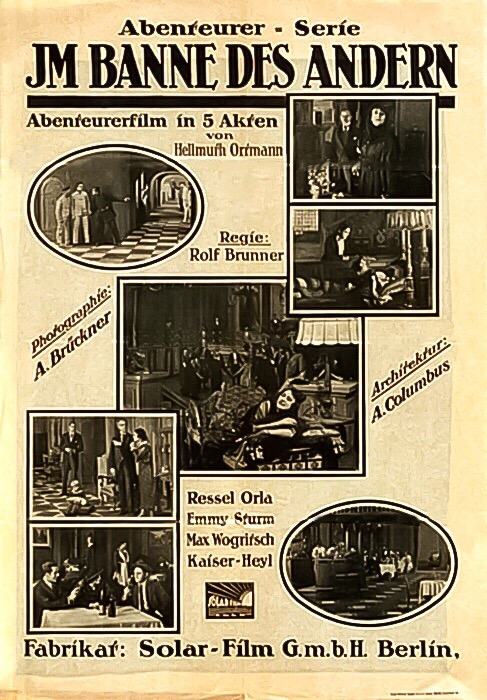
To witness Im Banne des Andern is to step into a temporal rift, emerging in an era where the cinematic medium was shedding its theatrical chrysalis to embrace a more profound, psychologically dense visual language. Directed by the often-underappreciated Rolf Randolf and penned with meticulous precision by Helmuth Orthmann, this 1920 production serves as a testament to the sophistication of early German cinema. It is not merely a relic; it is a living, breathing artifact of human anxiety and the complexities of the 'other.' Unlike the overt ruggedness found in Cavanaugh of the Forest Rangers, this film operates in the hushed corridors of the mind and the claustrophobic parlors of the bourgeoisie.
The narrative architecture of the film is constructed upon the premise of psychological gravity. We are introduced to characters who are less agents of their own will and more satellites orbiting a central, often unseen, force. Emmy Sturm, an actress of exceptional emotional range, carries the weight of the film's thematic core. Her facial expressions—a primary currency in the silent era—convey a spectrum of emotion that transcends the need for intertitles. She embodies the 'Bann'—the spell—not as a supernatural phenomenon, but as a sociological and psychological reality. This is a far cry from the more straightforward moral dichotomies seen in Beating Back, where the struggle is external and physical.
In 1920, Germany was a nation in flux, and Im Banne des Andern captures this pervasive sense of instability. The set design, while rooted in realism, occasionally veers into the shadows that would later define Expressionism. The use of lighting is particularly noteworthy; it doesn't just illuminate the actors but serves to isolate them, heightening the sense of individual loneliness amidst a crowded society. This isolation is a recurring motif, reminiscent of the tonal melancholy found in Faith Endurin', yet it is executed here with a specifically European cynicism.
The supporting cast, featuring stalwarts like Hans Walden and Alfred Scherzer, provides a sturdy framework for Sturm’s more ethereal presence. Walden, in particular, offers a performance of calculated restraint, representing the rigid societal structures that both protect and imprison the protagonist. In contrast, Ressel Orla brings a touch of the avant-garde, her presence on screen acting as a catalyst for much of the film’s internal friction. When compared to the ensemble dynamics of Whispers, Randolf’s direction feels more deliberate, more focused on the lingering gaze and the pregnant pause.
Helmuth Orthmann’s screenplay avoids the pitfalls of the melodramas of its time by grounding its stakes in the irrevocable nature of choice. There is a palpable sense of inevitability that permeates the second act. The dialogue—represented through elegantly designed intertitles—is sparse but impactful, often echoing the existential dread that would later characterize the works of Fritz Lang or F.W. Murnau. The film shares a certain thematic DNA with Ein Gruss aus der Tiefe, specifically in its preoccupation with the past’s intrusion upon the present.
Where a film like The Lottery Man might find humor in the absurdity of human desire, Im Banne des Andern finds tragedy. It posits that we are all, to some extent, under the influence of another's expectations, dreams, or failures. The character of Harry Frank acts as a foil to this entrapment, representing the possibility of escape, though even his path is fraught with the debris of the characters' collective history. The pacing is deliberate, allowing the audience to steep in the atmosphere of each scene, a technique that stands in stark contrast to the frantic energy of Hot Sands and Cold Feet.
The cinematography in Im Banne des Andern is a masterclass in silent-era framing. The camera rarely moves, yet the composition of each shot is dynamic. The use of depth is particularly effective; characters in the background often seem to be watching those in the foreground, reinforcing the theme of surveillance and the 'spell' of the other. It lacks the rugged, outdoor vastness of Tempest Cody Bucks the Trust, opting instead for a rich, interior density that feels almost tactile.
The costumes and makeup also play a vital role. Maria Forescu and Willy Kaiser-Heyl are styled with an eye toward their social standing, their attire acting as a second skin that defines their limitations. In a world without synchronized sound, the rustle of a dress or the adjustment of a collar—vividly suggested by the actors' movements—carries the weight of a monologue. This attention to detail reminds one of the cultural specificity in Shakuntala, where every visual element is steeped in meaning.
Central to the film’s enduring power is its treatment of its female characters. Emmy Sturm and Ressel Orla represent two sides of the Weimar woman: one struggling against the traditional domestic yoke, the other navigating the newfound, albeit dangerous, freedoms of the urban landscape. This duality is explored with more nuance than in She Couldn't Grow Up or Miss Adventure. In Im Banne des Andern, the stakes are not merely social standing or romantic success; they are existential.
The 'Bann' of the title suggests a hypnotic state, and there is a rhythmic, almost trance-like quality to the film’s editing. The transition between scenes is smooth, guiding the viewer through the emotional landscape with a steady hand. This fluidity is essential for a story that relies so heavily on internal shifts rather than external action. It captures the 'smile of nature' in a much darker, more ironic sense than When Nature Smiles, suggesting that while the world continues to turn, the individual remains frozen in their personal crisis.
Critics of the era might have focused on the film’s melodramatic tendencies, but from a modern vantage point, we can see the seeds of psychological realism being sown. The film deals with the 'tarnished reputations' of its characters with a level of empathy that was rare for the time, avoiding the moralizing tone found in Tarnished Reputations. Instead, it invites the viewer to understand the pressures that lead to their downfall.
The inclusion of Max Wogritsch in the cast adds a layer of gravitas to the film’s climax. As the 'spell' begins to break, or perhaps merely shifts into a new form, the performances reach a crescendo of silent intensity. It is a haunting conclusion that refuses to provide the easy catharsis found in Little Comrade. Instead, we are left with the image of individuals forever altered by their proximity to one another—a theme that resonates as strongly today as it did a century ago.
Ultimately, Im Banne des Andern stands as a significant, if overlooked, chapter in the history of German cinema. It bridges the gap between the simplistic narratives of early film and the complex, shadow-drenched masterpieces of the mid-20s. It shares the dark, cautionary spirit of The White Terror, yet it applies that terror to the intimate sphere of the human heart. For the modern cinephile, it offers a rare glimpse into the soul of an era, rendered in stunning shades of grey and punctuated by performances that refuse to be forgotten. To watch it is to fall, briefly and beautifully, under its own peculiar spell.

IMDb 5.5
1917
Community
Log in to comment.