DbcultAccessing Vault...
5.6/10
Senior Film Conservator
A definitive 5.6/10 rating for a film that redefined the boundaries of cult cinema. Mezhplanetnaya revolyutsiya remains a cornerstone of transgressive art.
In the feverish atmosphere of 1924 Moscow, where the embers of the Civil War still glowed and the avant-garde sought to reshape human perception, emerged a curious artifact of kinetic propaganda: Mezhplanetnaya revolyutsiya (Interplanetary Revolution). Directed by the triumvirate of Zenon Komissarenko, Youry Merkulov, and Nikolay Khodataev, this short animation serves as a fascinating specimen of the State Institute of Cinematography’s (GTK) early experimental output. While the world was reeling from the visual grandeur of The Phantom or the melodrama of Hearts of the World, the Soviet animators were busy dismantling the very foundations of bourgeois storytelling through the medium of cutout animation.
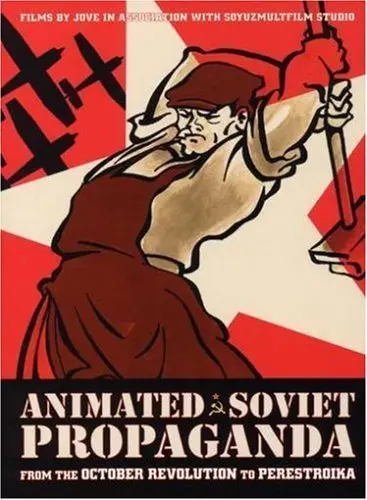
The aesthetic of Mezhplanetnaya revolyutsiya is one of deliberate fragmentation. Eschewing the fluid, rounded realism that would later characterize Western animation, the creators opted for a style rooted in the Lubok (folk print) and the political poster. Every character, specifically the bloated, spider-like capitalists, is rendered with a grotesque angularity that emphasizes their moral decay. This isn't merely a stylistic choice; it is a visual manifestation of class struggle. The sharp edges of Comrade Kominternov contrast sharply with the soft, decadent curves of his Martian adversaries, creating a visual tension that mirrors the ideological conflict of the era.
The animation process itself—utilizing jointed cardboard cutouts moved frame by frame—imbues the film with a jittery, nervous energy. This kineticism feels remarkably modern, prefiguring the punk-rock aesthetics of Terry Gilliam by several decades. Unlike the polished dread found in The Mysterious Stranger, the movement here is celebratory and aggressive. It is the movement of a new world being built, one frame at a time, over the ruins of the old.
To understand the impact of this film, one must view it as a direct assault on Yakov Protazanov's Aelita, released the same year. While Aelita was a massive, high-budget spectacle that flirted with Constructivist design but ultimately retreated into a dream-narrative, Mezhplanetnaya revolyutsiya refuses such escapism. It mocks the romanticism of the Martian princess and replaces it with the cold, hard logic of the Komintern. Where Aelita offered a bourgeois fantasy, this animation offers a proletarian reality—albeit one set in the stars.
The parody is biting. The capitalists, terrified by the impending triumph of the Red Army on Earth, flee in a spacecraft shaped like a giant money bag. This level of unsubtle symbolism is where the film finds its power. It doesn't ask for your interpretation; it demands your allegiance. In this sense, it shares a certain DNA with the blunt force of Congestion, though it swaps urban claustrophobia for the infinite expanse of the cosmos.
The depiction of Mars in the film is less about astronomical curiosity and more about geopolitical expansion. The red planet is, quite literally, destined to be Red. When Comrade Kominternov arrives, he doesn't find a mysterious alien civilization; he finds the same old enemies. The film suggests that the revolution is not merely a local event but a universal inevitability. This cosmic optimism is a recurring theme in early Soviet sci-fi, a belief that the laws of dialectical materialism apply as much to the vacuum of space as they do to the factories of Petrograd.
Consider the scene where the Red Army soldiers march across the stars. It is a sequence of pure rhythmic bliss, a visual poem to collective action. It lacks the individualistic heroism often seen in contemporary Western films like Mr. Dolan of New York. Instead, the protagonist is the movement itself. Kominternov is less a man and more a symbol, a vessel for the historical process. This rejection of the individual ego in favor of the collective will is the film's most radical proposition.
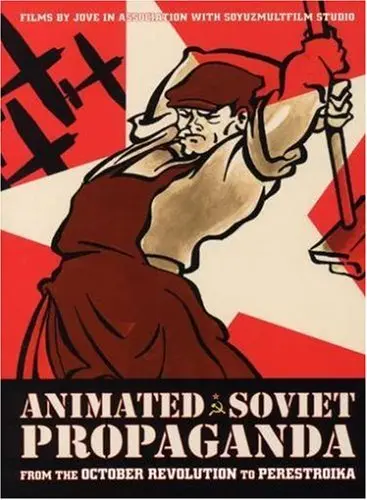
The animators—Komissarenko, Merkulov, and Khodataev—demonstrate a sophisticated understanding of the grotesque. The capitalist antagonists are not merely villains; they are biological aberrations. Their eyes bulge with greed, their limbs are spindly and insectoid, and their movements are frantic and uncoordinated. This stands in stark contrast to the fluid, purposeful strides of the revolutionary forces. The film employs a form of physiognomy that was common in the political cartoons of the time, yet here, the animation breathes a terrifying life into these caricatures.
There is a sequence involving a giant, multi-armed capitalist machine that feels like a precursor to the industrial nightmares of Solid Concrete. The way the machine is dismantled by the revolutionary spirit provides a catharsis that is both ideological and aesthetic. The destruction is not chaotic; it is surgical. It is the dismantling of an obsolete system to make way for the new. The use of negative space in these sequences is particularly striking, highlighting the isolation of the ruling class against the vastness of history.
One cannot discuss Mezhplanetnaya revolyutsiya without acknowledging the sheer technical audacity of its production. Working with limited resources in a country still recovering from revolution and famine, the GTK team pushed the boundaries of what was possible with paper and scissors. The film's use of multi-plane depth, though primitive compared to later standards, creates a surprising sense of scale. The stars are not just dots on a black background; they are layers of light that the characters move through.
The editing, too, is remarkably fast-paced. Influenced by the theories of Kuleshov and Eisenstein, the animators used montage to create a sense of urgency. The cuts are sharp, often timed to a rhythmic pulse that suggests an industrial beat. This is animation as a factory line—efficient, powerful, and relentless. It lacks the sentimentality of Forget Me Not, opting instead for a cold, metallic beauty that celebrates the machine age.
Decades after its release, Mezhplanetnaya revolyutsiya remains a vital piece of cinema history. It represents a moment when the future felt entirely up for grabs, when the stars were not just points of light but potential territories for the liberation of the spirit. While it was intended as a parody, it inadvertently created a new visual language for science fiction—one that prioritized political allegory over scientific accuracy.
The film’s influence can be seen in the later works of the Soviet animation school, which would continue to blend high art with state messaging. However, few films would ever capture the raw, unpolished energy of this 1924 short. It is a work of pure ideological adrenaline, a fever dream of a world—and a galaxy—reborn. It stands as a reminder that even in the darkest of times, the imagination can reach for the stars, provided it has a revolutionary heart to guide it. Comparing it to the stark realism of The Guilty Man reveals just how far the Soviet avant-garde was willing to stray from conventional narrative to make its point.
In the end, Comrade Kominternov’s victory on Mars is more than just a plot point; it is a declaration of intent. The film asserts that no corner of the universe is safe from the march of progress. Whether viewed as a historical curiosity, a piece of sophisticated propaganda, or a masterclass in early animation technique, Mezhplanetnaya revolyutsiya continues to resonate. It is a jagged, beautiful, and utterly unique artifact of a time when the world was changing so fast that even the planets couldn't keep up. It is, quite simply, a revolution in motion.
IMDb 6.7
1930
Community
Log in to comment.