DbcultAccessing Vault...
6.1/10
Senior Film Conservator
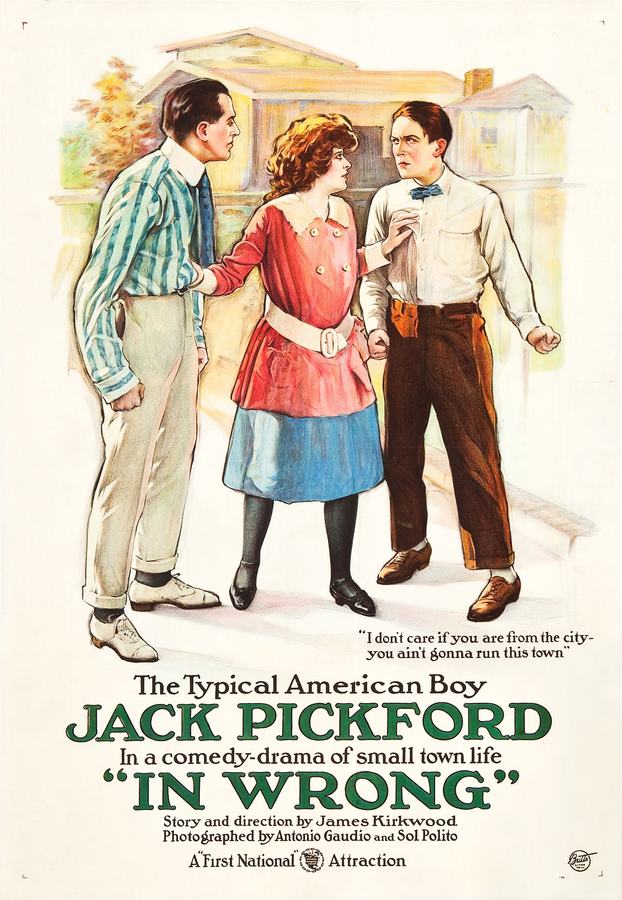
A definitive 6.1/10 rating for a film that redefined the boundaries of cult cinema. In Wrong remains a cornerstone of transgressive art.
Venturing back to the nascent days of cinema, one occasionally unearths a gem that, despite its century-old vintage, still sparkles with an undeniable charm and narrative ingenuity. James Kirkwood's 1919 silent romantic comedy, In Wrong, is precisely such a discovery. Far from being a mere historical curiosity, this film, featuring the ebullient Jack Pickford, transcends its era to deliver a story rich in character, humor, and heart. It's a delightful exploration of youthful infatuation, the pangs of jealousy, and the unexpected pathways to heroism, all rendered with the expressive artistry unique to the silent screen.
At its core, In Wrong is a quintessential underdog story, a narrative trope as compelling today as it was a hundred years ago. We are introduced to Johnny Spivins (Jack Pickford), a grocery-wagon driver whose existence is as unpretentious as his profession. Johnny is hopelessly, guilelessly enamored with Millie Fields (Marguerite De La Motte), the vivacious daughter of his boardinghouse proprietress. Their small-town world, painted with broad strokes of rustic simplicity, provides a picturesque backdrop for this budding romance. However, the equilibrium of Johnny's affections is dramatically upended by the arrival of Morgan Coleman (George Dromgold), a suave, impeccably dressed New Yorker whose urban sophistication and dashing demeanor immediately catch Millie's eye. This classic clash of worlds – the earnest country boy versus the polished city slicker – sets the stage for a comedic yet poignant exploration of romantic rivalry.
Johnny's initial attempts to compete with Morgan are, to put it mildly, spectacularly ill-fated. His ambition to secure a more respectable position at the local bank, a transparent bid to elevate his status in Millie's eyes, is thwarted by a comically irate bank president, whose fury stems from Johnny's neglected grocery deliveries. This early setback highlights Johnny's endearing clumsiness and the film's gentle humor. His subsequent, equally transparent gambit to ignite Millie's jealousy by feigning interest in Dolly Sheldon (Clara Horton), another city visitor, backfires with predictable and amusing results. These early scenes establish Johnny as a character who, despite his good intentions, often finds himself, quite literally, 'in wrong' – a man whose efforts to impress are consistently undermined by circumstance or his own lack of social finesse. This narrative arc, where a seemingly ordinary individual faces seemingly insurmountable romantic obstacles, resonates with the thematic underpinnings found in many early comedies, and even echoes the later struggles of protagonists in films like Romance and Dynamite, where personal valor often trumps superficial charm.
The film reaches a pivotal dramatic crescendo during a canoe accident, a scene that perfectly encapsulates the contrasting personalities of our two romantic rivals. As Millie's canoe overturns, Johnny, ever the earnest but slightly delayed hero, is poised to leap to her rescue. However, Morgan, with a breathtakingly theatrical dive from a high bridge, seizes the moment, performing a heroic feat that instantly solidifies his image as the town's dashing savior. This act, while genuinely courageous, leaves Johnny further marginalized, a poignant illustration of how perception can often overshadow intent. The townspeople, including Johnny's own mother (Lydia Knott), rally to honor Morgan, deepening Johnny's sense of inadequacy and prompting his decision to leave town altogether. It's a moment of profound dejection for our protagonist, expertly conveyed through Pickford's expressive performance, reminding us of the often-cruel hand of fate in matters of the heart.
Yet, it is precisely at this nadir that destiny intervenes with a comedic and triumphant twist. On his mournful journey out of town, Johnny stumbles upon two bank robbers. In an inspired moment of accidental heroism, he captures them, armed with nothing more than his trusty pitchfork. This unexpected turn of events transforms Johnny's rustic tool into an unlikely instrument of justice, symbolizing his inherent, albeit latent, strength and courage. His return to town, leading the apprehended culprits with his pitchfork held high, is a moment of pure cinematic joy – a reversal of fortunes that is both satisfying and genuinely funny. The town, quick to embrace its new hero, now showers Johnny with the accolades previously reserved for Morgan. The once-livid bank president, recognizing Johnny's newfound valor, not only offers him the coveted bank job but, more importantly, Millie, finally seeing beyond the superficial, declares her love for him. This resolution, while perhaps predictable by modern standards, is delivered with such heartfelt sincerity and comedic flair that it feels utterly earned, cementing Johnny's journey from an awkward suitor to a celebrated, beloved figure.
At the heart of In Wrong's enduring appeal is Jack Pickford's masterful performance as Johnny Spivins. Pickford, often overshadowed by his more famous sister Mary, possessed a unique screen presence – a blend of boyish charm, genuine vulnerability, and a knack for physical comedy. His Johnny is not a caricature but a deeply sympathetic character whose struggles are palpable, even without spoken dialogue. Pickford conveys a wealth of emotion through subtle facial expressions, body language, and perfectly timed comedic reactions. His ability to elicit both laughter and empathy is a testament to his skill as a silent film actor. He embodies the everyman hero, a figure audiences could easily root for, making his eventual triumph all the more satisfying. One can see echoes of this relatable, slightly clumsy but ultimately good-hearted protagonist in later silent era icons who built careers on similar personas, proving that authenticity, even in exaggerated form, always finds an audience.
Marguerite De La Motte, as Millie Fields, delivers a nuanced portrayal of the young woman caught between two suitors. Her performance captures Millie's initial fascination with Morgan's suave allure while subtly hinting at her underlying affection for Johnny. De La Motte's expressive eyes and graceful movements convey a character who is not merely a prize to be won but an individual navigating her own desires and societal expectations. Her eventual realization of Johnny's true worth feels organic, a testament to the chemistry she shares with Pickford. Her role is crucial in grounding the romantic narrative, providing a believable emotional anchor amidst the comedic hijinks. Much like other leading ladies of the era, such as those in A Continental Girl, De La Motte brings a compelling blend of innocence and strength to her character, making Millie a truly memorable figure.
George Dromgold's Morgan Coleman is a perfectly crafted foil. Dromgold imbues Morgan with just the right amount of debonair charm and subtle arrogance to make him a formidable, yet not entirely villainous, rival. He's the kind of character who excels effortlessly, making Johnny's struggles all the more pronounced. Clara Horton's Dolly Sheldon, though a minor character, serves her purpose effectively as a brief, unsuccessful romantic diversion for Johnny, further underscoring his singular focus on Millie. And, of course, no discussion of the cast would be complete without mentioning Pard the Dog. Animal actors played a significant role in early cinema, often stealing scenes with their natural charisma. Pard's presence adds a layer of warmth and authenticity to the rural setting, reminding us of the simple pleasures and loyal companions that populated these early cinematic worlds. The inclusion of animal performers, whether for comedic relief or as plot devices, was a common thread in films like The Lion Man or The Tiger Man, showcasing the public's fascination with the animal kingdom on screen.
James Kirkwood's direction is marked by a clear understanding of silent film aesthetics. The visual storytelling is paramount, with carefully composed shots and effective use of editing to convey emotion, action, and comedic timing. The film's pacing is excellent, building momentum towards key narrative beats while allowing moments for character development and comedic interplay. The use of natural settings, particularly the river scenes, adds a layer of visual authenticity and provides a dynamic backdrop for the dramatic rescue. Kirkwood, along with writers James Kirkwood (who also directed) and Madeline Matzen, crafts a screenplay that, despite its simplicity, is remarkably effective in building character arcs and delivering a satisfying conclusion. The narrative structure, while adhering to classic comedic formulas, never feels stale, a testament to the inherent strength of the storytelling.
In Wrong deftly balances elements of romantic comedy with touches of melodrama. The comedic moments, often stemming from Johnny's hapless attempts at romance or his awkward interactions, are genuinely funny without resorting to slapstick for its own sake. The humor is character-driven, arising naturally from Johnny's personality and the situations he finds himself in. The melodramatic elements, such as Millie's near-drowning or Johnny's despair, are handled with a sincerity that prevents them from becoming overly sentimental. This delicate equilibrium between laughter and earnest emotion is a hallmark of well-crafted silent cinema, allowing audiences to fully invest in the characters' journey. It's a testament to the era's ability to communicate complex emotional states through visual cues and subtle acting, much like the nuanced storytelling seen in films such as Der stumme Zeuge (The Silent Witness) or Wenn Tote sprechen (When the Dead Speak), which relied heavily on visual narrative to convey intricate plots and emotions without dialogue.
Released in 1919, In Wrong emerged during a pivotal period in cinema history. The industry was rapidly maturing, moving beyond nickelodeons and short subjects towards feature-length narratives with more complex character development and production values. World War I had just concluded, and audiences were eager for entertainment that offered escapism, romance, and a sense of optimism. Films like In Wrong, with their lighthearted tone and ultimately triumphant conclusions, perfectly tapped into this cultural zeitgeist. They provided a comforting reflection of simple virtues and the belief that perseverance, even if clumsy, would ultimately be rewarded. The film's exploration of rural versus urban ideals was also a common theme in American culture at the time, as the nation grappled with rapid industrialization and urbanization. Johnny's journey from a small-town grocery boy to a bank employee and a local hero can be seen as a metaphorical representation of the American Dream, albeit one filtered through the lens of romantic comedy.
The narrative of a seemingly unremarkable man finding his moment of glory against a more glamorous rival is a timeless one. One might draw thematic parallels to other films where the underdog ultimately prevails, showcasing the inherent human desire for justice and recognition. While direct stylistic comparisons might be challenging given the unique nuances of each production, the core romantic rivalry and the eventual triumph of genuine character over superficial charm can be seen in the broader landscape of early cinema. One could consider the earnestness of protagonists in films like Love's Pay Day, where hard work and sincere affection eventually win out, or even the dramatic stakes of films such as The Target, where a character's true mettle is tested under pressure. The emphasis on visual comedy and physical performance also connects In Wrong to the broader tradition of silent comedies, a genre that was flourishing with talents like Charlie Chaplin and Buster Keaton, though Pickford's style here leans more towards gentle situational humor rather than elaborate slapstick.
The film also subtly touches upon themes of class and perception. Johnny's initial low status as a grocery driver and his subsequent desire for a bank job speak to the societal hierarchies of the era. His transformation isn't just about winning Millie's heart; it's about earning respect and proving his worth to the community, including the once-disdainful bank president. This journey of self-improvement and societal acceptance forms a compelling subtext to the romantic comedy. The contrast between Morgan's New York origins and the rural setting further emphasizes these socio-economic distinctions, a common trope used to highlight character differences in early narratives. This thematic richness, woven into a seemingly simple romantic comedy, elevates In Wrong beyond mere entertainment, offering a glimpse into the values and aspirations of its time.
In conclusion, In Wrong is much more than a historical artifact; it is a vibrant, engaging piece of cinematic art that continues to resonate. Its narrative, though straightforward, is executed with such heartfelt sincerity and comedic timing that it feels fresh even today. Jack Pickford's performance is a particular highlight, anchoring the film with his endearing portrayal of Johnny Spivins. For anyone interested in the foundational elements of romantic comedy, the expressive power of silent film acting, or simply a charming story well told, In Wrong offers a delightful and rewarding viewing experience. It reminds us that sometimes, being 'in wrong' is just the circuitous route to finally being 'in right'. This film stands as a testament to the timeless appeal of a good story, proving that even a century later, its simple truths and genuine humor can still capture the imagination and warm the heart.
IMDb 6.1
1936
Community
Log in to comment.