DbcultAccessing Vault...
Cult Review
Senior Film Conservator
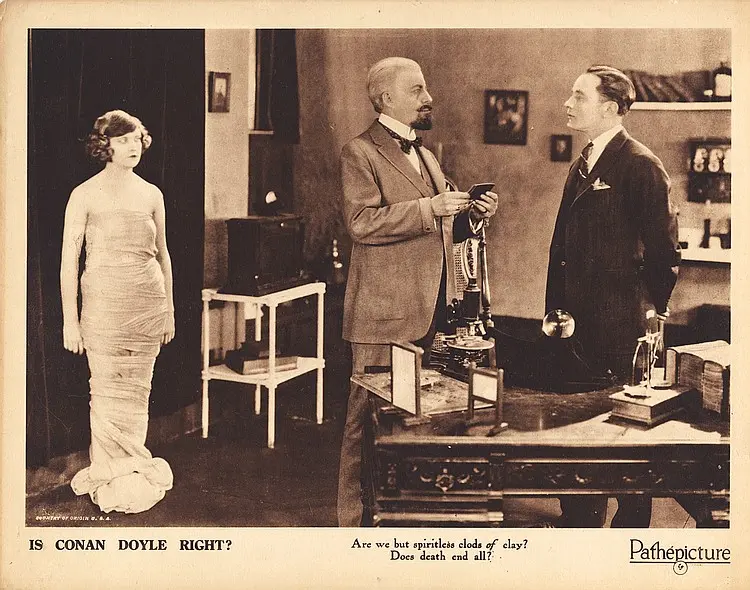
The year 1923 stood at a precarious crossroads of human history. The shadow of the Great War still loomed large, leaving a vacuum of loss that traditional religion struggled to fill. Into this void stepped Sir Arthur Conan Doyle, a man whose literary creation, Sherlock Holmes, epitomized the pinnacle of cold, deductive reasoning, yet who personally surrendered to the allure of the supernatural. Jack Harvey’s Is Conan Doyle Right? emerges not merely as a film, but as a cultural intervention—a celluloid exorcism aimed at the spectral fads of the era.
To witness this documentary today is to observe the birth of the 'debunker' subgenre. Harvey does not approach his subject with the whimsical curiosity one might find in A Cat's Life; instead, he employs a clinical, almost prosecutorial aesthetic. The film’s structure is a fascinating tapestry of re-enactments and technical demonstrations. While contemporary audiences are accustomed to the high-definition CGI of modern hauntings, Harvey’s use of primitive trick photography serves a dual purpose: it creates the very 'ghosts' it seeks to invalidate, proving that the eye is easily deceived by the shutter.
The pacing is deliberate, eschewing the frantic energy of slapstick contemporaries like Monkeying Around or the chaotic slapstick of Tillie's Punctured Romance. There is a gravity here that mirrors the somber themes of The Toll of Mammon, focusing on the spiritual 'cost' of these deceptions. Harvey meticulously breaks down the mechanics of the 'cabinet'—the dark enclosure where mediums supposedly manifested spirits—showing how hidden levers and accomplice-fed information were the true sources of the 'miraculous.'
The central tension of the film lies in the figure of Doyle himself. The documentary treats him with a paradoxical blend of respect for his intellect and pity for his perceived gullibility. It is a far cry from the straightforward characterizations seen in The Girl of the Golden West (1923), where heroes and villains are clearly demarcated. Here, the villain is not a person, but an epistemological error. The film suggests that even the sharpest minds can be blunted by the overwhelming desire to see a loved one once more.
"Is the camera a witness to truth, or the ultimate accomplice in the fabrication of the divine?"
Harvey’s direction shines when he contrasts the 'spiritual' images with the reality of their production. He uses split-screens and overlays that, for 1923, were cutting-edge. This technical prowess reminds one of the visual experimentation in Felix Turns the Tide, though the intent here is strictly naturalistic rather than fantastical. By showing the 'how,' Harvey strips the 'wow' from the spiritualist’s repertoire, effectively performing a public service through the medium of entertainment.
When compared to the sentimentalism of The Heart of a Child or the moralistic domesticity of The Deciding Kiss, Is Conan Doyle Right? feels remarkably modern. It lacks the saccharine artifice that defined much of the silent era's output. Even in its most dramatic moments, it maintains a distance that feels more like a lecture than a melodrama. It shares some of the stark, unflinching qualities found in The Bludgeon, particularly in how it treats the vulnerability of its subjects.
The film also touches upon the sociological impact of spiritualism on women, who were often the primary targets (and sometimes the primary practitioners) of these séances. Unlike the trope of the 'fallen' woman or the 'virtuous' maiden seen in No Man's Woman or Sally's Blighted Career, the women in Harvey's documentary are portrayed as victims of a sophisticated psychological trap. The vulnerability displayed here is more akin to the quiet pathos of The Brief Debut of Tildy, where the search for significance leads to a bittersweet realization.
Visually, the film is a masterclass in early 20th-century lighting. To capture the 'spirit' manifestations, Harvey had to manipulate light in ways that were usually reserved for horror or high-concept drama. The shadows are deep, the highlights are blown out to create a 'heavenly' glow, and the grain of the film stock itself adds a layer of unintended grit that enhances the documentary's authenticity. This is not the polished, storybook aesthetic of Harestegen; it is a raw, almost invasive look into the darkened rooms of London and New York.
There is a sequence involving 'spirit slate writing' that is particularly effective. Harvey shows the medium's hands moving with a dexterity that would make a card sharp jealous. This focus on the physical—the hands, the chalk, the hidden compartments—grounds the film in a tactile reality that contrasts sharply with the airy, ethereal claims of the spiritualists. It reminds the viewer of the grounded, often tragic realism in A Broken Doll, where the physical world offers no easy escapes through magic.
Jack Harvey’s work here is a precursor to the modern skeptical movement. It predates the Amazing Randi and the investigative journalism of the late 20th century by decades. While it may lack the narrative cohesion of a film like Man and His Angel, its importance as a historical document cannot be overstated. It captures a moment when humanity was trying to reconcile its ancient fears with its new technologies.
In the end, Is Conan Doyle Right? answers its own titular question with a resounding, albeit sympathetic, 'No.' It suggests that while Conan Doyle might have been right about the human heart's capacity for love and its endurance through grief, he was profoundly wrong about the physics of the universe. The film remains a haunting reminder that the most dangerous illusions are the ones we want to believe in the most. It is a stark, fascinating, and intellectually stimulating piece of early cinema that deserves a place in the pantheon of great investigative works.
IMDb 5
1930
Community
Log in to comment.