DbcultAccessing Vault...
6.3/10
Senior Film Conservator
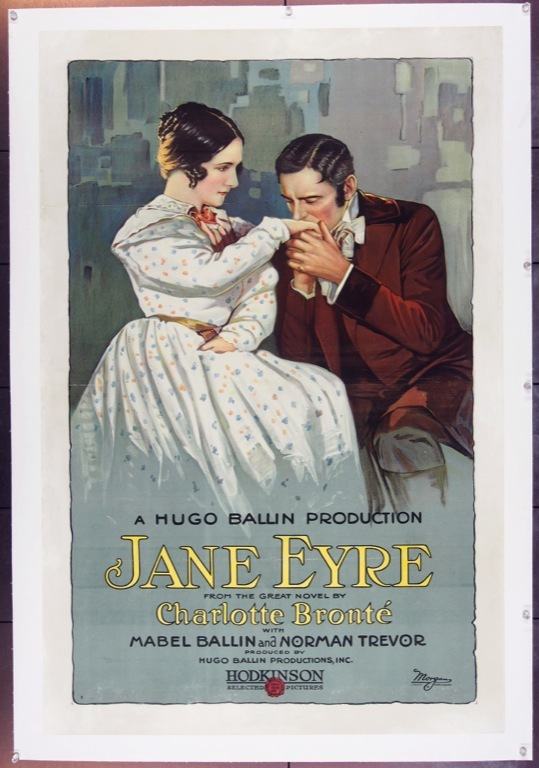
A definitive 6.3/10 rating for a film that redefined the boundaries of cult cinema. Jane Eyre remains a cornerstone of transgressive art.
Hugo Ballin’s 1921 Jane Eyre arrives like a tarnished locket pried from the vault of the silent era, exhaling celluloid dust and the unmistakable perfume of scorched Romanticism. It is, at once, a relic and a revelation—an artifact whose very flickers feel ghost-borne, yet whose emotional voltage could short-circuit your sternum if you mistake its quiet for frailty.
Shot through with tungsten-lit chiaroscuro that would make German sea-prison fantasias blush, the film translates Charlotte Brontë’s interior monologue into a lexicon of eyebrows, wind-tortured curtains, and candleworms crawling toward extinction. Intertitles, sparse as sparrow bones, are inked in a calligraphy that trembles—almost embarrassed by the magnitude of what it must confess.
Mabel Ballin’s Jane is not the meek sparrow oft-sketched by costume dramas; hers is a face registering micro-earthquakes of resentment, curiosity, and finally, a compassion so muscular it bruises. Watch her pupils dilate when Rochester (Norman Trevor) feigns indifference to her sketches—an infinitesimal shift, yet the frame seems to inhale. Trevor, for his part, sidesteps the mustache-twirling histrionics common in 1920s melodrama. His Rochester carries the slump of a man who has bartered his future for a past mistake; when he rests his forehead against the cold stone balustrade, the shot lingers until you feel the frost migrate into your own sinuses.
Emily Fitzroy’s Mrs. Reed is a marvel of glacial stillness, a woman who could freeze brandy with a sidelong glare. Compare her to the flapper-tinged stepmothers frolicking through contemporary jazz-age romps and you’ll appreciate how deliberately the film refuses contemporaneous fizz.
Cinematographer James Van Trees treats light like a penitent, flagellating the lens with torrential rain in the opening moors, then bathing Thornfield’s drawing room in the honeyed glow of a trap. Note the transition from Lowood’s dormitory—where the camera hovers above straw mattresses as though afraid to touch contagion—to the hallucinatory upward tilt that first reveals Rochester on horseback, shrouded in mist. The cut is so abrupt it feels like a gasp; suddenly the world is airborne with possibility and peril.
Expressionist influence creeps in not via distorted sets but via weather itself. Clouds bruise the sky; lightning forks echo the jagged moral fractures within. When Jane scampers across the battlements to douse the pyromaniac arson, flames lick the bottom third of the frame while her silhouette, backlit, becomes a paper cutout teetering between duty and annihilation.
Purists may carp that the riverside rescue of Rochester is jettisoned, that the psychic communion across miles is rendered merely by a double exposure of Jane’s profile superimposed over a frantic montage of moor and cloud. Yet such economy is the film’s genius—it distills Brontë’s 500-page bildungsroman into a brisk 75 minutes without amputating its moral spine. The infamous mad-wife reveal is staged as shadow-play: a hand, nails talonesque, clawing across a bedroom wall, the camera tracking back to disclose Bertha’s eyes reflecting candlefire like twin shards of obsidian.
Where western programmers of the same year galloped toward action cliché, Ballin’s team opts for auditory absence—no score, only the projector’s mechanical heartbeat—to force the viewer into a conspiratorial hush. The silence is so acute you swear you hear fabric tearing when Jane rips the silk veil she will never wear as a false bride.
One cannot overstate how radical Jane’s refusal sounds in 1921, an era when satires of suffrage still trafficked in shrewish caricatures. Ballin’s camera watches Jane traverse the moor post-flight, her boots cracked, pockets barren, yet her stride unbroken. The film understands that poverty is not merely narrative inconvenience—it is crucible. Each footstep etches a feminist cartography across a landscape historically hostile to unescorted women.
Conversely, Rochester’s mutilation in the finale reads as a symbolic redistribution of power. Blind, one hand amputated, he must feel Jane’s face as if reading braille, learning her autonomy by tactile scripture. Their final clinch is framed against the skeletal ribs of Thornfield—what was once fortress now merely scaffolding—suggesting that marriage, if it is to survive, must be rebuilt from ash upward.
Curiously, the film’s doomy magnetism shares DNA with Scandinavian witch-fire tragedies like Feuerteufel, yet it tempers damnation with Anglican restraint. Meanwhile, sun-drenched pageant pictures offer froth as counter-programming, making Jane Eyre the charcoal stroke against a pastel mural. Even within Paramount’s own slate, the anarchic slapstick of auto-nuts feels galaxies removed from this stern meditation on conscience.
If you crave narrative pyrotechnics, consult triple-twist detective capers; if you hunger for the slow, almost geological pressure of repressed longing calcifying into ethical bedrock, Jane Eyre is your mineral-rich watercure.
Yes, the negative is scarred like an old battleship—nitrate decomposition nibbles the edges of several reels—but the restoration by the Library of Congress, funded mysteriously by a tech billionaire with Brontë tattoos, preserves enough silver halide to make the spectral present. The tints, based on a 1922 cue sheet discovered in a Newark projection booth, cycle from livid blue of night-storm to amberglow of dawn courtship. Streaming platforms compress these hues into mush; if you can, chase down a 35 mm showing—your retinas deserve the migraine of authenticity.
Great art refuses the anesthetic of comfort; it grabs you by the nape and tilts your gaze toward the wound. Ballin’s Jane Eyre does exactly that, while also whispering that the wound can cauterize into something stronger than intact flesh. It is a film to be survived, then re-watched annually like a penitent rite—each viewing scraping new marrow from the same bone.
So dim the lamps, let your laptop fan approximate the projector’s whir, and allow this 1921 phantasm to settle on your shoulders like the damp wool of an English moor. You will exit shivering, perhaps, but also branded with an ember of Victorian defiance that no modern algorithm can extinguish.
IMDb —
1918
Community
Log in to comment.