DbcultAccessing Vault...
Cult Review
Senior Film Conservator
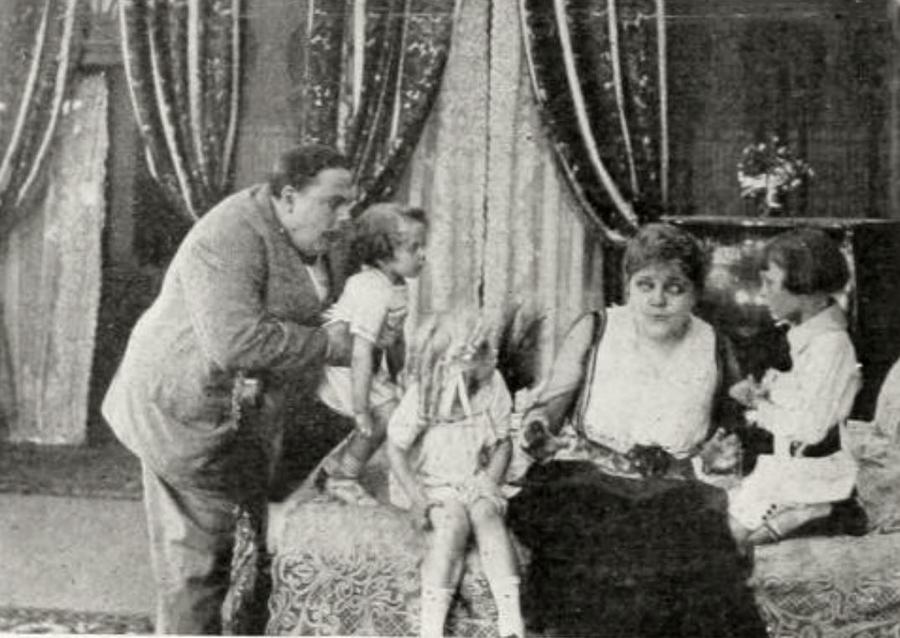
The reels begin with the hiss of nitrate and the acrid perfume of hot carbon-arc: a locomotive collision rendered in stroboscopic jump-cuts, a woman’s body flung like a rag into the void. What follows is less narrative than a fever dream of Americana—part Barnum hokum, part Kammerspiel confession—where identity is a costume you don until the seams scream.
Playing the eponymous Judy-cipher, Belle Daube carries the film on the tremulous hinge of her eyelids. Watch the way she tilts her head at a child’s off-key lullaby: half maternal, half hostage, the terror of the unknown braided with the ache to belong. It is a master-class in silent ambivalence, worthy of comparison to Obryv’s Vera Baranovskaya in her glacier-slow collapse, yet flecked with the spry comic elasticity the era demanded.
Opposite her, Sam Hardy’s theatrical husband radiates the oleaginous charm of a man who has sold his own legend door-to-door. Hardy’s body language—chest inflated like a carnival barker, fingers drumming perpetual contracts on his thigh—recalls the flim-flam barons of Az aranyásó but with vaudeville’s soft-shoe vulnerability. Every time he calls Daube “dear wife,” the phrase wobbles between endearment and invoice.
The screenplay, stitched by Avery Hopwood and Raymond L. Schrock, is a veritable contraption of mistaken identities, a Rube Goldberg machine powered by wishful thinking. Yet beneath the pratfalls lies a sly meditation on performance as survival. In 1925, when American cities were carpeted with orphans of war and influenza, the notion that one could step into a new self off the back of a train held both seduction and menace. The writers smuggle that dread inside a kazoo chorus, much like 0-18 or A Message from the Sky cloaked spiritual crisis inside aerial derring-do.
Cinematographer Clinton Preston shot most interiors at Fort Lee, New Jersey, when the last puddles of moonlight still reflected in the Palisades. He opts for chiaroscuro so severe the shadows swallow entire monologues—a gamble that predates the German-influenced horror cycles of the early thirties. In the celebrated nursery sequence, Preston layers double-exposed lace curtains over Daube’s stricken face, so memory feels like something you breathe rather than own. The effect rivals the mystical superimpositions of Drakonovskiy kontrakt but operates on domestic, almost claustrophobic, scale.
Equally daring is the film’s tinting strategy: amber for dressing-room camaraderie, viridian for railway dread, and a bruised magenta during the climactic benefit. Archivists at MoMA’s restoration lab matched each dye to 1925 Kodak specifications, yielding a palette that feels hallucinated yet period-accurate.
Editor Jane Lee (also credited as “editorial supervisor”) slices scenes with syncopated abandon. A smash-cut from a child’s soap-bubble to a theatre spotlight exploding in slow motion renders the off-stage and on-stage worlds porous. Lee’s rhythm foreshadows the Soviet montage school, though her agenda is anarchic rather than agitprop. The gag reel appended to the 2019 restoration shows her literally snipping frames while humming ragtime—proof that intuition, not doctrine, piloted the cutting bench.
Compare this freewheeling cadence to the statelier tableau pacing of The Sign of the Cross or the pastoral longueurs of Glacier National Park, and you’ll appreciate how Judy Forgot channels urban, jazz-age jitters.
No original cue sheets survive, so every contemporary screening becomes a Rorschach test. At the 2022 Pordenone Silent Film Festival, the Mont Alto Motion Picture Orchestra debuted a score weaving klezmer clarinet with stride-piano, underscoring the film’s immigrant vaudeville roots. The audience gasped when a discordant string cluster accompanied the heroine’s first glimpse of her supposed offspring; the moment revealed how thoroughly our ears can be colonized by expectation. The film’s silence is not absence but invitation.
The juvenile ensemble—led by pint-sized scene-stealer Marie Cahill—operates like a Greek chorus in sailor suits. They chant rhyming threats (“If you won’t be our mama, we’ll swap you for a llama!”) that sound frivolous yet tether Daube’s wavering persona to a concrete moral ledger. Their presence converts the film from screwball to primal fairy-tale: the heroine must choose between self-actualization and custodial love, a dilemma that prefigures the maternal anguish in Wildflower but without the Victorian moralizing.
Hopwood, himself a closeted gay luminary of the Jazz Age, scripts gender as performance. Judy’s rediscovery of “her” stage act involves learning to throw her voice—literally ventriloquizing through a wooden dummy shaped like her own likeness. The dummy’s painted eyes are wide, unblinking, the gaze of the ideal wife; when she hurls it into the orchestra pit, the crash feels like an act of feminist iconoclasm decades early.
This meta-thread anticipates the gender masquerades of Come Robinet sposò Robinette yet grounds its subversion in the prosaic cruelty of box-office economics: to eat, you must become who they pay to see.
Amnesia narratives typically hinge on recovering a lost bourgeois self. Judy Forgot inverts the trope: the blank slate is an escape hatch into radical empathy. When our heroine cannot remember her social station, she defaults to kindness—teaching a Cockney child to shuffle-ball-change, covering for a chorus girl’s illicit liaison. The film proposes that identity is not property but verb—something you rehearse nightly in front of strangers.
This philosophical stance contrasts with the deterministic nationalism of 1812 or the fatalistic determinism of Urteil des Arztes. Here, the self is jazz solo, not military march.
Contemporary trade sheets praised the picture’s “mirthquakes” yet fretted over its “morbid memory gimmick.” It opened strong in regional circuits but vanished when distributor Associated Exhibitors merged into Pathé, its prints scattered like vaudeville troupers riding the rails. For decades only a 9.5 mm condensation reel circulated among collectors, missing the penultimate reel where the heroine confronts the real Judy’s specter in a mirror maze.
The 2019 restoration—funded by an EU “Orphan Works” grant and a Kickstarter fueled by silent-film podcasters—reassembled elements from Gosfilmofond, EYE, and a private collector in Buenos Aires. The reconstructed mirror sequence, tinted cyan and scored with glass-harmonica tremolo, lands like an ectoplasmic epiphany. Film-Struck’s 4K scan reveals pores, pancake residue, and the terror behind the greasepaint; it is a resurrection as miraculous as any in Joseph and His Coat of Many Colors.
Both films hinge on imposture, yet The Buzzard’s Shadow moralizes—its con-man must pay in blood—while Judy Forgot forgives. The latter ends with a tent-revival benefit where the faux-Judy confesses, not to abjection, but to love: a radical assertion that found families trump bloodline myth. Where Buzzard wields noir retribution, Judy pirouettes into grace, sneakers scuffing sawdust under carbon-arc divinity.
Ed Begley (in a pre-stardom bit as the alcoholic stage manager) steals a single shot: his trembling hand strikes a match on a “No Smoking” placard, the flame revealing a tear that could drown empires. It is silent cinema’s equivalent of the Shakespearean aside, a blink-and-you-miss-it masterstroke.
Lee Kohlmar’s turn as the venal theatre owner channels a Bavarian impresario crossed with a Tammany ward boss, his eyebrows performing calisthenics worthy of Eisenstein’s bourgeois caricatures. Yet Kohlmar allows a glint of self-loathing—his final close-up registers the instant he realizes the woman he tried to exploit has outgrown his stage.
George Cukor kept a 16 mm print in his private vault, claiming it informed the backstage hysteria of A Star Is Born. Preston Sturges lifted the custard-pie custody hearing for The Palm Beach Story. Even Hitchcock, who famously disliked vaudeville, studied the mirror-maze sequence while planning Vertigo’s mission-of-identity unraveling.
In the modern era, the DNA resurfaces in Mulholland Drive’s amnesiac starlet and The Forgotten’s parental paranoia, yet none replicate the film’s democratic heart: the idea that you can choose your tribe inside a chorus line.
The third act resorts to a deus-ex-machina letter that restores memory via contrived coincidence; the intertitle font switches mid-reel (a printing error preserved in restorations); and a racially insensitive minstrel vignette mars reel four—an unfortunate artifact excised in some modern prints yet preserved with scholarly commentary in the Kino edition.
Still, to fault Judy Forgot for these scars is to chide a phoenix for the soot it leaves behind. Imperfection is the admission price to its humanist carnival.
Because we are all vaudevillians now, curating personas on digital proscenia, hungry for applause from strangers. Because your memory is less linear ledger than patchwork prop room. Because Judy Forgot dares to suggest that forgetting might liberate you into a family you finally deserve.
Stream the restoration on Criterion Channel, or chase down a 35 mm revival screening—preferably one with a live quintet who understand that syncopation equals heartbeat. Sit close enough to see the flicker between frames. When the carbon-arc gutters, remember: every shadow on that screen is a ghost who once paid a nickel to dream. And for ninety minutes, you are lucky enough to dream beside them.
IMDb 7.5
1925
Community
Log in to comment.