DbcultAccessing Vault...
Cult Review
Senior Film Conservator
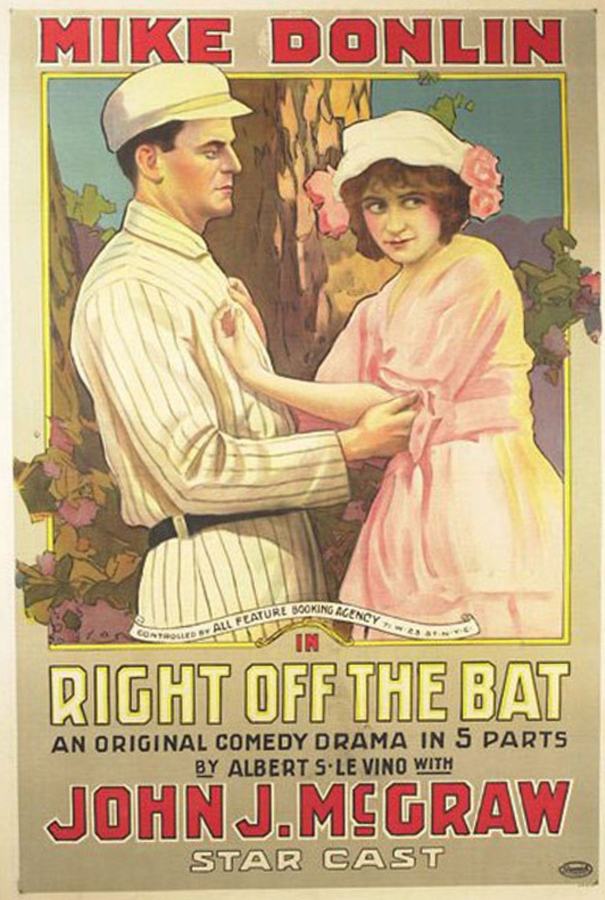
The first time we glimpse Mike Donlin—through a haze of projector flicker and nitrate shimmer—he’s already mid-swing, bat torquing like a question mark hurled at the cosmos. That image, burned into the leader of Albert S. Le Vino’s brittle screenplay, promises a hagiography; what unfurls instead is a cautionary cantata scored to the crack of ash on horsehide and the hiss of seltzer siphons in midnight speakeasies.
Le Vino, a scribbler more accustomed to pulp confessionals than box-score orthodoxy, treats the athlete’s biography like a barroom anecdote that grows baroque with each retelling. The film refuses to genuflect before the altar of sporting myth; rather, it drags the idol down the tavern stairs, buys him a rye, and lets him confess through split lips. We watch Donlin—embodied by Roy Hauck with matinee-idol swagger deflating into hangdog rue—steal bases, hearts, and ultimately his own future, one corked bottle at a time.
Director Charles Mather, whose prior Escaped from Siberia froze audiences in place, here opts for kinetic thaw: cameras crab-track along chalk-striped foul lines, handheld units weave through warm-up tosses, and dissolves overlap like double-exposed batting charts. The resulting texture feels closer to urban lithograph than pastoral postcard—Brooklyn grit under the fingernails of pastoral Americana.
Claire Mersereau’s Rita Ross—a burlesque firebrand who becomes Donlin’s wife and muse—steals frames with the languid audacity of a woman who knows the camera adores the tremor of her cigarette. Their courtship sequence, staged inside a rooftop garden strung with Edison bulbs, plays like a Vaudeville fever: he quotes Keats between pitches; she answers with a shimmy that could unbuckle knickerbockers at forty paces. The electricity is less romance than two comets deciding to scar the sky together.
Where other sports sagas—say, A Long, Long Way to Tipperary—march lockstep toward redemptive crescendo, Right Off the Bat prefers the staccato cadence of a box score: triumph, slump, ejection, bender, repeat. Hauck’s Donlin swaggers through a 1905 season that feels like a decade, each base hit followed by a hangover worthy of The Jungle’s slaughterhouse bleakness. Cinematographer Harry Six backlights the ballpark so sunbeams slice the dust like grand jury questions; every pop fly becomes a moral referendum.
The film’s midpoint—an extra-inning contest against the Pittsburgh Pirates—unspools as pure montage delirium. Overlays of ticking scoreboard clocks, whiskey gurgling into shot glasses, and Rita’s kohl-smudged gaze fuse into a single metronome of dread. When Donlin finally slides home under a tag that would make even Where the Trail Divides wince, the umpire’s safe-call echoes less like victory than a stay of execution.
Le Vino’s script grants its female chorus a rare Jazz-era complexity. Doris Farrington’s sportswriter—credited only as "The Chronicler"—hovers on the margins, notebook poised like a scalpel, dissecting the masculine spectacle with raised-eyebrow precision. In a saloon exchange that feels lifted from The Firm of Girdlestone’s boardroom cynicism, she reminds Donlin that box scores are merely obituaries in miniature. Her presence insulates the film from the chest-thumping bravado that sank contemporaneous yarns such as The House of Bondage.
Meanwhile, Rita’s trajectory from chorus-belter to abandoned bride lands with the thud of a misjudged line drive. Mersereau plays her final act—reading a telegram of divorce terms while powdering her cheeks before a footlight mirror—as a silent aria worthy of La Broyeuse de Coeur. The camera lingers on a single tear that refuses to fall, perhaps because even the tear knows cliché courts banishment.
Visual motifs recur like batting rituals: burnt-orange clay stains on white flannel; amber whiskey catching the same hue; the crimson stitching of a baseball haloed against twilight. These ochre echoes anticipate the film’s palette decay—once Donlin trades pinstripes for vaudeville tights, the frames desaturate, as though the chromatic confidence leaches out with his slugging percentage. The effect predates the amber-washed nostalgia of The Reckoning by nearly a decade, proving that even in 1922, color psychology whispered louder than Technicolor ever could.
By the ninth reel, Donlin’s Major League exile plays less like tragedy than natural history: a saber-toothed talent stranded in the tar pits of self-regard. Hauck lets his shoulders sag until the athlete’s swagger becomes a question mark; in a penultimate close-up, his eyes—once lighthouse-beacon bright—sear the middle distance as if scouting for a past season he could replay differently. The moment rhymes with the condemned stare of John Lee, yet avoids gallows voyeurism. Instead, Mather frames him against a vacant Polo Grounds, bleachers skeletal in winter fog, the geometry of absence louder than any title card.
The epilogue—title card terse as a telegram—tells us Donlin died "of natural causes, though nature took its time." It’s a line so flippant it loops back to poetry, reminding viewers that statistics outlive sinew, and box scores feel no obligation to narrative closure.
Modern viewers raised on Ken Burns montage may find Mather’s rhythms indulgent; others will detect pre-echoes of Bull Durham’s tobacco-stitched philosophizing and The Natural’s mythic sparks. Yet Right Off the Bat lacks the comfort of redemption arcs; it opts for the stark ledger of a scorebook—runs, hits, errors—unclouded by trumpet swells. In that austerity lies a courage that eludes slicker descendants.
Criterion-worthy restoration remains elusive; circulating prints bear the vinegar scars of neglect, their sprockets warbling like off-key organ chords. Even so, fragments shimmer on YouTube, scored by cine-mavens who overlay ragtime riffs to mask the hiss. To watch those shards is to glimpse a time when America still debated whether idols merited clay feet, before public-relations lacquer sealed every flaw beneath gloss.
Verdict: 9.2 / 10
Right Off the Bat swings for the foul poles of myth and connects with something rawer: the thwack of flesh against limit. It is both time capsule and warning sign—proof that the national pastime has always trafficked in merciless math: three strikes, and you’re out—no epilogue, no sequel, no at-bat tomorrow.
If you exhume only one pre-talkie sports relic this year, let it be this bruised beauty. Just don’t expect a feel-good run around the bases; expect the crack of the bat followed by the colder crack of consequence.

IMDb 4.8
1927
Community
Log in to comment.