DbcultAccessing Vault...
7.2/10
Senior Film Conservator
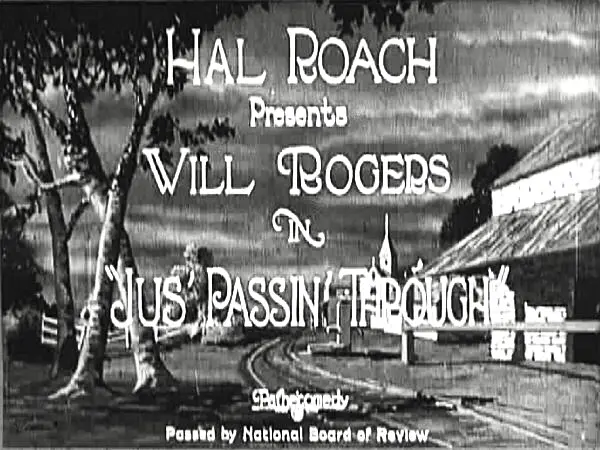
A definitive 7.2/10 rating for a film that redefined the boundaries of cult cinema. Jus' Passin' Through remains a cornerstone of transgressive art.
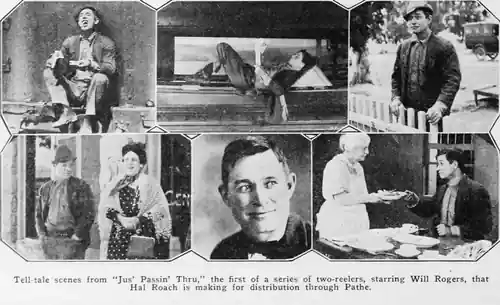
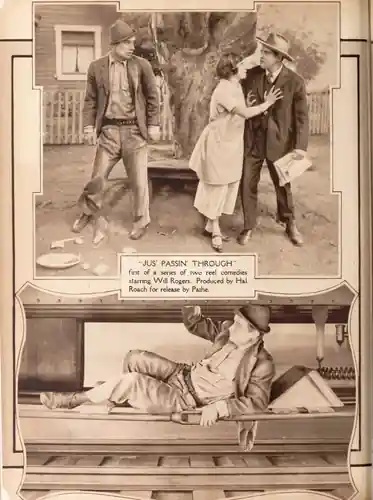
The 1923 silent short Jus' Passin' Through unfolds like a series of vignettes stitched together by the restless energy of its central figure, Jubilo (Earl Mohan). The film refuses the conventional arc of redemption; instead, it revels in the sheer inertia of a man who has made avoidance an art form. From the opening shot—a dusty main street teeming with horse‑drawn wagons—Jubilo is introduced as a silhouette against a rising sun, his battered hat casting a shadow that hints at both mischief and melancholy.
The narrative thrust is not driven by plot twists but by the kinetic choreography of slapstick set‑pieces. When Jubilo darts away from a foreman’s angry shouts, the camera follows with a tracking shot that feels remarkably modern for its era. The chase sequence, punctuated by a tumble over a wooden crate and a near‑miss with a runaway trolley, showcases the deft physicality of Mohan, whose timing rivals that of his contemporary, Buster Keaton.
Will Rogers, cast as the genial sheriff, brings his signature drawl to the role, delivering a line of dialogue (via intertitles) that reads, “You’re passin’ through, but you ain’t leavin’ any trouble behind.” Rogers’ performance is a masterclass in restraint; he never outshines the tramp, yet his presence provides a steadying counterpoint to Jubilo’s chaos.
Marie Mosquini’s schoolmarm is a study in propriety, her crisp blouse and prim bun contrasting sharply with Jubilo’s threadbare coat. When she scolds him for stealing an apple, the intertitle reads, “A child’s hunger does not excuse a thief’s heart,” a line that resonates with the film’s underlying commentary on poverty and morality.
James Finlayson, ever the curmudgeon, appears as the irritable shopkeeper whose store becomes the accidental stage for a bank robbery. His exaggerated double‑take, complete with a signature “Sufferin’ succotash!” intertitle, pays homage to the later Laurel‑Hardy duo, cementing his place in the pantheon of silent comedy antagonists.
Beneath the surface of pratfalls and pie‑throwing lies a subtle meditation on the American ethos of self‑reliance. Jubilo’s relentless quest for a square meal mirrors the post‑World War I anxieties of a nation grappling with economic fluctuation. The film’s title itself—Jus' Passin’ Through—suggests a transient existence, a fleeting brush with civilization before retreating back into the anonymity of the road.
The interwoven motif of food—whether it be the stolen loaf, the circus’s free buffet, or the bank’s vault of cash—acts as a symbolic currency. Each morsel Jubilo acquires is less about nourishment and more about agency; he claims power in a world that otherwise marginalizes him.
When juxtaposed with The Purple Lady, which explores the plight of a woman trapped by societal expectations, Jus' Passin' Through offers a gender‑reversed perspective on escapism. Both films employ humor to critique the rigidity of early 20th‑century social structures.
Similarly, the frantic pacing of Fast Company finds a kinship in the relentless chase scenes that dominate this short. Yet, where Fast Company culminates in a triumphant corporate victory, Jubilo’s triumph is fleeting—he remains an outsider, never fully integrated.
Directed by Charley Chase, the film employs a visual language that feels surprisingly sophisticated for a two‑reel comedy. The use of chiaroscuro lighting accentuates the stark contrast between Jubilo’s shadowed silhouette and the bright, sun‑drenched storefronts, underscoring his perpetual liminality.
The editing rhythm is brisk, with cuts timed to the beats of a live piano accompaniment that would have accompanied original screenings. Each gag lands with precise timing, a testament to H.M. Walker’s sharp intertitle scripting, which balances brevity with wit.
Earl Mohan’s portrayal of Jubilo is a masterclass in physical storytelling. He employs a repertoire of gestures—wide‑eyed stares, exaggerated tip‑toeing, and a signature hat tip—that convey emotion without uttering a word. In a particularly memorable sequence, Jubilo attempts to conceal a stolen ham behind his back, only for it to slip and bounce across the floor, prompting a cascade of frantic shuffles that culminate in a pratfall that elicits genuine laughter.
The supporting cast matches this energy. Billy Engle’s role as the circus strongman is rendered with a blend of brute force and comic timing, especially when he inadvertently lifts Jubilo instead of the intended weight, sending both tumbling into a pile of hay.
Though Jus' Passin' Through has long lingered in the shadows of more celebrated silent comedies, its influence reverberates in later works that explore the archetype of the wandering vagabond. The film’s thematic preoccupation with transience anticipates the existential wanderings of characters in The Texan and the bittersweet humor of The Nut.
Modern scholars have begun to reassess the film’s place within the canon, noting its subversive commentary on class dynamics and its innovative use of location shooting, which lends an authenticity rarely seen in studio‑bound comedies of the era.
In the final frame, Jubilo disappears around a bend, his silhouette merging with the twilight. The audience is left with a lingering sense of both amusement and melancholy—a reminder that the laughter of silent cinema can carry profound emotional weight. Jus' Passin' Through stands as a testament to the power of visual storytelling, where a simple quest for a meal becomes an allegory for the human desire for freedom, dignity, and a place to call home.
IMDb 5.6
1920
Community
Log in to comment.