DbcultAccessing Vault...
Cult Review
Senior Film Conservator
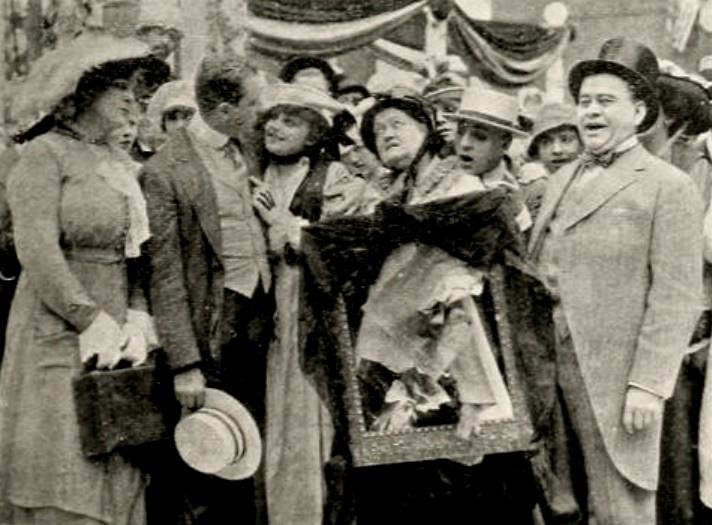
There’s a special venom in the optimism of 1915, a year when the Great War was still something happening across oceans and the nickelodeon reeked of popcorn and possibility. Just Out of College arrives like a champagne bottle hurled through that optimism—its effervescence masking a bite that draws blood even now.
Walter Hiers, equal parts Buster Keaton bone-structure and W.C. Fields rotund mischief, embodies Edward Swinger with a gait that anticipates each paved crack of adulthood. Watch him pivot from quadrangle to boardroom: shoulders thrown back, mustache wax catching the arc-light, every step an overcorrection toward a future he refuses to earn honestly. The performance is silent yet loquacious; eyebrows semaphore entire prospectuses, and when his pupils dilate at the sight of Caroline’s gloved hand accepting a dance card, you witness capitalism’s nascent erotic charge.
Director Mark Swan—often dismissed as merely prolific—here conducts a chamber piece about America’s congenital gift for self-invention. Notice the repeated visual motif of doors: dormitory doors slamming shut on irresponsibility, mahogany bank doors yawning open to tempt Edward, and finally the Pickering garden gate clicking closed, its wrought-iron vines looking disconcertingly like prison bars. We’re ushered through thresholds until the threshold itself becomes the joke.
George Ade’s source material—an epistolary satire of Midwestern boosterism—translates to title cards that pop like bubble gum. One intertitle reads: "He incorporated the breeze, issued stock in the sunrise, and capitalized the ozone." The line is pure Ade, a newspaperman who knew that American fortunes were minted first in language, only later in ledgers. Read those words aloud and you taste the same giddy ether that pumped through Florida land-boom brochures a decade later.
Compare Edward’s scheme to The Root of Evil (1915), where embezzlement is a grim moral lesion. Here fraud is flirtation, a collegiate prank inflated to socioeconomic allegory. The tonal tightrope—keeping audiences amused rather than appalled—owes much to Marie Wells’ Caroline. She plays ingenue without the saccharine aftertaste, giving us micro-glances of skepticism: a half-arched brow when Edward claims his factories "never sleep," a pause too long before accepting his fraternity pin. The film trusts viewers to suspect that she suspects, and that suspicion rescues the romance from Stockholm-Syndrome territory.
Cinematographer Jack Sherrill—unheralded artisan of early Paramount—captures ivy-covered brick in diffused noon light that feels like pressed flowers between pages. Interiors, by contrast, are pools of umber shadow where gas-jets flicker like interrogation lamps. The push-pull between pastoral innocence and mercantile gloom foreshadows the Roaring Twenties’ own whiplash. When the camera dollies back to reveal Edward’s empty office—chair askew, phone off the hook—it’s a proto-noir void, an urban cousin to the Expressionist nightmares brewing in Weimar.
Film scholars hunting for feminist seeds will latch onto Charlotte Lambert’s supporting turn as Myra Wendell, Caroline’s sharp-tongued roommate who pens investment limericks for the college paper. She alone calls Edward’s bluff, but instead of moralizing she leans into the game, offering to ghostwrite his shareholder bulletin in exchange for theater tickets. Her transactional savvy feels shockingly modern, a #GirlBoss avant la lettre, and her eventual eye-roll when Edward’s empire collapses is the film’s most succinct editorial.
Amelia Summerville, as Pickering Sr., strides through scenes like a Gilded Age colossus, watch-chain tracing the arc of his belly. In one delicious tableau he lectures Edward on "character being collateral," unaware that the very desk between them is rented. Summerville lets the corner of his mouth twitch—almost a smile—hinting that perhaps, deep down, this titan recognizes a kindred spirit in the swindler. It’s a microscopic gesture that opens an abyss: American business as a wink-and-handshake conspiracy.
Meanwhile, Eugene O’Brien cameos as the bemused bank examiner, a pre-code harbinger of future bureaucratic killjoys. His monocle catches the projector beam, turning the lens itself into a cyclopean judge. The moment lasts maybe four seconds, yet it prefigures every regulatory reckoning that would haunt the stock market a decade later.
Viewers reared on talkies may scoff at silent storytelling, but hear this film’s hush: the rustle of taffeta as Caroline descends a staircase equals any symphony. The absence of spoken dialogue amplifies ambient truth—when Edward’s fountain pen scratches across a counterfeit contract, the room seems to hold breath along with him. Such moments anticipate the sonic minimalism of Chûshingura (1915), where stoicism speaks louder than words.
Critics often yoke Just Out of College to collegiate romps like The Chorus Lady (1915), yet its DNA coils closer to confidence-game classics such as The Mysterious Mr. Wu Chung Foo (1915). Both narratives hinge on protagonists who weaponize exoticism—or in Edward’s case, the mirage of entrepreneurial genius—to penetrate social fortresses. The difference: Wu courts danger through Orientalist mystique, whereas Edward peddles the more indigenous myth of the self-made man.
And what of the women who orbit these tricksters? Compare Caroline to the heroines of Zudora (1915) or The Folly of Desire (1915). Those serial-queens race trains and unmask conspiracies; Caroline merely listens, and in that listening becomes the film’s moral seismograph. Her final close-up—eyes glistening yet unbroken—implies that surviving America’s hustle requires not muscle but perception.
For decades the picture languished in 9.5 mm Pathé fragments until a 2018 MoMA nitrate seminar stitched a 65-minute composite. The new tinting follows early cinema convention: amber for exteriors, lavender for night, rose for romance. Purists decry the addition of a modest piano score by Donald Sosin, yet his ragtime arpeggios sync with Ade’s rat-a-tat dialogue cards, lending momentum to scenes that otherwise risk postcard stasis. Stream it via Paramount+’s “Silent Vault” carousel, or snag the Kino Classics Blu-ray which includes an audio essay on George Ade’s theatrical pedigree.
Does the film indict capitalism or merely chuckle at its pubescent pranks? The answer lies in its refusal to punish Edward with Griffith-style melodrama. No prison bars clang; instead he trudges down a dusty road, diploma flapping like a surrender flag, while Caroline watches from the porch, unreadable. The camera cranes skyward to an iris-out, a silent-era blackout that feels oddly compassionate: America itself is the escaped convict, forever forging ahead, conning itself that tomorrow will validate today’s lie.
Verdict: Just Out of College is a buoyant cautionary tale, carbonated with flapper-era wit yet curdled by the recognition that every generation graduates into the same shell game. Watch it for the performances that pirouette on silence, for the cinematographic whispers of things to come, and for the chill that arrives when you realize Edward Swinger’s business may be fictional, but the hustle is alive in every swipe-right, every crypto whitepaper, every résumé bullet we polish to blinding sheen.
Rating: 4.5/5 caps. A minor miracle of early American satire, freshly restored and still stinging a century later.
IMDb 5.9
1935
Community
Log in to comment.