DbcultAccessing Vault...
4.9/10
Senior Film Conservator
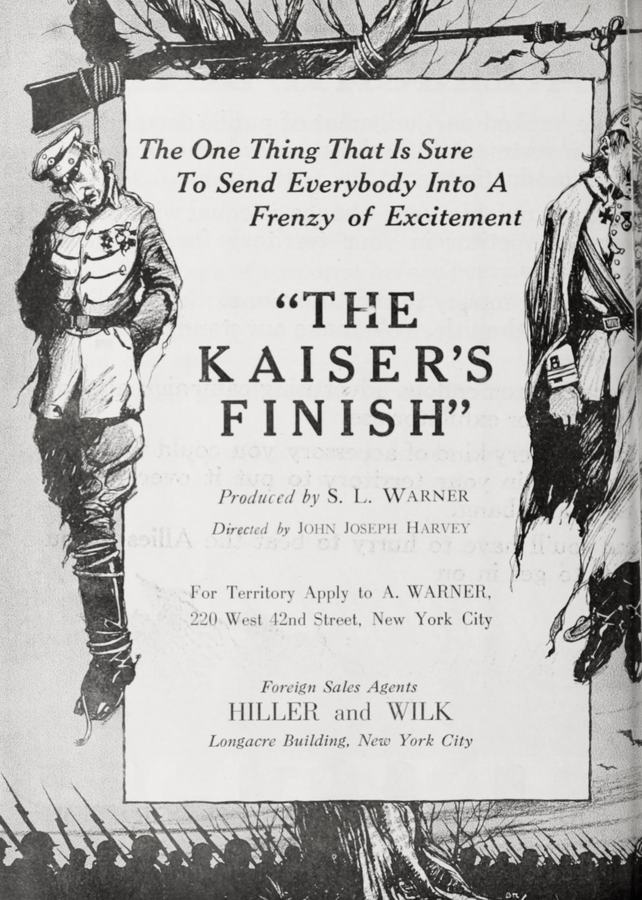
A definitive 4.9/10 rating for a film that redefined the boundaries of cult cinema. Kaiser's Finish remains a cornerstone of transgressive art.
Picture this: 1918 audiences, still coughing on the gunpowder of a world war, watch a film in which the Kaiser’s own seed turns against him. Jack Harvey’s Kaiser’s Finish does not merely flirt with regicide—it slow-dances with it under fractured chandeliers, letting each frame glint like a blade pressed against the empire’s pulse. The illegitimate prince, never named beyond “Richard” (Louis Dean), arrives not as a brash Yankee but as a wound in human form: eyes too hollow for innocence, smile too rehearsed for trust. Dean’s physicality—shoulders pitched forward as if forever breaching enemy lines—makes the resemblance to the real Crown Prince feel less like casting luck and more like predestined sabotage.
Harvey, doubling as director and co-writer, engineers a narrative that folds time back on itself: flashbacks to Coney Island ferris wheels bleed into Potsdam parade grounds, producing the vertigo of a man caught between two national lullabies. The film’s tinting strategy—amber for American memories, cadaverous blue for German present—was primitive yet poetically effective, anticipating the emotional colour grading that would become de rigueur a century later.
Dean’s task is Herculean: he must impersonate an impersonation. Watch the micro-shifts in his gait—how the American slouch hardens into Prussian ramrod posture the moment he crosses the palace threshold. His hands, calloused from Brooklyn dock work, learn to linger on white gloves with the delicacy of a bomb-maker. In a banquet scene, he raises a schnitzel fork with such cautious reverence you’d think it might detonate. Silent-film acting can easily balloon into semaphore; Dean instead compresses turmoil into the twitch of a single cheek muscle. It is a performance calibrated for the intimate scrutiny of the camera, not the proscenium arch—a distinction few theatre-trained actors grasped in 1918.
As Countess Marlene von Hagen—part courtier, part reluctant co-conspirator—Claire Whitney supplies the film’s bruised moral compass. Her introductory close-up, eyes glistening beneath a veil of cigarette smoke, is a masterclass in chiaroscuro portraiture. She intuits the protagonist’s fraud long before the script allows her to voice it, communicating suspicion through the way she fingers the medals on his coat—like a jeweller hunting for flaws in a counterfeit diamond. Their love, never verbally declared, flickers in exchanged glances during a waltz scored only by the rustle of 800 silk gowns. In a daring reversal of gendered expectations, she ultimately engineers the escape route, commandeering an ambulance under the guise of Red Cross piety.
Cinematographer John W. Brown, shackled by wartime shortages of electric arcs, turns deprivation into aesthetic. Corridors are lit by single candles, throwing 20-foot shadows that dwarf the Kaiser’s equestrian portraits—an unsubtle but chilling visual coup suggesting the eclipse of monarchical grandeur. Note the repeated motif of mirrors: whenever Richard nears a psychological breaking point, Harvey places him before fractured glass, producing a kaleidoscope of selves—each reflection a potential traitor. The climactic assassination attempt is staged entirely in reflection: we see only the Kaiser’s mirrored back, the pistol emerging like a steel blossom, before the crack of gunfire shatters the looking-glass and the image itself.
Released months before the actual abdication of Wilhelm II, the film functioned as cinematic prophecy. Newspapers of the era ballyhooed it as “the picture that will shorten the war,” a claim both hyperbolic and revealing—evidence of cinema’s growing reputation as psychic warfare. Censors in several states snipped the intertitle “Every tyrant carries the seed of his own destruction,” fearing it might sap enlistment morale. Yet the War Department privately screened the reel for training operatives in psychological camouflage—proof that propaganda and subversion can share the same strip of nitrate.
Where The Great Secret hinges on chemical formulas and A Continental Girl weaponizes cabaret charisma, Kaiser’s Finish weaponizes bloodline. The film’s obsession with dynastic doubles anticipates the tragic doppelgänger motif in The Other’s Sins, though the latter swaps politics for gothic melodrama. Meanwhile, the moral vertigo of impersonating a national icon resurfaces—more benignly—in Little Mary Sunshine, where mistaken identity yields comic redemption rather than regicide.
Clocking in at 68 minutes, the picture adopts a three-movement tempo: the American prelude (languorous, almost pastoral), the court infiltration (a slow-burn fuse), and the assassination night (a galloping prestissimo). Contemporary viewers conditioned by modern thrillers may smirk at intertitles that linger for four whole seconds, yet the rhythm of tension is cunningly modulated. Harvey withholds the first genuine close-up until the 18-minute mark, making the sudden intrusion of a magnified face feel like a cannon report. The final reel crosscuts between a ticking pocket watch, a cavalry regiment racing through fog, and the Kaiser’s prayer—an Eisensteinian triptych avant la lettre.
Original exhibitors received a cue sheet recommending a pastiche of Wagner’s “Lohengrin,” Sousa marches, and the folk lullaby “Ach, wie ist’s möglich dann.” The clash of Teutonic grandeur and American bravado underlines the protagonist split identity. Modern restorations often substitute a brooding string quartet; either choice illuminates how the film’s emotional cortex lies not in spoken language but in musical counterpoint—proof that silence can be orchestral.
Today, only a 43-minute condensation survives at the Library of Congress, the rest dissolved into chemical vinegary ghosts. Yet what lingers is potent enough to fertilise countless royal-conspiracy thrillers—from Hitchcock’s Sabotage to the recent Kingsman franchise. The film’s boldest bequest is the notion that identity itself is a wartime resource: faces can be weaponised, names counterfeited, bloodlines hijacked. In an age when deep-fake technology can resurrect any monarch for any agenda, Kaiser’s Finish feels less like antiquated curio and more like a cautionary telegram from the past, its Morse still tapping: Trust no silhouette, no emblem, no crown.
Even truncated, the film detonates with aesthetic audacity and political chutzpah rarely matched by today’s risk-averse studio algorithms. Seek it out at cine-archives, YouTube uploads of varying fidelity, or the occasional repertory house armed with live accompanists. When the lights die down and the piano begins its mournful overture, you may feel the chill of 1918 crawl across your skin—a reminder that history’s most explosive revolutions often begin not with cannon fire, but with a mirror, a mask, and a man who cannot recognise his own reflection.
IMDb 6.5
1937
Community
Log in to comment.