DbcultAccessing Vault...
Cult Review
Senior Film Conservator
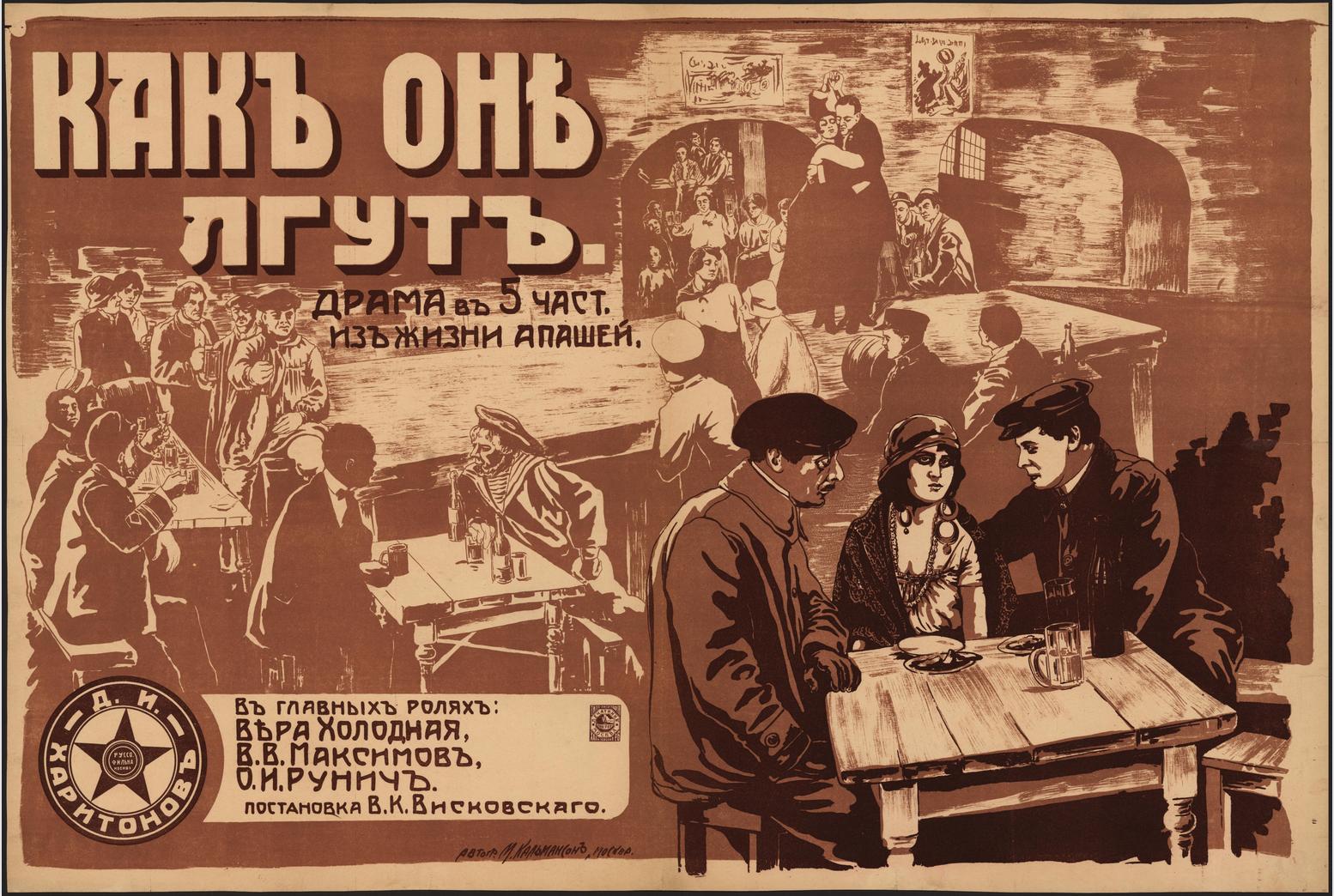
Stepping into the spectral glow of a silent film, particularly one as evocative as Vyacheslav Viskovsky's 'Kak oni lgut' (How They Lie), is akin to sifting through forgotten dreams. It’s a journey back to an era where storytelling was an art of grand gestures, nuanced expressions, and the profound silence that amplifies every flicker of emotion. This particular cinematic relic, with its potent blend of melodrama and social commentary, offers a piercing glimpse into the moral ambiguities of early 20th-century Russian society, a world teetering on the brink of seismic change. Viskovsky, a director known for his keen eye for human drama, crafts a narrative that, despite its lack of spoken dialogue, resonates with a startling clarity, its themes of deception, ambition, and the fragility of truth remaining disturbingly pertinent even today. The film, a product of the prolific Russian studio system before its revolutionary overhaul, stands as a testament to the sophisticated narrative capabilities of silent cinema, proving that a story's impact is not diminished by the absence of sound, but rather, heightened by the meticulous craft of visual articulation.
At the heart of 'Kak oni lgut' lies the luminous Vera Kholodnaya, the undisputed ‘Queen of the Russian Screen,’ whose presence alone could command an audience's rapt attention. Here, she embodies Anya, a character whose initial naiveté gradually gives way to a crushing awareness of the world's inherent cruelty. Kholodnaya, with her famously expressive eyes and graceful movements, masterfully conveys Anya's journey from hopeful innocence to heartbroken disillusionment, a transformation that forms the emotional anchor of the film. Her performance is a masterclass in silent acting, each gesture, each tilt of the head, imbued with a profound psychological depth. She doesn't just portray emotion; she *becomes* it, drawing the viewer into Anya's predicament with an almost gravitational pull. This ability to communicate complex internal states without uttering a single word is what cemented Kholodnaya's legendary status and elevates 'Kak oni lgut' beyond mere entertainment into a profound character study. Hers is a tragedy etched not in words, but in the very fabric of her being, a testament to the power of non-verbal storytelling.
The narrative itself, penned by Viskovsky, is a meticulously constructed edifice of deceit. Count Vorontsov, portrayed with chilling efficacy by Osip Runich, is the architect of this grand deception. Runich imbues Vorontsov with a veneer of aristocratic charm that barely conceals a predatory avarice. His portrayal is a nuanced study in villainy; he is not a caricature, but a man driven by desperation and a ruthless ambition to maintain his opulent lifestyle at any cost. The film meticulously details his manipulative scheme: using Anya, whom he feigns affection for, as a prop in a convoluted plot to secure a crucial loan and solidify his social standing through an advantageous marriage. This elaborate charade is further complicated by a forged will, designed to reroute a substantial inheritance. Runich's performance is a fascinating counterpoint to Kholodnaya's, their on-screen dynamic a tense interplay between vulnerability and calculated cruelty. The dramatic tension generated by this central conflict is palpable, keeping the audience on edge as Vorontsov's web of lies grows increasingly intricate and precarious. The film's title, 'How They Lie,' is not merely a descriptive phrase but a thematic core, explored through every twist and turn of Vorontsov's treacherous machinations.
Viskovsky’s direction is marked by a sophisticated understanding of visual rhetoric. The mise-en-scène is rich with symbolism, from the opulent, yet increasingly stifling, interiors of aristocratic homes to the stark contrast of Anya’s humble dwelling. Shadows often play a crucial role, enveloping characters in moral ambiguity or foreshadowing impending doom. The camera work, while adhering to the conventions of the era, is remarkably dynamic, employing close-ups to emphasize emotional states and wider shots to establish the social context and power dynamics. The pacing, though deliberate, builds tension effectively, allowing the audience to absorb the unfolding drama and the psychological torment of its characters. Unlike some of its contemporaries, which occasionally suffered from static compositions, Viskovsky’s 'Kak oni lgut' maintains a visual fluidity that keeps the viewer engaged, pulling them deeper into its intricate narrative. One might even draw a comparison to the narrative complexity and social critique found in films like Lyubov statskogo sovetnika, another Russian melodrama that dissects the moral decay within societal structures, though 'Kak oni lgut' perhaps delves deeper into the psychological toll of deception.
The supporting cast contributes significantly to the film's overall impact. Vladimir Maksimov, as Sergei, Anya's loyal childhood friend and a principled lawyer, provides a much-needed moral compass in a world awash with duplicity. Maksimov portrays Sergei with a quiet dignity and unwavering resolve, his growing suspicions about Vorontsov's true nature driving much of the investigative subplot. His performance is understated yet powerful, a beacon of integrity against the backdrop of corruption. Nikolai Branitskii, as Mikhail, the cynical journalist, adds another layer of complexity. Branitskii's Mikhail is an astute observer, his detached demeanor masking a keen intellect and a burning desire to expose societal hypocrisy. He acts as the audience's surrogate, piecing together the fragments of truth and documenting the unraveling drama. His character serves as a vital catalyst for the eventual revelation, pushing the narrative towards its inevitable, dramatic climax. The interplay between these characters, each driven by different motivations, creates a rich tapestry of human experience, making the film a compelling study of morality and consequence.
Viskovsky’s writing, translated into visual cues, explores profound themes. The central lie—Vorontsov's fabrication about Anya's identity and the forged will—is not merely a plot device; it is a metaphor for the pervasive dishonesty that permeates the upper echelons of society. The film critiques the superficiality of social standing, where appearances are paramount and moral rectitude is easily sacrificed for wealth and power. It also delves into the destructive nature of ambition unchecked by ethics, portraying how one man's greed can shatter multiple lives. The theme of innocence corrupted is particularly poignant through Anya's arc, highlighting the vulnerability of the pure-hearted in a cynical world. Furthermore, 'Kak oni lgut' touches upon the role of media (through Mikhail's character) in exposing truth, suggesting that even in an era before mass communication, the power of journalism to hold the powerful accountable was recognized. These thematic layers elevate the film beyond a simple melodrama, imbuing it with a social relevance that transcends its historical context.
The film's climax is a masterstroke of silent era dramatic construction. As Sergei and Mikhail close in on Vorontsov, the intricate web of lies begins to unravel with agonizing slowness, then collapses spectacularly. The confrontation, devoid of spoken dialogue, relies entirely on the actors' heightened expressions, the rapid-fire editing, and the stark visual contrasts to convey the shock, betrayal, and ultimate disgrace. Kholodnaya's portrayal of Anya’s realization, a silent scream of agony and disbelief, is particularly devastating. Runich’s Vorontsov, stripped of his facade, reveals a desperate, cornered man, his arrogance giving way to pathetic fear. The scene is a powerful demonstration of how silent cinema, when executed with such precision, can achieve an emotional intensity that often eludes its sound-era counterparts. The dramatic reveal is not just a plot resolution; it's a moral reckoning, leaving the audience to ponder the true cost of deceit. The silence amplifies the weight of the revelations, making each gesture and expression carry the full burden of the narrative's emotional thrust. One might recall the moral gravity and dramatic unmasking of truths in films like The Majesty of the Law, where legal and moral principles clash, though 'Kak oni lgut' focuses more on the personal devastation wrought by the legal and social consequences.
Viskovsky’s legacy, often overshadowed by the later Soviet avant-garde, is one of a meticulous craftsman and a sensitive storyteller. His ability to draw out such compelling performances from his cast, especially Kholodnaya, speaks volumes about his directorial prowess. He understood the nuances of the human condition and translated them into a visual language that was both accessible and profound. 'Kak oni lgut' is not merely a historical curiosity; it is a vibrant, emotionally charged piece of cinema that holds its own against the test of time. It serves as a vital reminder of the rich and diverse landscape of pre-revolutionary Russian filmmaking, a period that produced countless gems before political upheaval reshaped the artistic landscape. The film's enduring appeal lies in its universal themes and its masterful execution, demonstrating that genuine artistry transcends technological limitations.
Compared to other films of the era, 'Kak oni lgut' distinguishes itself through its psychological depth and its unflinching portrayal of moral decay. While a film like The Life of Our Saviour; or, The Passion Play might offer a grander, more overtly spiritual narrative, 'Kak oni lgut' grounds its drama in the very human frailties of ambition and mendacity. Its focus is not on divine intervention but on the consequences of human choices. Similarly, while films such as From Broadway to a Throne or Man of the Hour explored social mobility and the pursuit of success, 'Kak oni lgut' offers a darker, more critical perspective on the means employed to achieve such ends. Viskovsky’s film is less about aspirational journeys and more about the corrosive nature of the journey itself when paved with falsehoods. The intricate plotting and the slow revelation of secrets might also draw a faint parallel to the investigative thrillers of the era, such as The Hound of the Baskervilles, albeit with a focus on psychological rather than overt physical mystery. The film's strength lies in its ability to generate suspense not from external threats, but from the internal collapse of truth.
The aesthetic choices in 'Kak oni lgut' are also worth noting. The use of intertitles is particularly effective, not merely relaying dialogue but often offering sardonic commentary or poetic reflections on the unfolding events. These textual interventions serve to guide the audience's understanding and amplify the film's thematic concerns, often adding a layer of ironic detachment or moral judgment. The costumes are meticulously designed, reflecting the social status and psychological states of the characters – Anya’s simple dresses contrasting sharply with the elaborate finery of Vorontsov and his aristocratic circle, symbolizing the chasm between their moral standings. The production design, while perhaps not as extravagant as some Hollywood productions of the time, is nonetheless carefully crafted to create a believable and immersive world, enhancing the film's atmospheric qualities. Every element, from the flickering gaslights to the ornate furniture, contributes to the overall sense of a society ripe for exposure.
In a broader context, 'Kak oni lgut' can be seen as a precursor to later cinematic explorations of societal hypocrisy and the dark underbelly of wealth. Its critique of a class system built on artifice and exploitation resonates with the socialist realism that would later dominate Russian cinema, though Viskovsky's approach is far more nuanced and less overtly propagandistic. It’s a film that asks profound questions about identity, integrity, and the cost of maintaining a lie, questions that continue to echo through modern narratives. The enduring power of silent cinema, often underestimated, is powerfully demonstrated here. The absence of spoken word forces the viewer to engage more actively, to interpret facial expressions, body language, and visual metaphors, creating a deeply personal and immersive experience. This active engagement is what makes films like 'Kak oni lgut' not just historical artifacts, but living, breathing works of art that continue to provoke thought and stir emotion.
Ultimately, 'Kak oni lgut' is more than just a forgotten melodrama; it is a vital piece of cinematic history, showcasing the talents of its director, writer, and a stellar cast. Vera Kholodnaya’s tragic beauty and Osip Runich’s chilling portrayal of villainy remain etched in the mind long after the final frame. It’s a film that reminds us that lies, no matter how meticulously constructed, inevitably unravel, often with devastating consequences. Its exploration of human frailty, the corrupting influence of power, and the search for truth in a world shrouded in deceit is as compelling today as it was a century ago. For enthusiasts of early cinema and those fascinated by the rich tapestry of Russian cultural history, 'Kak oni lgut' offers an unforgettable journey into a world where silence speaks volumes and every gesture carries the weight of destiny. Its powerful narrative, combined with its historical significance, makes it a film that truly deserves rediscovery and critical reappraisal. The film's legacy is not just in its individual brilliance, but in its contribution to the evolving language of cinema, demonstrating the profound capacity of the visual medium to capture the complexities of the human spirit. Its enduring relevance is a testament to Viskovsky's foresight and the timeless nature of its core message: that the truth, however painful, always finds a way to surface, shattering the illusions of those who dare to lie.
IMDb —
1916
Community
Log in to comment.