DbcultAccessing Vault...
5/10
Senior Film Conservator
A definitive 5/10 rating for a film that redefined the boundaries of cult cinema. Kapten Grogg badar remains a cornerstone of transgressive art.
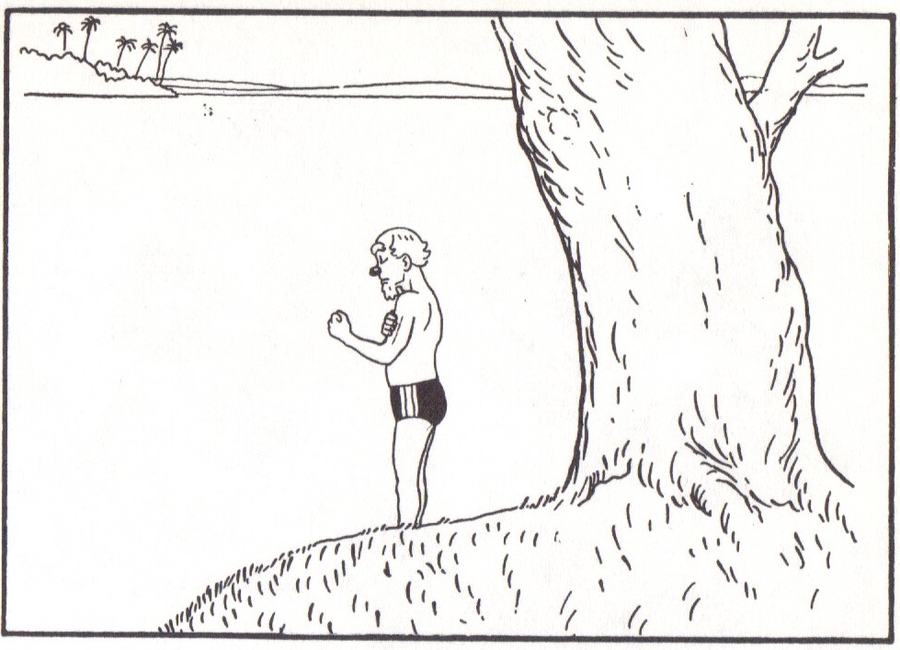
The crystalline surfaces of the frame ripple with liquid light as Victor Bergdahl's singular creation, Captain Grogg—a bearded colossus whose physique suggests a barrel-chested satyr—emerges from the foam alongside his twig-limbed compatriot Kalle. Their splashing abandon feels like a visual manifesto: Bergdahl rejecting the rigid physicality of live-action comedies prevalent in 1916 (An American Live Wire comes to mind) for animation's boundless plasticity. Grogg's buoyant belly bobs like a cork, rendering the sea itself a character in this aqueous vaudeville.
Bergdahl's genius manifests in the simian antagonists—not as realistic primates but as whirlwinds of anarchic motion. Their theft unfolds with balletic precision: one scout monkey cartwheels across the sand as a lookout while two conspirators bundle the garments into chaotic parcels using their prehensile feet. The trousers become sails caught in an invisible wind, shirts transform into flapping ghosts of respectability. It’s a silent-era heist sequence predating The Learnin' of Jim Benton by months, yet executed with surreal wit no live camera could achieve.
What follows transcends mere chase narrative. Grogg's emergence from the surf—water sluicing from his ursine torso—becomes a Renaissance painting of indignity. His bellows are almost audible through the pen strokes: a guttural roar that disturbs seabirds from cliffs. Kalle’s panic manifests as spindly-limbed contortions, evoking a trapped spider. Their nudity isn't erotic but existentially vulnerable, stripping away social armor in a manner that would later echo in the vulnerability of characters in The Lad and the Lion. The shoreline morphs from playground to hostile geography—razor-edged barnacles, hot sand, suspiciously anthropomorphic rocks—all amplified by Bergdahl’s exaggerated perspectives.
The monkeys’ retreat into jungle vines operates as a metaphorical digestion of civilization. Garments snag on branches like flotsam, sleeves catching the wind like surrender flags. Bergdahl inverts Darwinism—these primates aren't evolving toward humanity but gleefully dismantling its symbols. In a stroke of visual wit, Grogg's hat crowns a chimpanzee who mimics his captain's swagger, parodying authority itself. This symbolic undressing predates the psychological nudity of The Christian by decades, achieving through animation what live-action propriety forbade.
Bergdahl’s animation technique reveals its magic in textures: sea spray rendered as explosive starbursts of white ink, Grogg's beard absorbing shadows like moss. Unlike the polished industrial output of Bray Studios, each frame thrums with handmade imperfection—a charcoal smear suggesting speed, watercolor washes for the horizon. When Grogg scales a cliff face, Bergdahl employs multiplane sensibilities before the term existed: foreground boulders sliding left while distant clouds drift right, creating dizzying depth. This tactile quality connects it to the artistic ambition of Marga, Lebensbild aus Künstlerkreisen, though Bergdahl channels artistry into absurdity.
The pursuit culminates in a slapstick apotheosis. Grogg’s attempt to swing vine-to-vine like the monkeys becomes a physics-defying disaster—his momentum carries him in a full circle around a palm tree, wrapping him like a mummy in foliage. Kalle’s encounter with a coconut involves recursive humiliation: he throws it at a monkey, only for the fruit to rebound via multiple branches onto his own head. These gags rhyme with but transcend live-action contemporaries like Beans, leveraging animation’s capacity for hyperbole. Gravity becomes negotiable; cause-and-effect, delightfully perverse.
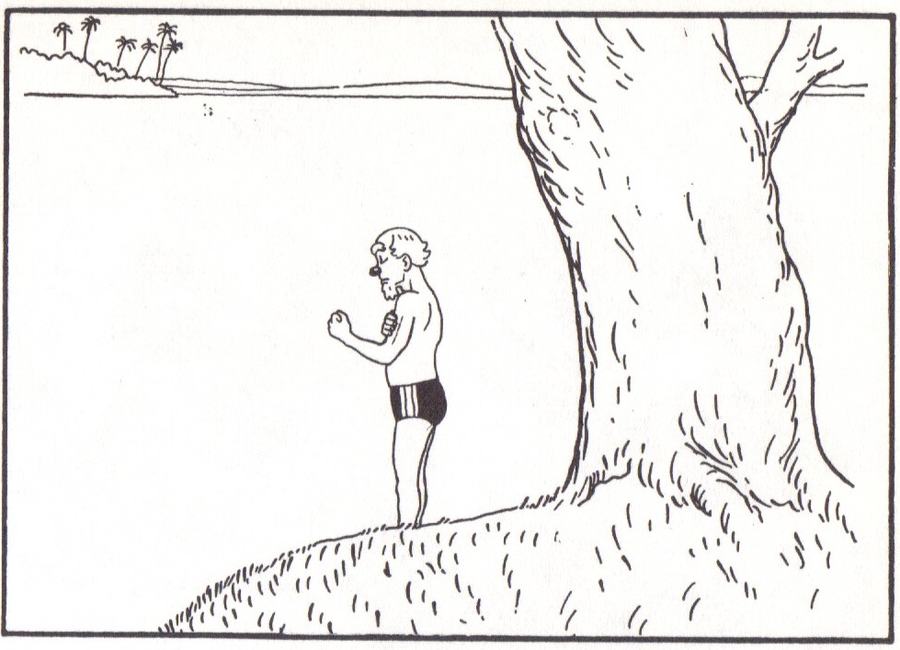
In the climax’s quietude, Bergdahl unveils his masterstroke of pathos. Cornered monkeys return not the clothes, but grotesque approximations—kelp trousers, a seashell hat. Grogg’s tragicomic modeling of these oceanic raiments transforms him into a Neptune figure stripped of dignity. The final shot—a wide-angle tableau of Grogg and Kalle trudging shoreward, absurdly attired, backlit by a setting sun—suggests a pilgrimage of fools. Their silhouettes against the Baltic twilight evoke the melancholy clowns of In the Balance, but with seaweed epaulettes.
Bergdahl’s work resonates as subversive artifact. Where The Spirit of the Poppy indulged in exotic melodrama, this animation weaponizes silliness against propriety. Its post-colonial whisper is unmistakable: the monkeys aren’t ‘savage’ but sophisticated thieves outwitting colonizer figures. The theft of clothing—that thin membrane of civility—prefigures surrealist interrogations of identity. That Bergdahl achieved this through meticulously inked cells, likely working alone in a Stockholm garret, makes the film’s survival (in fragments) miraculous.
Comparing Kapten Grogg badar to its 1916 cohort reveals its radicalism. While For the Freedom of the East sermonized nationalism, Bergdahl embraced borderless absurdity. Against Southern Pride's regional sentimentalism, he crafted a universal language of physical comedy. His monkeys operate outside moral binaries that constrained even the villains of The Bride of Fear. The film’s closest spiritual relative might be David Harum’s rural wit, but Bergdahl traded horses for primates and added existential nudity.
Technically, Bergdahl anticipates animation milestones. Grogg’s facial expressions—a single eyebrow arching like a drawn longbow—foreshadow Fleischer’s rubber-hose flexibility. The monkeys’ kineticism suggests early motion studies, their movements a proto-simulation of simian agility. Water effects—drawn frame-by-frame with crosshatched ripples—create weight and resistance absent in flat backgrounds of contemporaneous cartoons. Even the pacing feels revolutionary: deliberate silences between frenetic bursts, allowing the humor to breathe unlike the frantic accumulations of The Primitive Call.
The film’s legacy is palpable yet ghostly. No celluloid print survives intact—we reconstruct its brilliance from production stills and Bergdahl’s notes. Yet its DNA surfaces in the cartoon surrealism of Eastern European animators, the pathos of Chaplin’s Tramp (who shared Grogg’s battles with inanimate objects), even the environmental storytelling of Hayao Miyazaki. In five minutes, Bergdahl proved animation could be more than moving comic strips—it could be philosophical vaudeville.
Watching the reconstructed frames, one marvels at Bergdahl’s aquatic choreography. Grogg doesn’t merely swim—he negotiates the sea, arms ploughing waves like a steam engine, legs churning foam. When submerged, his beard floats upward like kelp forests, a visual joke about human-animal hybridization. The ocean isn’t backdrop but antagonist and accomplice—washing away dignity, then offering concealment. This nuanced environmental relationship feels centuries ahead of The Governor's Daughters' decorative seascapes.
Ultimately, Kapten Grogg badar endures not as relic but revelation. Bergdahl understood that true comedy resides in the gap between aspiration and reality—here embodied by a naked giant shaking his fist at primates mocking him from a tree. The stolen clothes symbolize everything we construct to feel civilized: status, modesty, identity. That monkeys—creatures so like us—reduce Grogg to howling absurdity feels like a cosmic punchline. In an era hurtling toward global war, Bergdahl reminded us that sometimes, the most profound statement is a well-animated buttocks scampering up a coconut palm.
IMDb —
1928
Community
Log in to comment.