DbcultAccessing Vault...
5.9/10
Senior Film Conservator
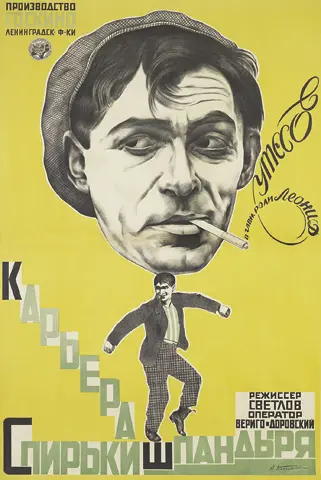
A definitive 5.9/10 rating for a film that redefined the boundaries of cult cinema. Karera Spirki Shpandyrya remains a cornerstone of transgressive art.
Should you track down this 1926 Soviet curiosity? Short answer: yes, but only if you have a stomach for the flickering, silent chaos of a world being rebuilt from scratch. This is a film for those who find the dark humor of the New Economic Policy (NEP) more interesting than the stiff propaganda of the 1930s; it is definitely not for viewers who require high-definition polish or a clear-cut hero to root for.
This film works because Leonid Utyosov brings a frantic, proto-jazz energy to the screen that feels decades ahead of its time.
This film fails because the narrative structure is essentially a series of loosely connected sketches rather than a cohesive dramatic arc.
You should watch it if you want to understand the 'wild west' era of Soviet cinema before the iron curtain of Socialist Realism fully descended.
To understand Karera Spirki Shpandyrya, one must understand the NEP era. It was a time of strange contradictions—a socialist state allowing a temporary return to private enterprise. This film captures that specific, greasy atmosphere. Spirka is not a worker; he is a parasite, yet the film treats him with a weirdly affectionate cynicism. Unlike the ethereal dramas of the same period, like The Woman from Nowhere, this is a movie with dirt under its fingernails.
The plot moves with a jagged, nervous energy. We see Spirka moving through crowded marketplaces where everything is for sale, including loyalty. There is a specific scene where Spirka attempts to mimic the mannerisms of the 'new elite.' He fumbles with a cigarette case, his eyes darting around the room to see if anyone has noticed his fraud. It is a masterclass in physical anxiety. It reminds the viewer that in 1926, everyone in Russia was, in some way, pretending to be someone they weren't.
Leonid Utyosov is the primary reason this film remains watchable nearly a century later. Most people know him as the king of Soviet jazz, but here he is a pure creature of the screen. He doesn't just act; he vibrates. His Spirka is a man who knows he is one mistake away from a labor camp, yet he cannot stop himself from grinning. It’s a performance that feels much more modern than the heavy-handed theatricality found in Mürebbiye.
The supporting cast, including Yekaterina Korchagina-Aleksandrovskaya, provides a solid, if somewhat traditional, backdrop. Korchagina-Aleksandrovskaya plays her role with a grounded gravity that makes Spirka’s antics look even more ridiculous. When they share the frame, you see the clash between the 'Old Russia' and the 'New Soviet' chaos. It is a fascinating dynamic that many Western critics of the time completely missed. They saw it as slapstick; we see it as a survival horror disguised as a comedy.
The cinematography by the Leningrad school is stark. There is no attempt to beautify the city. The streets are muddy, the interiors are cramped, and the lighting is often harsh and unforgiving. This isn't the dreamlike quality of The Shadow of a Doubt. Instead, the camera acts as a witness to the decay. The use of close-ups on Spirka’s hands—counting money, adjusting his collar, stealing a loaf of bread—creates an intimate, almost claustrophobic experience.
One particular shot stands out: Spirka standing against a massive, crumbling stone wall of a former aristocratic mansion. He looks tiny, insignificant, and yet he is the one who is thriving while the stones rot. This visual metaphor for the 'new man' rising from the ruins of the empire is subtle but effective. It suggests that the revolution didn't just change the government; it changed what kind of predator could survive in the urban jungle.
Is Karera Spirki Shpandyrya worth your time in the 21st century?
Yes. It is a vital piece of cinematic history that avoids the heavy-handedness of later Soviet works. While it lacks the high-concept thrills of modern films like Thelma, it offers a raw, unfiltered look at a society in the middle of a nervous breakdown. It is a film about the 'career' of a man who has no business having a career, which makes it eternally relatable to anyone who has ever felt like an impostor in their own life.
Pros:
Cons:
If there is one major critique to be leveled at Karera Spirki Shpandyrya, it is the editing. Soviet cinema of this era is famous for montage, but here the montage feels a bit haphazard. There are moments where the film lingers too long on a transition, losing the comedic timing it worked so hard to build. For instance, a sequence involving a dinner party starts with great tension but ends up feeling like a series of outtakes from Come Out of the Kitchen.
However, when the film hits its stride, it is unstoppable. The final act, where Spirka’s 'career' reaches its inevitable, messy conclusion, is handled with a surprising amount of pathos. You don't necessarily feel sorry for him, but you understand why he did what he did. It’s a nuanced take on criminality that you rarely see in early cinema, which usually preferred black-and-white morality like that in Fires of Rebellion.
Karera Spirki Shpandyrya is a messy, energetic, and deeply cynical film that deserves a spot in the conversation about early Soviet art. It isn't a 'masterpiece' in the traditional, polished sense. It is something better: it is honest. It shows a world that is broken, populated by people who are just trying to find a way to eat. It works. But it’s flawed. And that flaw is exactly what makes it human. If you can handle the grain and the silence, Spirka’s journey is one of the most interesting careers you’ll ever witness on screen. It is a far more compelling character study than the often-praised The Little Fool, simply because it refuses to play by the rules.
"A frantic, muddy, and brilliantly acted snapshot of a society that had forgotten how to be normal. Utyosov is a revelation."
IMDb —
1921
Community
Log in to comment.