DbcultAccessing Vault...
Cult Review
Senior Film Conservator
A cabin fevered opera of snow, sweat, and suppressed growls
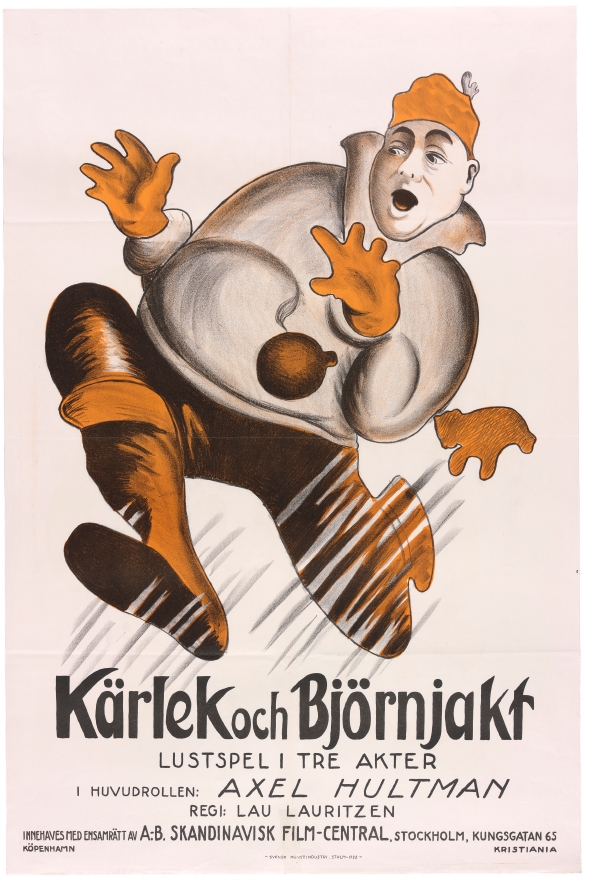
There are films you watch and there are films that watch you—Kärlek och björnjakt belongs to the latter cabal. Lau Lauritzen’s 1920 curio, long buried beneath the avalanche of Scandinavian silent cinema, surfaces now like a taxidermied beast thawing in midwinter: moth-eaten yet magnificent, reeking of mothballs and musk, eyes still glassily alive. Viewed today, the 78-minute fever dream feels less like narrative and more like a rune-carved spell—one that traps you inside a pine-log cabin where the wallpaper sweats resin and every creak of the floorboards is a Morse code for dread.
Colonel Körner—played by Axel Hultman with the brittle authority of a man who has militarised his own pulse—has dragged his only child Greta (Sigrid Holmquist, equal parts snowmelt and smolder) to a high-altitude exile. Ostensibly the retreat is for her health; subcutaneously it is a scorched-earth campaign against every suitor who might peel away the paternal armour. Their days are measured not in hours but in the slow drip of ice from the eaves, until Glob (Ernst Eklund) explodes into their sanctum like a brass band in a monastery. He arrives with a bear-hide cloak of dubious provenance and a grin that claims ownership of the horizon. His hunting yarns—told in frantic intertitles that throb like migraine auras—ignite something feral in Greta’s gaze, a slow-motion spark that travels from her pupils to her fingertips until she fingers the table edge as though testing the fur of an invisible beast.
Lauritzen inverts the typical safari arc: the bear is not antagonist but libidinal litmus. Each time Glob brags, the animal seems nearer; each time the Colonel harrumphs, the snow outside sighs deeper. Spatial logic warps—doorways yawn wider, rifles appear comically small—and by the time the trio trek into the blinding white, the landscape has already swallowed daylight. What we get is not a chase but a tryst in which every gunshot is a substitute for the kiss that etiquette forbids.
Hultman’s Körner is a study in calcified masculinity: spine erect even while seated, moustache waxed to lethal points, voice (via eloquent title cards) clipped as if each word were court-martialled. Watch him peel off his gloves—one finger at a time—while interrogating Glob; the gesture is a striptease of menace. Opposite him, Eklund’s Glob pirouettes between bonhomie and bestiality; his eyes glint like sun on a helmet, then cloud with something murkier when he realises the daughter is not mere trophy but fellow predator.
Holmquist, meanwhile, weaponises stillness. In a medium that rewarded theatrical semaphore, she gives us micro-movements: the almost imperceptible flare of a nostril when tales of blood on snow reach orgasmic pitch, the way her thumb rubs the rim of a porcelain cup as though testing the edge of a secret. Greta’s awakening is not a blossoming but a bruise blooming—one you spot only when the lantern light hits.
Cinematographer Nils Whiten lenses the fjords like a man who suspects God is watching through the viewfinder. The cabin interiors are chiaroscuro cauldrons: firelight tongues lick the rafters, shadows knot into hangman nooses. Outside, the snow is not white but the bluish pallor of a corpse left overnight. Compare this to The Wood Nymph, where nature is erotic playground; here it is tribunal and executioner.
Lauritzen repeatedly frames Greta against taxidermy: a stuffed lynx frozen mid-snarl, its glass eyes matching hers. The motif crescendos in the penultimate reel when she stands beside the slain bear—its fur rippling like a moonlit sea—her silhouette merging with the carcass until you cannot parse woman from animal, prey from predator.
Archival prints arrive sans official score, a void that festival curators stuff with everything from Hardanger fiddles to doom-metal drones. I experienced it with a trio who improvised on detuned nyckelharpa and brushed snare; each scrape became wind scything the pines, each sudden rest left the audience alone with the thud of our communal pulse. In that hush I swear I smelled cordite and wet dog, though neither was present. The film’s true soundtrack is olfactory hallucination.
Scholars slot the movie beside The Isle of the Dead for its dance with mortality, but its sharper lineage is with Das Phantom der Oper—both probe the moment desire recognises its reflection and shatters the mirror. Greta’s arc is the inverse of Christine’s: instead of being lured by disfigured genius, she awakens to the beast caged by decorum. The bear is merely the externalised id of every man who ever claimed to protect her while measuring her wrist for shackles.
Consider the scene where Greta kneels to lace her boots while Glob recounts ripping out a bear’s throat with a single knife thrust. The camera tilts down to her fingers; they tremble, yet the tremor is indistinguishable from ecstasy. Lauritzen cuts to a close-up of boot eyelets tightening—an image of bondage that whispers: every hunt ends in a wedding of skins.
Released only two years after post-war treaties redrew borders, the film smuggles imperial anxiety into its marrow. Körner’s medals are not souvenirs but scars; his stories of campaigns in unnamed colonies echo with the same hollow brass as Glob’s bear tales. The bear itself—an indigenous sovereign of the forest—becomes the occupied territory over which men wave flags of phallus and rifle. When Greta ultimately strokes the animal’s pelt, she is signing a treaty whose terms are written only in her bloodstream.
Seek the 4K restoration by the Swedish Film Institute—its tinting alternates between arsenic green and arterial red, recreating the nitrate’s original intent. Avoid the 1990s VHS bootleg floating on auction sites; its piano score is tinny and the cropping amputates Greta’s crucial boot-lacing close-up. If you must stream, hunt the version with optional subtitles by poet Paavo Haavikko whose intertitles read like runic haiku: "Snow remembers the scream longer than the wound."
Great cinema does not answer questions; it infects you with exquisite viruses. Kärlek och björnjakt leaves you fevered, hearing nonexistent footfalls in the hallway at 3 a.m., wondering whether the thing outside your door is bear, lover, or father. Long after the closing title card—whose final intertitle simply reads "Who is hunted?"—you realise the film has done to you what Glob did to Greta: told you a story so scalding you cannot peel it from your skin. And like any good hunt, the true trophy is not the pelt on the wall but the scar that every heartbeat keeps alive.
—originally published on Nordic Nocturne, the author’s cinema shrine.
IMDb —
1918
Community
Log in to comment.