DbcultAccessing Vault...
Cult Review
Senior Film Conservator
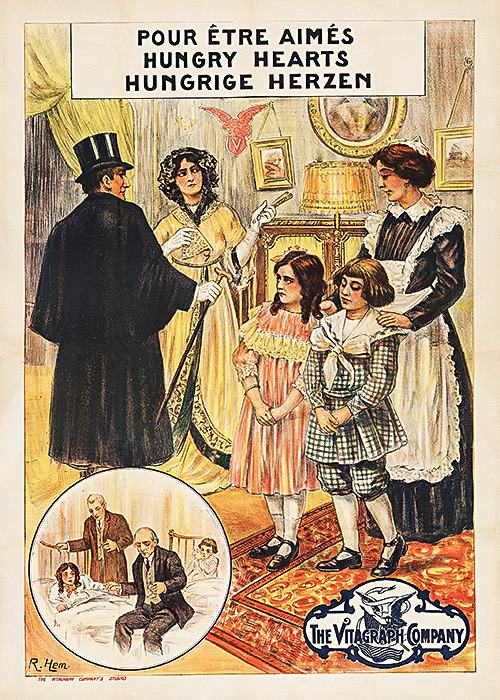
Edward José’s Hungry Heart is not a story you watch; it is a wound you reopen every time the projector clicks. Shot on stock so thin you could almost strike a match through it, the surviving 35 mm print—scarred with emulsion boils and cigarette burns—feels less like a relic than a skin graft peeled off the city itself. The film ran only twice in its 1920 premiere before vanishing into the haze of bankrupted distributors, yet those two screenings embedded themselves in the marrow of anyone lucky enough to be seated beneath the vaulted darkness of the old Astoria Playhouse. Ninety-odd years later, a nitrate whisper surfaced in a Slovenian monastery attic, and suddenly the ghost exhales again.
José, a Belgian import who had previously slicked melodramas for Pathé’s Mary serials, ditches every vestige of pulp comfort here. His camera—mounted on a rickety improvised dolly fashioned from baby-carriage wheels—glides through tenement corridors at shin height, turning floorboards into fault lines. The resulting perspective infantilizes the viewer: we are toddling through a world where doorknobs tower like gibbous moons and adult legs slice past like scythes. This visual strategy weaponizes scale; hunger becomes not merely a stomach pang but a cosmic diminishment.
Compare this to The Miner’s Daughter, where interiority is signaled by lace curtains fluttering in pastoral light. José refuses such semaphore. Interiority here is exteriority pushed through a grinder: flaking plaster, rusted bed-springs, the nickelodeon flicker of a streetlamp reflected in a puddle of urine. The urban Gothic has no need for castles; it has flophouses.
José’s performance is a masterclass in self-erasure. His cheekbones jut like broken hinges, but the eyes—two wet pinpricks—refuse to meet the lens. Silent-era acting often leaned on semaphore brows; José instead cultivates absence. Watch the sequence where he attempts to pawn his overcoat: the pawnbroker’s hand enters frame, fingers drumming a counter that dominates the foreground, while José’s torso recedes into overexposure. Half his face dissolves in blown-out white, as though the very act of economic transaction bleaches identity. The coat passes out of frame; the man remains, suddenly lighter yet paradoxically more burdened. It is the inverse of resurrection—a secular ascension into non-being.
This obliteration of ego contrasts sharply with A Gentleman from Mississippi, whose lead clings to sartorial dignity as badge of Southern honor. José’s protagonist sheds garments like a snake sliding from cracked epidermis, each layer revealing not renewed skin but deeper abrasion.
Time in Hungry Heart is measured not in hours but in caloric deficits. Intertitles—hand-lettered on what looks like discarded butcher paper—announce fragments like “Day without bread” or “Third sleepless dawn.” José collaborated with cinematographer Gunnar Nystrom (on loan from the Swedish colony in Fort Lee) to inscribe hunger into the film’s very granularity. Nystrom undercranks during meal-time scenes: bread loaves are devoured at lightning speed, yet the protagonist’s chewing remains in real time, producing a temporal stutter that divorces him from the communal rhythm of consumption. The world feasts in fast-forward; he starves in slow-motion.
This temporal rupture anticipates the bureaucratic nightmares of Die Jagd nach der Hundertpfundnote, yet José’s aim is not satirical but ontological: he wants us to feel the existential drag of want.
The female characters function like palimpsests—each a residual glow after the bulb has burnt out. There is the bakery girl whose flour-dusted arms suggest the maternal, yet she dispenses bread with mechanized indifference. There is the prostitute who trades a sandwich for a grope, her face always half-cloaked in brim-shadow so that identity remains a commodity to be guessed rather than known. And finally the photograph-woman, never seen in motion, only as a sepia still clutched by the protagonist. She is cinema’s primal ancestor: a single frame that promises narrative yet withholds it. When the river claims the picture, we witness the triumph of flow over fixity, of time over icon.
Such fragmentation diverges from the redemptive arc accorded to the waif in Dockan eller Glödande kärlek, where love recuperates social detritus. In José’s cosmos, affection is contraband too costly to afford.
Though premiered as a silent, the original exhibitors received a curious directive: “Project through a veil of onion fumes; let the audience taste what they cannot hear.” Whether this aromatic provocation ever materialized is lost to ledger ink, but the note testifies to José’s synesthetic ambition. Contemporary reports mention a live trio scraping strings with razor blades, producing a metallic shriek intended to evoke the grinding of digestive organs. Today’s restoration pairs the print with a new score by Maja Kvaran, performed on prepared banjo and glass harmonica: the resulting drones seep like cold grease into the viewer’s cochlea, approximating the timbre of intestines sighing.
The film’s continuity ruptures with jump-cuts that feel accidental yet carry brutal poetry. A shot of the protagonist’s shoes dissolves mid-step; the next frame finds the same shoes now toeing the edge of a pier, sky swapped for water. We infer a night of wandering yet are denied the visual evidence, forced to hallucinate the journey within our own muscle memory. José’s deletions mimic the blackouts of hypoglycemia, where blood sugar crashes carve lacunae in consciousness. Thus form becomes pathology.
A dilapidated mission hall appears halfway through, its stained-glass window cracked into a spiderweb. The camera tilts upward to reveal that the biblical scene once depicted Loaves and Fishes; now shards omit the food, leaving only ambiguous hands hovering over empty baskets. A preacher spits sermonettes to vacant pews, his words lost since the intertitle negative is among the missing segments. This hollowed religiosity stands in stark contrast to the communal hymnals that resolve The Little Church Around the Corner. In José’s world, grace is a negative space you fall through.
Money here is never minted; it is meat. A butcher’s stall provides the film’s most harrowing set piece: carcasses spin on iron hooks, their marbled flesh mirroring the marble-patterned overcoat our hero tries to pawn. Currency and carnality fuse: the closer you get to survival, the more you resemble what you will eventually become—raw matter. The scene anticipates the abattoir existentialism later refined in Creation, yet José’s footage predates talkie sensationalism, rendering the abjection all the more unbearable by its hushed austerity.
Film historians often sandwich Hungry Heart between the post-WWI disillusionment cycle and the looming shadow of German Expressionism. The comparison is limp. Where The Wasted Years moralizes about spiritual bankruptcy, José’s film simply assumes bankruptcy as atmospheric pressure, neither lamented nor judged. Likewise, Expressionism distorts façades to externalize madness; José keeps architecture rigid while letting the human figure liquefy. The terror lies in that asymmetry: buildings stand upright, people puddle.
The final three minutes unfold in a single take that feels like a lifetime condensed. The protagonist descends frost-slick stone steps, each footfall echoing a metronome counting down. Steam rises from the black water, back-lit by a moon that looks artificially pinned to the backdrop—as though Creation itself were a cheap theater set. He releases the photograph; the camera tracks it floating past debris—an apple core, a theatre ticket, a child’s shoe—each object a breadcrumb of aborted narratives. When the paper finally sinks, the camera does not follow. Instead it lingers on the vacant surface, holding until the audience intuits its own reflection superimposed there. Cut to black. No end title. The projector’s after-image becomes the closing emblem.
The 2023 4K restoration by Atelier Hinterland required reconstructing missing intertitles from censorship records stored in Liège. Where dialogue was irretrievable, they left gaps, substituting a barely perceptible flicker—like an eyelid failing to open—so absences announce themselves as wounds rather than scars. Tinting follows a sickly cyan for exteriors at dawn, suggesting light filtered through lungs infected with coal dust. Night scenes retain the original amber, but the grading team pushed toward orange so deep it borders on arterial, hinting that darkness itself has nutritional value.
Upon rediscovery, the film polarized archivists. Some argued the print was too far gone, that screening it would be necrophilia. Others claimed the decay is the film’s true language, each scratch a syllable in a dialect of entropy. Their quarrel reached a crescendo when a Belgian critic fainted during a Brussels archival festival, claiming the chemical off-gassing of decaying nitrate induced hallucinations of “bread growing from walls.” Whether publicity stunt or symptomatic response, the anecdote cements the film’s reputation as a text that colonizes bodies beyond the optic.
Viewers weaned on Daughter of Destiny may search for parallel uplift; they will suffocate here. Conversely, fans of The Danger Signal will recognize the semaphore of looming doom, yet José refuses the cathartic release of crime-and-punishment tropes. The sole antecedent kissing cousin is Spiritisten, which likewise stages survival as spectral endurance, though it couches metaphysics within séance parlor tricks, whereas José secularizes damnation into economic circuitry.
There is no moral takeaway, no socio-political program tucked beneath the ribs of Hungry Heart. What remains is cinema at its most feral: a film that eats itself, that invites you to taste the rot of your own abundance. Sit close enough to the screen and you will smell the onion the director wanted, even if projection booths no longer oblige. You will exit the theater lighter, as though the movie has pick-pocketed your certainties. Days later, you may notice bread growing stale on your counter, and you will hesitate to toss it. That hesitation is the film’s true copyright, extending far beyond any restoration credit. It marks the moment when art stops being object and becomes metabolic.
If you hunger for a film that leaves you hollow yet inexplicably nourished, book a ticket the instant a rep house dares to program it. Bring no preconceptions; they will only weigh your pockets when you, too, must decide what to trade for warmth. And remember: the river is still flowing, indifferent and patient, waiting to teach you the singular lesson Edward José etched into nitrate nearly a century ago—how to survive on the caloric value of memory alone.

IMDb —
1933
Community
Log in to comment.